Instrument

violin
Joseph Hijman
Amsterdam,
± 1815
played by
Floor Kes
Floor Kes

*vóór 1800 , Amsterdam †na 1825 , Amsterdam
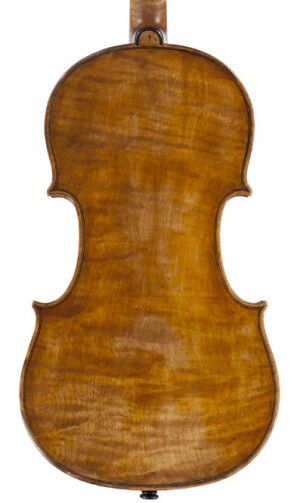
Research shows that only four violins by him are known to exist so far. The violin in the National Musical Instrument Fund’s collection was recently discovered within the collection, after having been registered since 2009 as “attributed to J.B. Lefèbvre.” The violin bears a very strong resemblance to a signed example in the collection of the Kunstmuseum in The Hague. That violin has an original label that reads: “Joseph Hijman fecit Amsterdam 1815.” It is noteworthy that while the label is printed, the name “Hijman” is handwritten.
Violin by Joseph Hijman (± 1760) from the collection of the Musical Instrument Fund—back made from a single piece
His work is very much in line with what was being produced in the Netherlands during that period, including by the late Johannes Theodorus Cuypers and Jean Baptiste Lefèbvre. In particular, the light amber-colored varnish on a light-colored base is very typical of this period. His f-holes are a free interpretation of those by the famous Cremonese luthier Guarneri “del Gesù,” a feature often seen in the work of the Cuypers family as well. This freedom in the f-holes is a recurring theme in Hijman’s work. While the model and scroll are the same—with identical characteristics and finish—the f-holes can vary greatly and sometimes take on a completely different shape.
Nevertheless, Hijman has his own style; in particular, the outlines of his soundboxes and scrolls are identical to one another. The carving on his scrolls reveals the following similarities, among others: the eye is quite large and ends with a sharp cut from his gouge; there is also a small, characteristic triangle at the back, at the bottom of the scroll, again a remnant of his gouging technique. Another striking detail is the—often beautiful—one-piece back plates.
D.J. Balfoort, 1931 *Dutch Violin Makers*, H.J. Paris, Amsterdam.
Bolink, J., Giskes, J., Lindeman, F., and Stam, S., 1999, 400 Years of Violin Making in the Netherlands, Amsterdam.
Amsterdam City Archives, accessed in 2025