Our History
Wrapped in newspaper or carried in a plastic bag, they were brought to Theo and Noortje Olof’s doorstep by their owners. That is how the first instruments found their way to what would later become The Netherlands Musical Instrument Foundation. The records were kept in the attic of the Moerenhout family’s home. More than 35 years later, The Musical Instrument Foundation has a collection of instruments with an insured value of over €50 million and plays a prominent role in Dutch musical life. How were the foundations of its current success laid? Based on interviews with those involved from the very beginning, a picture of the early years emerges: a noble yet urgent cause, an ideal mix of expert board members and broad public support. A winning combination.
Author: Marije Bosnak
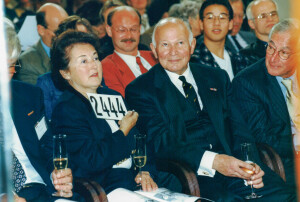
Noortje and Theo Olof at a Diner Orchestral (1995)
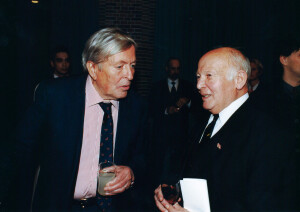
Patron Prince Claus and Theo Olof
Audience
It all began in the early 1980s with Pieter Moerenhout (1930–2018). The difficult search for a good violin for his daughter Saskia gave him an idea. In a conversation in 2019, his wife Gré (1928–2022) said: “Typical Pieter – he’d been mulling over a plan for a while – I didn’t know a thing about it. And then suddenly: we need to raise money; we need to set up a foundation so that poor students or their parents can buy a good instrument. Pieter didn’t know how, but it was clear it was going to happen. When we couldn’t sleep, that’s what he’d talk about.”
In 2008, Pieter Moerenhout chronicled his experiences from those early years in *De dwaasheid gekroond*. He describes how the implementation of his plan took him, as a teacher, into a world that was unfamiliar to him. He had to build a new network to form a board of directors, a nominating committee, and an advisory board. In 1987, the first board was established, with violinist Theo Olof as chair; Jhr. Cyril van Lennep as vice chair; Christian Timm, deputy director of the Royal Conservatory; Louk van Haastrecht, founder of SIRE; Joop Hoogland, former director of Shell; and certified public accountant Jan Helderman.
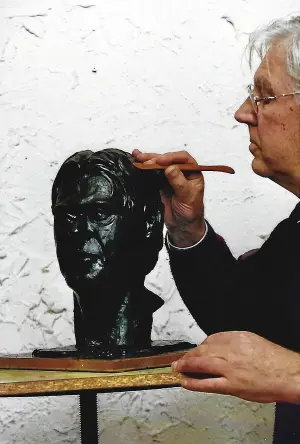
Pieter Moerenhout sculpting at home (2018)
Jan Helderman explains that the Prince Bernhard Fund (now Het Cultuurfonds) seemed willing to provide start-up capital, on the condition that a professional board be established with a competent treasurer. “I would be that person. Along with a delegation that included Theo Olof and Pieter Moerenhout, we went for an audience—that’s how it felt.” It turned out to be a fruitful visit. The new foundation to be established received a loan from the Prince Bernhard Fund and the Algemene Loterij Nederland for an initial four-year plan. If 100,000 were added each year from its own fundraising efforts, the loan would eventually be converted into a grant. In 1988, the first instruments were purchased and loaned to promising young musicians for a fee of 1 percent of the insured value. Board member Christian Timm writes about 1988: “The foundation’s board could look back on a turbulent yet successful year and fully realized that the real work was only just beginning.”

The “Pasman Violin,” built by Willem Bouman in The Hague in 1988. One of the first instruments in the collection.
Under the kitchen table
Former treasurer Jan Helderman opened an account for the 700,000 guilders from the Prince Bernhard Fund, and a workspace was set up at Gré and Pieter Moerenhout’s home in Bunnik. Gré: “The attic was transformed into an office, complete with, for example, a computer—which we knew nothing about. I had an office background, so I wrote the memos. The most important task was to build brand awareness. I remember the mailing to 1,100 notaries: two student workers, handwritten labels, stacks of envelopes in the bookcase, on the grand piano, and on the windowsills. We also welcomed everyone into our home: little Janine Jansen with her parents, the Den Herder family, Ingrid van Dingstee… We had quite a few meals at our kitchen table, and I poured countless cups of coffee and glasses of wine. It was all about improvising, making do.”
In 1989, the foundation held its first concert in the Schönberg Hall of the Royal Conservatory in The Hague. Board members actively and successfully sought media attention. Jan Helderman: “Our goal was clear and appealing: to provide young musicians with a good instrument—essential for the development of their talent—in a market where fine stringed instruments were becoming increasingly unaffordable.” Jan Verheugt, a board member in later years, describes the invaluable contribution of chairman Theo Olof: “He didn’t necessarily have connections with wealthy people—musicians don’t have money—but he appealed to the sentiments of the general public: everyone did it for Theo!” The foundation began to make a name for itself; the first donations came in, and instruments were donated and made available through bequests. After two years, the foundation had 56 items (instruments and bows) at its disposal, many of which were very valuable.
“There was no strategy behind the collection,” Noortje Olof emphasizes, “people would go up to the attic, look for their old violin, and then bring it to us.” At first, we stored the instruments under the kitchen table. That first batch also included a violin that the royal family brought in—an instrument that had belonged to former Queen Wilhelmina. But I don’t remember if it was of any value.” At the Moerenhout family home, a large safe was placed two flights of stairs up to store the first valuable instruments. Violin maker Wim Bouman has been involved for many years since then as one of the specialists responsible for appraising the instruments.
Into the country
In his article, Pieter Moerenhout also describes how the initial media attention led to a flood of well-intentioned offers of instruments, most of which turned out to be unusable. “I traveled quite a few pointless kilometers in those early days.” Recalling a visit to an elderly gentleman who assured him that the trip would not be in vain, he writes: “The man stood up, rummaged around in a corner behind a massive cushion cabinet, and walked over to my chair carrying the violin case—leaving a trail of woodworm gnaw marks on the deep-pile carpet. The top plate turned out to be riddled with tunnels and holes; the back plate and neck had been partially eaten away. A situation like that called for my sense of tact.”
But the first beautiful instruments also came within reach. Pieter Moerenhout writes about an 82-year-old woman and the passing on of her violin, a Camillo Camilli, which she had owned since she was 17. “The violin case lies open next to her on the couch. As the time to say goodbye approaches, she caresses the Camilli and says, ‘Goodbye, sweetheart, take care.’” An anecdote that Pieter Moerenhout would often cite to describe the relationship between a musician and his or her instrument.
The fall of 1992 marked the absolute highlight of those early years for the collection, with the loan of top-quality instruments from Hedwig and Max Rodriguez. Pieter Moerenhout: “I don’t know how to describe the feelings that overwhelmed me when the instruments were brought in and unpacked. I held in my hands the Golden Age of Italian violin making.” Three violins, a cello, and 16 bows—all together representing a current value of nearly five million euros.
Public engagement and the generosity of donors were key to the support for The Netherlands Musical Instrument Foundation.

Quirine Viersen with her Guarnerius.
At the gas station
But as the foundation grew and became more successful, the workload increased, and Pieter and Gré Moerenhout, in particular, sensed the danger that the foundation might collapse under the weight of its own success. It was time to transform the volunteer organization into a professional institution. With the help of an additional grant from the Prince Bernhard Fund, Jan Deiters was appointed as the first director in 1995. He recalls the remarkable situation during those first few months: “There was no real office, just operations taking place in the Moerenhout family’s attic. It certainly had a certain charm! And at 12:30, Gré would call from the bottom of the stairs, ‘Time for lunch!’”
Jan Deiters was given full support by the board and worked energetically to further professionalize fundraising and recruit staff. He found a new home in a building on Sint Annenstraat in Amsterdam that had been renovated by Stadsherstel. Together with office assistant Rose-Marie Bleekemolen and Christian Timm—who served as the instrument management commissioner until his death in 2024—Jan Deiters formed the core of the new office of The Netherlands Musical Instrument Foundation. One of the highlights for him was acquiring the cello for Quirine Viersen. “Quirine had been playing her teacher Heinrich Schiff’s Guarneri for years. But when Schiff retired, he needed the capital from the instrument. Quirine was terrified she would lose the instrument. It involved a huge sum of money. We fought hard—writing to foundations and appealing to private individuals with a major article in De Telegraaf. During the Christmas break, I drove with my children toward Switzerland. We stopped at a gas station so I could call a board member about an expected contribution. That’s when it all came together! Just within the deadline Schiff had set for us. So exciting!”
Jan Deiters looks back with great pleasure: “It was truly pioneering work back then. Amazingly enough, it was a constant stream of fantastic events. We became increasingly visible; we hosted fundraising dinners, developed a new construction program with the VSBfonds, secured major donations, and saw growing interest in entrusting valuable instruments to our care. We truly became a significant force in the music world.”
In an adventure novel
The recollections of the former board members convey a sense of enthusiasm and the awareness that everyone in the group found themselves in a new world in their own way; everyone brought their own expertise and network to the table. Jan Helderman: “That was the best part: having all those disciplines at the table. Whenever the conversation turned to instruments, I listened with great interest. Theo Olof was an inspiring chairperson; he knew the music world and the young students we were focused on. But as soon as finances came up, I was the one speaking!” As a board member, Jan Verheugt brought his love and knowledge of instruments to the table. Laughing, he said: “It was a distinguished group; I didn’t bring any money or connections to the table and sometimes felt like an outsider. But as soon as the topic of instruments came up, I was all in! And as a lawyer, I was able to make a meaningful contribution, too.” Jan Deiters was also a lawyer and had worked at a bank, but he actually wanted a job in the nonprofit sector. “And then, out of the blue, I ended up at this club—it was truly special.” Gré Moerenhout describes how exciting it was for her and her husband to move from the world of education into new social circles: “All the way up to the royal family! Suddenly we were attending fundraising dinners; Pieter bought a tuxedo back then—it felt like we’d stepped into an adventure novel.”
According to Jan Helderman, it was essential for the foundation that everything be handled as professionally as possible from the very beginning. “It was certainly a pioneering effort in the attic, but at the same time, it was carried out transparently and by experts.” With a large advisory board, we took the selection of instruments seriously from the very beginning—we didn’t automatically add everything to the collection. We also established clear procedures right away for determining who was eligible for an instrument. Every application had to be well-reasoned, and agreements were properly documented.” Jan Deiters confirms: “We established clear and strict rules regarding contracts with musicians and lenders, but beyond that, we figured out how to build the foundation as we went along.”
The foundation was laid for today’s The Netherlands Musical Instrument Foundation as an indispensable institution for classical music in the Netherlands—through improvisation and discovery, grounded in expertise and dedication.
Special thanks to
Noortje Olof – wife of co-founder and chairman Theo Olof
Jan Helderman – treasurer from 1987 to 2006
Jan Verheugt – board member from 1994 to 2018
Jan Deiters – Director from 1994 to 2000
Dries van de Beek – Vice Chair from 1999 to 2006
Most of the interviews for this article took place in 2018, including the one with Gré Moerenhout (wife of founder and board member Pieter Moerenhout). She passed away in 2022. The Netherlands Musical Instrument Foundation is grateful that she was able to share her memories.
Sources
Nationaal Muziekinstrumenten Fonds, 1988–2013. Christian Timm, The Hague 2012.
De waanzin bekroond. Pieter Moerenhout, Bunnik 2008.