Instrument

violin
Sebastian Klotz (Kloz)
Mittenwald,
1758
played by
Annieke Bakker
Annieke Bakker

*1696 , Mittenwald †1775 , Mittenwald
Sebastian’s father was Mathias Klotz (1653–1743), son of the tailor Urban Klotz (Vrbanus Cloz, 1627–1691) and his wife Sophia (?–1681). When he was about twelve years old, Mathias went to the town of Füssen, where by far the best lute and violin makers in Europe worked. He stayed there for two years as an apprentice, and in 1672 he continued his training with the lute and violin maker Pietro Railich in Padua.
Through Railich, Mathias Klotz also came to know the Venetian lute makers, who were among the best in Italy. They, too, were originally from Füssen and the surrounding area, and once in Venice, they had brought their craft to a high level of mastery, just as they had in Padua. His father’s craftsmanship would prove crucial to Sebastian’s later success, as would the network his father had built up.
His father’s craftsmanship would prove to be crucial to Sebastian’s later success, as would the network his father had built up
When Mathias completed his training six years later, Railich gave him a document authorizing him to establish himself as a violin maker anywhere in the region under the guild’s jurisdiction. It stated that Mathias Klotz had “worked faithfully and honorably” and that “his good name and honor had not been tarnished in any way.” His master was confident that Mathias would “continue to be exemplary in his work and conduct.”
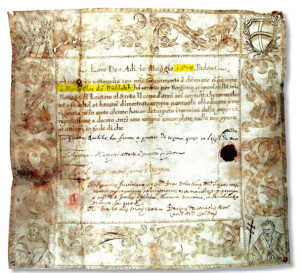
Certificate (1678) by Pietro Railich regarding Mathias Klotz: "À Mattio Cloz dá Mithbolt," highlighted in yellow. *See Sources

Mathias Klotz Monument in Mittenwald
Once back in Mittenwald, Mathias was entitled to call himself a master lute maker. In 1686, he married Sebastian’s mother, Maria Seiz. The guild document was included in the marriage certificate. The certificate also shows that Mathias already owned his own house with a garden and a workshop at that time. Sebastian was born there in 1696. The numerous notarial deeds of purchase and sale indicate that his father was already wealthy during the first few years after his marriage. He owned several houses, plots of building land, and fields. Sebastian therefore grew up in a prosperous family.
Partly because of his prestige, Mathias had already established contacts with more distant cities such as Venice, Salzburg, and Vienna. These were cities where musical culture was developing more rapidly than in the rest of Europe.
Mittenwald, Sebastian’s hometown, was located along the important ancient Roman “Via Raetia,” a trade route that ran from Augsburg to Venice and was known as the “Rottstraße.” Inns and transshipment points were located at regular intervals along that road. Until 1650, Bolzano had been the region’s premier trading city, but after a fierce conflict, the powerful Venetian merchants had shifted their market from Bolzano to Mittenwald. In that city, goods from all over Europe were transshipped and transported onward. Among them were many musical instruments.
The wood that grew around Mittenwald proved to be ideally suited for violin making. This attracted artisans to the town, and by the time Sebastian began his work, there were already several violin makers and a multitude of apprentices and journeymen, almost all of whom had been trained by his father. The guild system that had made violin making a major industry in Füssen was also introduced in Mittenwald.

Mittenwald (1700) in a painting by Valentin Gappnig in the "Fürstengang" in Freising
Instruments made by prominent luthiers such as Amati, Stainer, and others from Augsburg and Venice passed through Mittenwald. They traveled not only via the “Rottstraße,” but also along the Isar River, which flowed past Mittenwald and over which goods were transported downstream to Munich. Instruments by Mathias and Sebastian Klotz found their way to other parts of Europe via the same routes.
Mathias and Sebastian's studio grew into a large family workshop

Portrait of Leonore, Baroness von Keyserlingk, with a lute, by Antoine Pesne, circa 1745
Sebastian began working with his father around the age of twelve. His oldest brother, Georg, and the violin maker Andreas Jais were already working in his workshop. The guild required that a person must have worked for at least two years as an apprentice and six years as a journeyman under a master violin maker before being allowed to market instruments under his own name. Around the age of twenty, Sebastian was therefore permitted to use his own label. It is believed that Sebastian initially built more lutes than violins, as he was referred to as “Plectopoeus,” a lute maker, in various deeds and documents.
After the death of Sebastian’s mother, his father remarried, and Sebastian gained three more brothers. They, too, became violin makers. Mathias and Sebastian’s studio grew into a large family workshop. When Sebastian married Maria Rosina Mayr (ca. 1704–1770), the couple officially acquired ownership of a portion of a building at Stainergasse 33, where Sebastian set up his workshop. Six years later, it had become too small, and they moved to Hochstraße. There he would continue to work for the rest of his life.
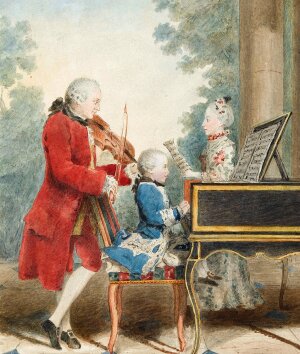
Of their eleven children, four followed in their father’s footsteps. His oldest brother, who had by then become an independent violin maker in Mittenwald, died in 1737, and six years later, his ninety-year-old father, Mathias, also passed away. His instruments and those of other family members were internationally renowned, as evidenced by a letter from Leopold Mozart dated 1764: “Paris and London are full of violins by Klotz from Mittenwald.” Wolfgang Amadeus Mozart owned a Klotz violin built between 1710 and 1750. Wolfgang had several, but he would use this one for nearly thirty years.
Leopold Mozart in 1764: “Paris and London are full of violins made by Klotz of Mittenwald”
After the deaths of Georg and Mathias, Sebastian became the leading violin maker in Mittenwald.
Sebastian’s four sons, who followed in their father’s footsteps, undoubtedly gained their first experience in violin making in Mathias and Sebastian’s workshop, but they completed their further training with another master violin maker. Three of the sons subsequently set up their own businesses, but Aegidius returned to Sebastian’s workshop. Researchers believe that the violin on which Amadeus Mozart later played was built around that time.
From the period between 1726 and about 1740, only handwritten labels by Sebastian are known to exist. After that, he had his labels printed. He initially spelled the place name Mittenwald with “vv,” but starting in 1760, he changed his style again and used the “w.”
Seb. G. Kloz, in Mittenvvald, 1732; Sebastian Klotz, in Mittenvvald on the Iser, 1734; Sebastian Kloz, in Mittenwald, 1761.
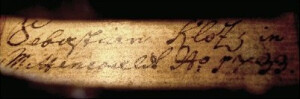
Handwritten label by Sebastian Klotz, 1933. Photo courtesy of the Mittenwald Violin Museum
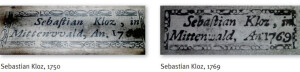
Label: Sebastian Klotz, Mittenwald, spelled with "vv" and "w"
It was long assumed that Mathias had learned his craft from Amati in Cremona and from Stainer in Absam. This assumption stemmed from the fact that Mathias’s work bore a strong resemblance to that of both violin makers. In the early years after he began working independently, Sebastian’s work still resembled his father’s, but later it took on a more personal style. He worked with great precision; the edges and inlays are exquisitely crafted.
The two main models were elongated and had vertically oriented f-holes. They had short corners and a slightly tapered central curve. He built them around an internal mold in which the lower rib runs from corner to corner. He let the glue edges slope diagonally into the corner blocks, a construction method also used in Cremona. The arch is less pronounced than that found in other regions. Sebastian gave the scroll sharp twists and let the whole instrument tilt slightly forward.
Until 1800, Sebastian Klotz’s style of violin making served as the model for what would later be called the “Mittenwald School of Violin Making”
The varnish Sebastian used was thin and usually had a deep brown color. He applied it to wood that did not have particularly attractive grain. Because of his more refined craftsmanship, Sebastian’s instruments are held in higher regard than his father’s. According to musicians, the sound is soft and full. In Mozart’s time, they were popular as orchestral instruments. Sebastian had many students from Mittenwald. Anton and Andreas Gäßler, as well as Johann Georg Psenner, were the best known.
Mittenwald has become the premier training center for violin making in Germany. The Klotz family, who worked there from around 1690 to 1988, played a major role in this development.
Archives of the Mittenwald Violin Making Museum.
Vannes, R., 1999, *Universal Dictionary of Instrument Makers*, Spa.
The Smithsonian Institution, The Klotz family.
Tarisio Cozio archive, accessed in 2022.
* Geigenbaumuseum-mittenwald.de: Early violin making in Mittenwald – Mathias Kloz and his sons (c. 1685–1740, history and illustrations of instruments)