Instrument

viola
The Klotz (Kloz) Family
Mittenwald,
1698
played by
Berdien Vrijland
Berdien Vrijland

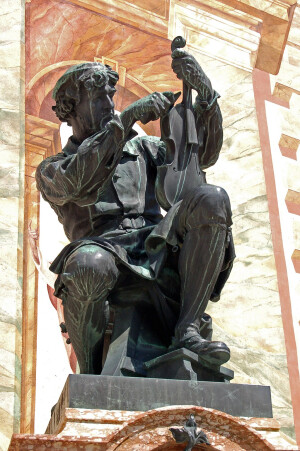
Mathias Klotz (1653–1743) was the first violin maker in the family and presumably also in the town. His father, Urban Klotz (Vrbanus Cloz, 1627–1691), and his mother, Ursula Schändl, had lived in Mittenwald for generations. At a young age, Mathias went to the town of Füssen to train as a lute and violin maker. Many of Europe’s finest instrument makers worked there. He remained there for two years as an apprentice and continued his training for another six years with the lute and violin maker Pietro Railich in Padua.
Once back in Mittenwald, he began building not only lutes but also, increasingly, violins. Mathias was not only skilled in his craft but also a successful businessman: he owned several houses, plots of building land, and fields, all in or around Mittenwald.
The village of Mittenwald was located along the important ancient Roman “Via Raetia,” a trade route that ran from Augsburg to Venice and was known as the “Rottstraße.” At regular intervals along the road were inns and transshipment points where powerful Venetian merchants held sway. Mittenwald was an important hub where goods from all over Europe were transshipped and transported onward, including many musical instruments.
The wood that grew around Mittenwald proved to be ideally suited for violin making. This attracted artisans to the town. Many of them were trained by Mathias Klotz. The guild system that had made violin making a major industry in Füssen was also introduced in Mittenwald at the end of the seventeenth century.
Instruments made by prominent luthiers such as Amati, Stainer, and others from Augsburg and Venice passed through Mittenwald. They traveled not only via the “Rottstraße,” but also along the Isar River, which flowed past Mittenwald and over which goods were transported downstream to Munich. Instruments made by Mathias and, later, by other members of the Klotz family found their way to other parts of Europe via the same routes.
Mathias had six children, of whom Sebastian (1696–1775), Georg (1686–1737), and Johann Karl (1709–1790) became violin makers. Sebastian was the first to be allowed to use his own label. He presumably built more lutes than violins at first, as he was listed as a “plectopaeus,” or lute maker. Both of his brothers, Georg and Johann Karl, also worked in the family workshop. The influence of other successful makers, such as Stainer and Amati, is clearly evident in their work. Although perhaps not as highly regarded as Sebastian, Johann Karl Klotz did build very refined violins, most of them modeled after Amati.
The third generation consisted of seven violin makers: two sons of Georg, three of Sebastian, and two of Johann Karl. They undoubtedly gained their first experience in violin making in the workshop alongside Mathias and their fathers, but they completed their further training under another master violin maker. With the exception of Aegidius, Sebastian’s youngest son, they went on to become independent violin makers. Aegidius returned to Sebastian’s workshop. He is considered the most talented of his generation. By the mid-eighteenth century, the Klotz family had become highly influential. After his trip through Europe, Leopold Mozart wrote that “London and Paris were full of Klotz violins.” He also bought a Klotz violin for his son Amadeus. Researchers believe that Aegidius built it together with his father. Amadeus played the instrument for a long time. He presumably also used the violin when composing his violin concertos.
Gradually, outside influences on the Klotz family grew; changing musical tastes placed demands that the original Klotz instruments could not meet. Every luthier in the family had to adapt to these changes in order to withstand the fierce competition that had emerged in violin making around 1900. They often labeled their instruments with the name of Jacob Stainer, whose instruments had become popular among composers and leading musicians. These individual Klotz makers could be identified by their instruments only in a few cases. Connoisseurs therefore often had to attribute many violins to an unidentifiable member of the family.
Johann Nepomuk Klotz (1903–1971) was the second-to-last violin maker of the dynasty. He was trained at the Mittenwald school and worked at Neuner & Hornsteiner, the company owned by two other prominent violin-making families in Mittenwald. In 1930, he moved to Munich and later to Berlin. There, he worked for the renowned luthier Otto Möckel, and in 1946 he established himself as an independent violin maker in that city. His work is distinctive and highly refined.
Hans Baptist Klotz (1906–1988) was the last violin maker in the family. He studied in his hometown but moved to Stuttgart, where he built a large number of excellent and distinctive instruments.
It has long been assumed that Mathias learned his craft from Amati in Cremona and from Stainer in Absam. This assumption stemmed from the fact that Mathias’s work bore a strong resemblance to that of both violin makers. His influence was considerable: he trained many makers, all of whom played a significant role in spreading his ideas both within and beyond Mittenwald. The best known of these was Johann Jais. (c. 1752–after 1780), who moved to the city of Bolzano. Bolzano served as the most important link between the German violin-making regions and Italy and had a long tradition of violin making.
In the early years after he became independent, Sebastian’s work still resembled that of his father; later, it took on a more personal style. He worked with great precision; the edges and inlays are exquisitely crafted. His two main models were elongated and featured vertically oriented f-holes. They had short corners and a slightly tapered central curve. He built them using a construction method employed in Cremona. The arch is less pronounced than that found in other German regions. Until 1800, Sebastian Klotz’s style of violin making served as the model for what would later be called the “Mittenwald School of Violin Making.” Sebastian had many students. Anton and Andreas Gäßler, as well as Johann Georg Psenner, were the best known. Sebastian’s work was widely copied even during his lifetime and distributed throughout Europe as “Klotz instruments.”
The third generation of Klotz and their students also remained faithful to their fathers’ work, but continued to develop the family legacy. Georg Klotz, Sebastian’s eldest son, gradually developed his own style. He built unusually large instruments and devised a unique approach to the arching, the construction of the sides, and the f-holes. His brother Aegidius Klotz went even further; the model he developed is strikingly compact in character and features broad edge inlays. The somewhat stocky scroll with a curl complements this well. The influence of Jacob Stainer can be seen in his work. His work, too, was frequently copied. Joseph Thomas, Sebastian’s third son, is regarded as one of the most refined luthiers of his generation; his work is flatter than that of the previous generation. His two sons became the fourth generation of Klotz luthiers. They no longer worked in the family workshop but established their own independent practices.
With the exception of a few individual makers who associated their names with their own models, most of the Klotz makers of previous generations had already gradually lost their influence on European violin making. The last two makers of the dynasty built recognizable instruments, but these were based on the styles of their teachers, not on the family tradition. They had no successors.
Read here to learn more about Sebastian Kloz
Archives of the Mittenwald Museum of Violin Making.
Vannes, R., 1999, *Universal Dictionary of Instrument Makers*, Spa.
The Smithsonian Institution, The Klotz family.
Tarisio, Cozio archive, accessed in 2022.


