Instrument
violin bow
Jean Jacques Millant
Paris,
± 1970
played by
Emil Giacometti
Emil Giacometti

*1928 , Parijs †1998 , Parijs
Together, they learned the trade from the Morizot brothers, who proved to be excellent teachers. The Morizots had a workshop known for its efficiency and the large number of bows it produced. Everyone had their own specific task. During their heyday, ten bow makers worked at Morizot. Morizot bows were popular with a wide audience, and they could barely keep up with demand. On average, each employee produced about five bows a day! Only shortly after the war was the number of employees temporarily reduced to five. That was the year Jean-Jacques and Bernard began working in this productive workshop.
After this apprenticeship, in 1948, Bernard left for America and Jean-Jacques returned to Paris. Before opening his own workshop, he wanted to further hone his skills and therefore went to work with his father and uncle for several years. The brothers Roger and Max Millant had shared a workshop since 1923 and were respected violin makers who crafted exceptionally refined instruments in the tradition of the classical Italian masters. In 1949, one year after Jean-Jacques’s arrival, they won first prize with a quartet (two violins, a viola, and a cello) at the prestigious exhibition in Cremona, and in that same year they also won first prize in The Hague. Jean-Jacques crafted his bows not with the grand gestures of the Morizot brothers, but with the refinement of Max and Roger.
In 1951, he opened his own studio. Over the years, he moved his studio twice more within Paris. Each new location was just a little better than the last. After a period from 1959 to 1965 during which he experimented with new shapes for the bow, he began making only bows based on the Peccatte model. In 1970, he was named “Meilleur ouvrier de France.” This prestigious title was awarded only once every four years, following a rigorous selection process, and was ceremoniously presented at the Sorbonne. In doing so, he followed in the footsteps of Victor and Jules Fetique. After that, this title would never again be awarded to a bow maker.
Shortly after completing his training, he already appears to have been influenced by Dominique Peccatte, and even then, the perfection of his work is striking. Experts believe that his bows are on par with—or hardly inferior to—those of Peccatte.
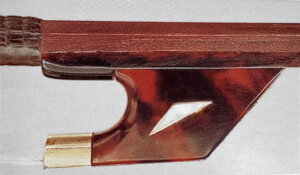
Influenced by the graphic modernists of the 1950s and 1960s, he developed a new model of shoe: experimental, unconventional, and geometric. Not only the shape, but also the construction was daring. He drew on a Hill technique he had learned at Morizot. In that technique, the shoe consists of two parts: one part is mounted on the shank, and the other slides over it. However, that construction is not equally stable under all conditions. He modifies the joint so that it suits his own style while also providing a high degree of stability. He crafts them from ivory, tortoiseshell, and ebony—all inlaid with gold. He gives the knob a matching, almost architectural shape and inlay. Crafting them requires a high level of technical skill.
After the war, the emphasis had been on social reconstruction. Reviving the musical tradition was hardly a priority. On top of that, movies and LPs had, in many cases, supplanted concerts. As a result, orchestras and individual musicians were often out of work well into the 1950s. The trade in high-quality used instruments and bows had replaced the production of new ones. Violin makers and bow makers had hardly any work. Many workshops had been forced to close their doors. Some makers had emigrated to countries outside Europe. In Paris, only the best workshops had survived.
The revival in the early 1960s brought a new sense of vitality. Jean-Jacques thought he could capitalize on this. It was during this period that he designed his new model. Most musicians, however, still struggled to make ends meet. Only the most prominent musicians could afford Jean-Jacques Millant’s modernist and expensive bows, though few appreciated them. He continued to make them only until 1965. No bows of this type by him are known to have been made after that date. However, the ferrules of his bows remained richly decorated until the 1990s and were often mounted in tortoiseshell and gold. The model was once again similar to that of earlier times; based on Peccatte’s design, but slightly more opulent. He died in 1998 as a respected pioneer of a small group of bow makers who do not shy away from innovation in form and technique.
It is not known who his employees were. His direct influence on later bow makers is therefore limited. Jean-Jacques Millant is considered one of the most important bow makers of the second half of the 20th century. This is due in no small part to the fact that his body of work is extensive, exhibits great coherence, and is of very high quality.
The brand he used was “J. Jacques Millant a Paris.” Jean-Jacques Millant preferred light-colored wood.
The bow by Jean-Jacques Millant, which is in the collection of the Musical Instrument Fund, is a good example of his later period, during which he returned to making bows in the style of Peccatte.
Millant, B., Raffin, J.F., 2000, *L'Archet: French Bowmakers, 1750–1950*. Paris.
Vatelot, E. 1976, *Les Archets Français*. Nancy.
Jacquot, A., 1912, La Lutherie Lorraine et Française, Paris.
Henley W., 1959 Universal Dictionary of Violin and Bow Makers. Amati Publications. London.
Tarisio; the Cozio archives, accessed in 2019.
Geneanet, accessed in 2019.
Archives Nationales de France, accessed in 2019.