Instrument

violin
Gregorio Antoniazzi
Glue,
±1750
played by
Beatriz Li Rosão
Beatriz Li Rosão

*± 1710 , Colle (Veneto) †± 1780 , onbekend
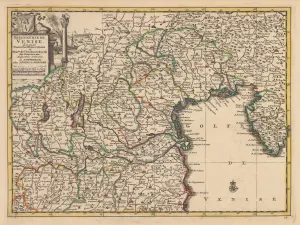
In the 18th century, Colle was a highly sought-after location for wealthy Venetian families. Between Treviso and Colle lay the estates of Venetian patricians (Loredan, Dolfin, Valier, Giustinian, Morosini) and of the local nobility (Spineda, Pola, Sbrojavacca).
Owning a country estate in the region brought great prestige. Moreover, it served as a base from which to manage the land they owned. And in the summer, it offered the opportunity to escape the heat of the city and host parties. The Giustinian family owned an estate in Colle, was involved in music, and had had composers among its ranks. Several members of the family played prominent roles in Venice’s patronage of the arts.
Another major landowner in Colle was the Morosini family. The family owned impressive palaces in Venice, including their Palazzo on Campo Santo Stefano, where private concerts and musical gatherings were held. And in Colle, they had a large country estate. Francesco Morosini had the estate in Colle expanded and furnished with great splendor so that they could host their parties there as well. The Morosinis were well-known patrons, particularly of composers and musicians, and often commissioned new operas and instrumental works. For example, while working in Venice, Antonio Vivaldi relied on the support of the Morosini family. The presence of these families ensured a strong connection between Colle and Venice. The journey to Venice took just over a day. Weekly shipments of wine and agricultural products were sent to Venice. Whether Gregorio’s instruments also reached Venice in this way is not mentioned.
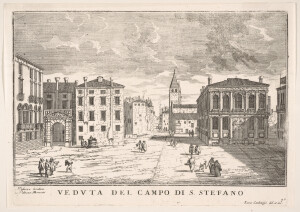
Campo di Stefano, Venice, featuring Palazzo Loredano and Palazzo Morisini. See Sources*
For violin makers such as Gregorio Antoniazzi and other makers working in the Veneto region, Venice was their benchmark. They themselves were barred by the guild from working independently in Venice. Only those who were under the patronage of the aristocracy or who had served an apprenticeship for years with one of the Venetian violin makers and had successfully passed the master’s examinations could open their own workshop. Those who could not or would not do so continued to work in the outskirts but maintained contact with luthiers in the city. There were dozens of lute and violin makers there, including Matteo Goffriller (ca. 1659–1742), Pietro Guarneri (1695–1762), Domenico Montagnana (1686–1750), and Santo Serafin (1699–ca. 1758) were the most prominent.
Gregorio Antoniazzi was undoubtedly familiar with their work. Venetian instruments also made their way across the Alps via Colle to Innsbruck or beyond. And from Venice, instruments built in the region were exported primarily to England. In London, very high prices were paid for Italian string instruments. For some dealers, that was reason enough to “relabel” instruments by unknown makers, allowing them to make a substantial profit on, for example, a “Montagnana” that he had not built himself.
‘Only eight violins and two cellosby Gregorio Antoniazzi are known to exist. It isquite possible that he built unlabeled instrumentsfor Venetian luthiers or directly forexport.’
Gregorio Antoniazzi’s instruments give the impression that he had learned his craft from a Venetian luthier. His scroll bears a strong resemblance to Montagnana’s. The varnish Gregorio Antoniazzi used was similar in composition and color to the Venetian style: ranging from orange-red to deep red.
In addition, experts also see similarities in style and working methods that were common in Bergamo. He himself did not work there; both the municipal archives and those of the Misericordia Maggiore in that city were kept with the utmost precision, and Antoniazzi does not appear in them. However, the maestro di cappella of St. Mark’s in Venice, Antonio Biffi (1692–1732), had been a student of Giovanni Legrenzi of Bergamo while Antoniazzi was still alive. This violinist and vice maestro di cappella of San Marco served as a violin teacher at one of Venice’s major Ospedali during his final years.
Gregorio Antoniazzi may have acquired instruments from Bergamo through Biffi, but it is even more likely that he obtained them through the leading musicians of the Cappella Musicale of the Basilica di Santa Maria Maggiore in Bergamo. These were outstanding musicians who often chose Venice as the destination for their musical careers. Thanks to them, according to Rozenholz-Witt, Bergamo was a city that had virtually no equal in the field of polyphony. The cappella performed polyphonic music about 100 times a year outside of church services. The concerts they gave were legendary. Only those at St. Mark’s in Venice surpassed them. The musicians from Bergamo were beloved in Venice but could not yet afford the more expensive Venetian instruments and presumably still played their own instruments.
During Gregorio Antoniazzi’s active period, many violin makers preferred the higher arches of Jacobus Stainer and Amati, which were regarded by many musicians at the time as superior to the flatter instruments of Antonio Stradivari.
Only eight violins and two cellos by Gregorio Antoniazzi are known to exist. Experts consider Gregorio Antoniazzi’s craftsmanship to be of such high caliber that it is unlikely he did not build more instruments. It is quite conceivable that he built unlabeled instruments for Venetian makers or directly for export. Colle was too insignificant to attract its own clientele of musicians, and there were too many makers in Venice.
One of Antoniazzi’s instruments, which was examined by Charles Beare, appears to have been modified by the London dealer Thomas Dodd (1764–1834) and fitted with a different neck from Dodd’s workshop—one whose scroll also bore a strong resemblance to Montagnana’s. Dodd was one of the most important London dealers who purchased Italian instruments on a large scale and had them shipped to London—sometimes in parts—so he could resell them with a label from another maker.
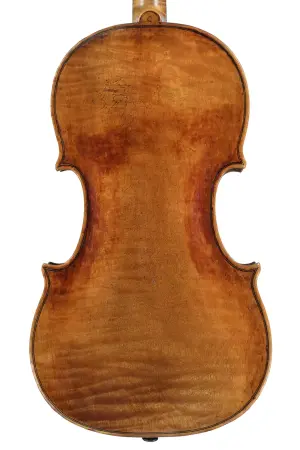
Gregorio Antoniazzi violin from the collection of the Musical Instrument Fund: one-piece back + construction pin clearly visible where the neck joins the back
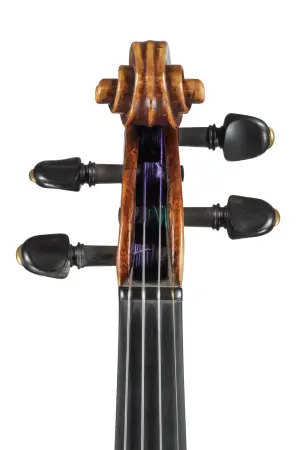
On this same violin, you can see the modest size of the scroll
Gregorio Antoniazzi’s instruments are distinctive. They have a high arch that falls between Stainer’s “bulge” and the slightly less full Amati shape. The edge inlay consists of two thin black bands and a wider central section that lies close to the outer edge; it is well-made but not refined. The f-holes are straight, and the back is often made from a single piece. Notably, he uses a construction pin in a recessed area where the neck joins the back. The scroll is relatively small, has fine coils, and is slightly bent forward.
The label reads: Gregorio Antoniazzi / Colle / 1738
Sources
Pio, S., 2004, Violin and Lute Makers of Venice 1640 - 1760. Venezia.
Jalovec, K., 1957, Italian Violin Makers, Prague.
Vannes, R., 1981, “Universal Dictionary of Instrument Makers,” Brussels.
The Strad; In Focus 2013, John Dilworth.
Goldfarb T., 2015, Art and Music in Venice, Londen.
Rosenholtz-Witt, 2020, Musical Networks in Bergamo and the Borders of the Venetian Republic, dissertatie, NY
Max Möller, 1970, Italian Violin Making from Gaspar da Salo to Pressenda, Amsterdam
Seghers H., 2020, Venice: Music and Painting, z.p.
Jaeger, Schmitt, Graff, 1995, Les Violons: Venetian instruments, paintings & drawings, Paris
Hersh S., Monteverdi to Goffriller: the advent of Baroque music in Venice, 1613–1742, How the pioneering music of Claudio Monteverdi and the skills of Matteo Goffriller combined to make Venice one of the greatest sources of 18th-century cellos.
Tarisio, Cozio Archive, accessed 2026
*Luca Carlevaris, 1703, etching from the series “Le fabriche e vedute di Venezia.” Bequeathed to The MET NY by Phyllis Massar in 2011.