Instrument

violin
Giovanni Maria del Bussetto
,
1680
played by
Marcel Sutedja
Marcel Sutedja

*± 1640 , onbekend †na 1681 , onbekend
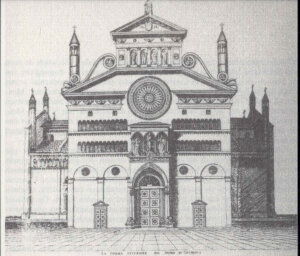
The confusion surrounding his career began as early as 1806, when the author of *em* *La Chélonomie ou le parfait luthier* */em*, Sibire Abbé, together with the French violin maker Nicolas Lupot, wrote a book about Italian violin makers of the 15th and 16th centuries. In it, Del Bussetto was already listed as a violin maker. Presumably, it was because of the way he built his instruments that he was placed in Cremona between 1550 and 1600. Even in later research, no information about Del Bussetto’s life or work was found in the archives—neither in the sixteenth nor in the seventeenth century. In the biographical overview by these authors, which appeared a few years later, they listed Giovanni Maria del Bussetto as Andrea Amati’s teacher. This is also an untenable assumption, since this founder of violin making lived from approximately 1505 to 1577.
Not only Abbé and Lupot, but also other authors—such as De Fétis in his 1888 biographical overview and George Hart in his 1890 book The Violin: Its Makers and Its Imitators—still placed Del Bussetto in the sixteenth century. Even as late as 1972, Walter Kolneder, in his “Amadeus Book of Violin: Construction and History”, still expressed the suspicion that del Bussetto was a sixteenth-century luthier and the teacher of Andrea Amati.
It was not Andrea Amati, but his grandson Nicolò Amati who was a contemporary of Giovanni Maria del Bussetto. Later researchers have been able to determine with considerable accuracy who Amati’s teacher actually was; it was not Giovanni Maria del Bussetto.
Although Brescia and Cremona are only 50 km apart, a border ran between the two cities in Del Bussetto’s time. Brescia was part of the (free) Republic of Venice, with the city of Venice serving as a vibrant musical metropolis, while Cremona fell under the much stricter Spanish/Austrian regime. For Brescia, this meant access to materials such as maple and spruce from the Alps—essential for violin making—as well as to a broad network of artisans, musicians, and aristocratic clients from Venice. Cremona was located on an ancient trade route, which made it very prosperous, but it lacked the musical and artisanal inventiveness that Brescia possessed in abundance.
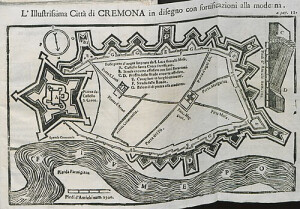
Map of Cremona in the 17th century
As early as around 1590, instrument makers in Brescia were responding to the need to build a type of stringed instrument that was robust and capable of projecting its sound powerfully in larger spaces, such as cathedrals or courtyards. This desire was driven by the changing musical needs as the Renaissance gave way to the Baroque era. String instruments took on an increasingly prominent role in ensembles and church music, which called for a more powerful, richer, and more versatile sound. The demand for innovative construction techniques grew accordingly.
In 1630, Brescia fell victim to the plague. The violin maker Giovanni Paolo Maggini died in 1632, bringing the golden age of violin making in Brescia to an end. It is believed that Del Bussetto was working in Brescia at that time. Although the plague had also killed two-thirds of the population in Cremona, Nicolò Amati and a few smaller makers had survived, and they lived up to Cremona’s reputation as a city—where violin making was practically synonymous with the city itself. Since Cremona offered better prospects for violin makers, Del Bussetto left Brescia for Cremona.

Claudio Monteverdi, Oil Painting by Bernardo Strozzi (ca. 1630)
Among musicians, Cremona had long been a household name. Claudio Monteverdi had brought the city and its instrument makers to the attention of musicians. He was born in Cremona and had studied there under Marc Antonio Ingegneri, a violinist, composer, and the music director of Cremona Cathedral. Ingegneri was an influential man with connections in the highest circles of Rome. Monteverdi’s music had reached the most important courts and musical centers in Europe, such as Venice, Ferrara, Nuremberg, and Copenhagen.
Between 1582 and 1590, he had published five of his nine books of compositions when he became maestro di capella at the Cathedral of Mantua and composed his first opera there. At that time, Mantua was one of the most important cultural centers of the Renaissance. On the title pages of his publications, he listed Cremona as his place of residence. His expressive madrigals and operas—which he later composed as chapel master at San Marco in Venice—were performed throughout Europe and required musicians to employ playing techniques different from those used previously. These could only be achieved with the finest instruments available. Amati, and later Guarneri of Cremona, became household names among most musicians. The Amati violin had become the standard and benchmark—even for Del Bussetto.
His instruments are rare, but those that have survived all feature distinctive elongated f-holes and an angular shape. They vary considerably in quality and appear to fall into three groups. His early instruments are of the Brescian style; a second group is more difficult to classify. These are of lower quality than his later work and often consist of highly arched violins that closely resemble the instruments from Tyrol, which were widely used in Europe. In his finest instruments, influences from the great Cremonese makers are evident.
Van Del Bussetto is known for his violins, (large) violas, cellos, and violas da gamba, but not for (double) basses. The materials he used are not always of the highest quality. The top often has a rather coarse grain, and on cellos, the top usually consists of three or more pieces. The f-holes are quite wide at the top. The varnish is typically Italian in composition—soft, usually brown, and sometimes dark yellow.
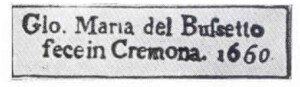
Harper Collins, 2019, Cremona. Collins English Dictionary. HarperCollins, Cremona
Kolneder W. Amadeus book of violin making, construction, history and music.
Dilworth j. On the history of violin making in Brescia.
Bowers, R., 2007, Monteverdi in Mantua, 1590–1612, Cambridge.
Whenham, J. W. R., 2007: The Cambridge Companion to Monteverdi, Cambridge.
Domenico R., 2002, "Lombardy: Cremona" a Reference Guide to History and Culture. Londen.
W. Henry Hill, Arthur F. Hill & Alfred E. Hill, 1910, The Violin Makers of the Guarneri Family, 1626-1762, Londen.
Vannes, R., 1981, “Universal Dictionary of Instrument Makers,” Brussels.
Goldfarb T., 2015, Art and Music in Venice, Londen.
Hargrave R., 2009, The Amati Method, Three articles about the Amati family.
"From the Archive: a violin by Nicolò Amati, Cremona, 1660-70”, The Strad, 2018.
Powers, W., 2000, “Violin Makers: Nicolò Amati (1596–1684) and Antonio Stradivari (1644–1737).” In Heilbrunn Timeline of Art History. New York: The Metropolitan Museum of Art.
Kass P. J. The Stati D'Anime of S. Faustino in Cremona: Tracing the Amati Family 1641-1686.
Hargrave R. G., 2011, The Working Methods of Guarneri ‘del Gesù’ and their Influence upon his Stylistic Development.