Instrument

violin
Giorgio Gatti
Turin,
1912
played by
Sonsoles Vallés
Sonsoles Vallés

*1868 , Chieri (bij Turijn) †1936 , Turijn
Giorgio Giovanni Gatti was from Chieri, a small village near Turin. Nothing is known about the profession he practiced there. According to the archives, his father was a shoemaker and his mother a weaver. It wasn’t until 1890, at the age of 32, that Giorgio moved to Turin. There, he started out as a grain merchant and was so successful that he quickly became a wealthy man. With the same entrepreneurial spirit, he expanded his business to include musical instruments. These must have fascinated him so much that he began building them himself around that time.
Researchers have been unable to prove that Giorgio Gatti had already apprenticed with a violin maker before coming to Turin. However, they have been able to establish that he came into contact in Turin with three of his future colleagues: Enrico Marchetti, Francesco Guadagnini, and Marengo Rinaldi. They were the only instrument makers working in that city at the time. Given Gatti’s early style, he must have been aided in learning his craft by Marchetti, but he also knew Guadagnini personally. The first instruments for which Gatti became known were not his violins, but his guitars. And those were made in the style of Guadagnini.
Giorgio Gatti married Angela Favero in 1892. A year later, in 1893, Enrico Marchetti left Turin and Giorgio Gatti took his place. That same year, he purchased a large building in a beautiful location, where he and his wife opened a studio and shop. They continued to live and work there until 1917.
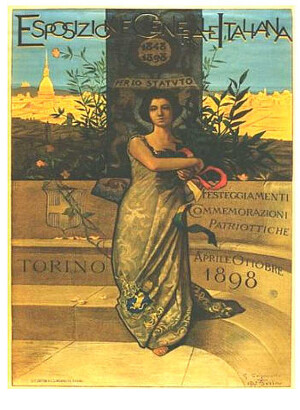
In the Turin archives, he is listed as the owner of “Gatti Giorgio & Co., dealer in musical instruments, grain, and flour.” Although he was involved in trade, he increasingly began building instruments himself: guitars modeled after Guadagnini and violins modeled after Pressenda. In 1898, he sent several of these to the Esposizione Generale Italiana. Later, in addition to violins and guitars, he also built cellos and mandolins. He exhibited a selection of these at the 1911 Esposizione Internazionale. Both exhibitions were held in Turin. His participation in the first exhibition established his reputation in the city, while the second reinforced it. This was necessary because a number of very skilled violin makers had settled in Turin within a short period of time.
Presumably, increased competition forced him to focus his attention on just one aspect of his work. In 1917, he stopped trading in grain and devoted himself entirely to building, selling, and trading instruments. He closed his workshop and grain storage facility and set up a studio in a new home where he built nothing but musical instruments. Giorgio Gatti worked there until his death in 1936.
The Turin school of violin making, of which Gatti is a representative, has an impressive history. Members of the Guadagnini, Rocca, Oddone, and Pressenda families were its most influential makers. The “Turin school” dates back to the seventeenth century. Around that time, Tyrolean violin makers fled to northern Italy as refugees from the Thirty Years’ War. In addition, a second movement in violin making began to take shape. This movement, characterized by a strong influence from the Flemish school, was brought to Turin by Parisian makers who had learned their craft in the Low Countries. The fusion of these two movements formed the foundation of the later Turin school of violin making.
After his brief stint with Marchetti, Gatti presumably had no other mentor. Given the exceptionally high standard of his work, which he would achieve over the years, experts consider him a brilliant self-taught artist.
The basic design of his violins resembles that of Pressenda, a former fellow citizen whom he regarded as the Turin luthier par excellence. Even though his work bore a strong resemblance to that of this luthier, he always imbued his instruments with a personal touch, making them fairly easy to recognize as his own. In many cases, this was a proportion that made them look “long,” particularly at the scroll. The f-holes of his violins are also strikingly elongated.
In the beginning, he used a deep red oil-based varnish on his instruments, which he applied carefully, but which tended to crackle. This color, combined with the distinctive shape of his designs, gave them a powerful appearance. Later, this changed somewhat; his work became less precise and the varnish lighter.
Depending on the period, he marked his instruments with two different labels, both bearing his address. He did not add a brand mark, although that was quite common in Turin. Gatti is not known to have had any students.
For a long time, Gatti was a relatively unknown architect; it was only after the 2003 studies by Thöne and Blot that he received the recognition he deserves.
The violin in the collection of the Musical Instrument Fund dates from 1912, which marks the beginning of a period during which he built his finest instruments.
Thöne, J, 2003, Italian & French Violin Makers, Grottamarre.
Blot, E., 2003, A Century of Italian Stringed Instrument Making, 1860–1960, Cremona.
Cozio Archive; Violin making in Turin, geraadpleegd in 2019.