Instrument

cello
Gennaro Gagliano
Naples,
1734
played by
Michaël Müller
Michaël Müller

*±1705 , Napels †±1780 , Napels
Gennaro’s father, Alessandro, was the first in the Gagliano family’s line of violin makers. (ca. 1665–1732). Of the thirteen violin makers the Gagliano family produced over the years, Gennaro’s brother Nicolò—the second and middle son of Alessandro Gagliano—was the best known and most influential. Gennaro, who was about eight years older than Nicolò, always remained in his brother’s shadow. Unfairly so; connoisseurs now consider his work to be just a touch more refined than that of the other Gaglianos. That refinement appealed to a different clientele than Nicolò’s. We know little about Carlo, a younger brother born as late as 1740, other than a few violins that bear his name.
When Gennaro’s father, Alessandro, began his career, there was no Neapolitan violin-making tradition to speak of. However, many instruments were being made in and around the city—not by Neapolitans themselves, but by lute and violin makers from the German city of Füssen.
Over the years, the early Neapolitan architectural style blended with the German style to form a new and highly recognizable Neapolitan style
Those builders had flocked to Naples in large numbers in the late 17th century. Like Venice and Rome, Naples was a cultural metropolis at that time. Music filled every street corner, and for those who could afford it, life there was carefree and joyful. There was intellectual debate on every conceivable topic, and the royal court encouraged new compositions, with operas and ballet performances drawing massive audiences.
The composers, singers, and instrumentalists came from the city’s four conservatories. Consequently, there was a high demand for instruments. German instrument makers such as Magnus Lang, Matthaus Selloß, Jacob Stadler, and Georg Kayser met that demand. They brought high-quality instruments and a high standard of craftsmanship with them from Füssen. Over the years, the early Neapolitan construction style blended with the German one to form a new and highly recognizable Neapolitan style.
Gennaro’s father was undeniably inspired by the luthiers from Füssen. It cannot be determined with certainty from whom he learned the craft. He himself claimed to have been an “Alumni” (apprentice) of Stradivari, but he was not a student of Antonio’s; the differences in their construction methods and in their instruments are simply too great for that. However, he likely learned a great deal from Antonio’s son, Omobono Stradivari.
After working for his father for about six years, Omobono was sent on a study or business trip. In 1697, he arrived in Naples. There, much to Antonio’s dismay, Omobono stayed for over two years. Omobono possessed neither the talent nor the ambition of his father, but he had seen firsthand how things were done in Antonio’s workshop in Cremona. Since Alessandro Gagliano was the only violin maker of note in Naples, Omobono must have spent several years in Alessandro Gagliano’s workshop, where a few German violin makers were presumably also working.
Even before Gennaro’s birth, his father—the only violin maker—had a small but steady source of income. Records from the archives of the Neapolitan conservatory, Santa Maria di Loreto, show that from around the time of Gennaro’s birth—from 1701 to 1722—Alessandro maintained the conservatory’s instruments and adapted them to the demands of new music in exchange for a fixed salary. Santa Maria di Loreto was the most important of the four Neapolitan conservatories. All four were of a high standard, and their musical direction was progressive. The conservatories were often led by established composers who, influenced by the Enlightenment, pioneered new music.
As early as the late 16th century, orphaned boys were introduced to music theory and learned to play an instrument, sing, and compose. In Gennaro’s time, Santa Maria di Loreto’s ties with the Church had largely been severed, and even those who were not orphans could be trained as professional musicians for a fee. Girls, however, were not admitted. The “Loreto” offered three main areas of study: voice (it was the premier training program for castrati), violin, and composition. The standard of instruction was so high that it was already regarded as one of the best music schools in Europe. In Gennaro’s time, Naples was the musical laboratory of Europe, where virtuosity was a defining characteristic.
Alongside this, there was a religious musical culture that performed music at a very high level in churches, monasteries, and religious brotherhoods. It organized large-scale events featuring choirs, soloists, and orchestras, such as the famous Miserere traditions during Holy Week.
As the eldest of the three sons who became violin makers, Gennaro learned a great deal from his father, but given the differences between the instruments made by father and son, he must also have received instruction from other makers. His body of work displays such greater refinement that it is suspected he, too, may have spent time in Cremona. That level of refinement was not available in Naples.
Gennaro and his younger brother Nicolò worked together in the workshop under Alessandro’s supervision for some time. When Alessandro died in 1733, the brothers continued to expand the workshop and their international contacts until the family business became by far the most important in southern Italy. It was Nicolò, not Gennaro, who took over the contract with the Santa Maria di Loreto Conservatory after Alessandro’s death. The salary Nicolò was paid was the same as his father’s had been twenty years earlier.
The two brothers worked together for years, but eventually went their separate ways. The exact year they parted ways is unknown, but the demand for instruments in Naples was apparently so great that there was enough work for all the luthiers in the Gagliano family, each with their own clientele.
Over the course of Gennaro’s life, his hometown changed hands four times. At the time of his birth, Naples was ruled by the Spanish King Charles II, who used the kingdom as a cash cow. In 1713, the Kingdom of Naples was ceded to the Austrian Habsburgs. And thirty years later, it was ceded again to the Spanish King Don Carlos de Bourbon.
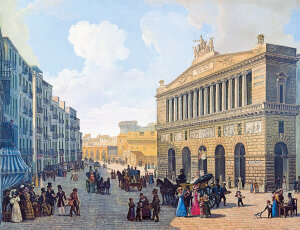
For Gennaro, the period from 1734 to 1759 was likely the most intense. The workload for Naples’ violin makers increased when Charles of Bourbon settled in Naples with a large entourage in 1734. He was a megalomaniacal ruler and had strong ideas about what the grandeur of a major European court should look like. To further his own glory, he commissioned, among other things, the construction of the “San Carlo,” an opera house intended to be the most beautiful and largest in Europe. As a result, even more musicians were drawn to Naples. According to the writer and member of the Academy of Sciences, Charles de Bosses, Naples had quickly become the musical capital of the world. The violin makers of the Gagliano family were not the only ones, but they were certainly the most important violin makers in Naples.
‘Of all the great cellos I’veseen or heard, the one that has stayed with me fordecades was one made by GennaroGagliano’
Due to Carlo of Bourbon’s failed economic reforms, by the time Gennaro was around forty, the city had become impoverished and hopelessly overpopulated. Prosperity was reserved for an ever-smaller number of Neapolitans. A large segment of the population suffered from severe hunger, and ten years later, 9,000 homeless people were roaming the streets.
Gennaro was at the height of his career when Don Carlos de Bourbon handed over Naples to his son Ferdinand in 1759, who turned out to be an enlightened despot.
Poverty reached its lowest point in 1764. In that year alone, thousands of Neapolitans died from malnutrition and disease. Gennaro survived the crisis. He presumably worked mainly for the small group of wealthy or better-off musicians who had not suffered under the yoke of Charles of Bourbon.
Despite this, Mozart and his son did not postpone their planned trip to Naples: “It is such an important center that we may well stay there until winter.” It turned out to be only six weeks. It was not Mozart who dominated European music, but the Neapolitan School, which was led by such greats as Alessandro Scarlatti, Nicola Porpora, Leonardo Vinci, and Giovanni Battista Pergolesi.
Wolfgang Mozart performed several times in Naples, including at the Pietà dei Turchini Conservatory. In June 1770, he also gave a concert at the home of a British diplomat and was introduced to musical and diplomatic circles. Although Mozart found some of the Neapolitans’ customs “backward” and them “deeply superstitious,” he was enthusiastic about the music in the city. He was particularly impressed by the virtuosity of the violinists. The trip was part of their “Italian tour,” during which the Mozarts sought connections and inspiration from the great composers of the time: Cimarosa, Paisiello, and Porpora. Although Mozart impressed the Neapolitans and the court provided the necessary connections, Amadeus did not secure a permanent position in Naples, which had actually been Leopold’s goal.
Naples had four influential conservatories, which at the time were primarily church-run orphanages and boarding schools offering an exceptional musical education. The “della Pietà dei Turchini,” the “di Santa Maria di Loreto,” the “di Sant’Onofrio,” and the “dei Poveri di Gesù Cristo” each had their own area of specialization. These institutions trained virtuoso instrumentalists and composers.
Violin makers such as Gagliano supplied instruments to students, teachers, and orchestras. These musicians not only represented a direct market for him, but were certainly also a source of ongoing feedback on the sound and playability of his instruments. In Gennaro’s time, the violin was becoming increasingly important. The violin replaced the viola d’amore and viola da gamba in much of the repertoire. Solo violin performance and chamber music flourished thanks to virtuosos such as Francesco Geminiani. The nobility also invested in chamber music, opera, and instruments. Wealthy patrons commissioned violins from families such as the Gaglianos, which made their work financially viable.
The San Carlo orchestras enjoyed a great reputation, and their repertoire required high-quality instruments—a key factor for Neapolitan violin makers. The Gaglianos also drew significant inspiration from the court concerts and the church music performed in countless basilicas.
At first, Gennaro drew heavily on his father Alessandro’s designs: Stradivari-style shapes combined with local Neapolitan characteristics. Gennaro did not merely follow in his father’s footsteps; his cellos, in particular, later became “something entirely original,” as Geminiani wrote.
Nicolò had a reputation for being the greatest of the Gaglianos. That may have been true in terms of numbers and popularity, but thanks to his consistently careful selection of materials and his meticulous construction and finishing, Gennaro Gagliano is now known as the most refined luthier of the Gagliano family, with instruments that are sometimes considered the best ever made in Naples.
His output must have been substantial; many of his violins are known, along with about a dozen cellos and a few violas. The earliest instrument dates from 1722, and the last one was likely made shortly before his death in 1780. His most productive years were between 1745 and 1768.
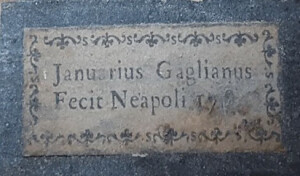
Label from Gennaro Gagliano's "ex-Barbirolli" cello
Three of his labels are known:
In two different versions: Ianuarius Gagliano, son of Alexander, made in Naples, 17..
And one with a decorated border: Januarius Gaglianus fecit Neapoli 17..
Olivieri G. String Virtuosi in Eighteenth-Century Naples: Culture, Power, and Music Institutions, Cambridge
Imbruglia G., 2002, Naples in the Eighteenth Century: The Birth and Death of a Nation State, Cambridge
DelDonna A. R. Instrumental Music in Late Eighteenth-Century Naples: Politics, Patronage and Artistic Culture, Napels.
The Letters of Mozart & His Family — verzameling en transcripties (archive/Internet Archive / Gutenberg).
DelDonna A. R. Opera, Theatrical Culture and Society in Late Eighteenth-Century Naples. Napels

