Instrument

double bass
Cesare Candi
Genoa,
± 1920
played by
Olivier Thiery
Olivier Thiery

*1869 , Bologna †1947 , Genua
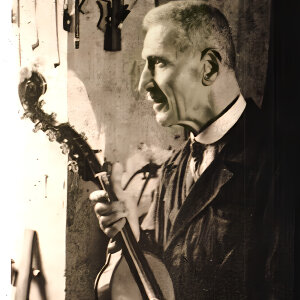
Cesare Candi was born in Bologna, as were his parents, Angelo Candi and Virginia Billi. It was a vibrant university town with a long tradition of musical practice. However, there were very few violin makers left there. Candi’s first and perhaps most important teacher, Raffaele Fiorini, had revived the ancient tradition of violin making. He had a workshop in the Palazzo Pepoli Vecchio, which was Bologna’s cultural hub. There he built stringed instruments in the traditional Bolognese style. Candi’s teacher, Fiorini, had a reputation in Bologna as someone who enjoyed “well-deserved respect for his honesty and good character,” not least because he generously shared his knowledge with his students and with the countless makers who visited him in his workshop to seek his advice. It was in this lively and stimulating environment that Cesare Candi had his first introduction to violin making.
Under Fiorini’s guidance, Cesare began his career at the age of fifteen. At that time, his brother Oreste was already working there, as were the brothers Gaetano and Auguste Pollastri and Armando Monterumici. Fiorini built models that bore a resemblance to Amati’s, but he used a method that French luthiers had brought from Paris to northern Italy a few years earlier. That construction method had its roots in the French violin-making town of Mirecourt. For Fiorini’s son Giuseppe, this was reason enough to leave his father’s workshop amid a falling-out. Giuseppe Fiorini believed that violins based on the great Italian masters should also be built in the Italian style.
After four years, Cesare Candi left for Genoa. There, he rejoined Oreste, his brother, who worked for the Barberis brothers as a maker of guitars, mandolins, and other plucked instruments. Cesare also spent more than four years building these instruments with them and became a true master of his craft. But encouraged by the older Eugenio Praga—who ran a workshop with Enrico Rocca and saw in Cesare a talent too great to remain at Barberis—Cesare struck out on his own.
In his early years as a self-employed craftsman, he did not yet build stringed instruments, but specialized in instruments featuring particularly ingenious decorative and carved ornaments. To secure his income, he continued to supply instruments to Barberis until 1892. At the Italian-American exhibition held in Genoa that year, Cesare Candi gained national recognition as a musical instrument maker.
His first violins date from around 1900. In 1896, he married Rosa Castello, with whom he had three daughters. He then moved twice more before finally settling, along with his brother and family, in a more prominent location in the city.
The turn of the century had set in motion major changes in cultural life. Modernism in art and the belief in progress through mechanization led to different compositions and performance practices than before. Whether to move with the times or return to the origins—the Golden Age of Cremona—was a question that regularly arose for all violin makers at the time. For Cesare Candi, Stradivari and Guarneri became the new sources from which he drew inspiration. These were different from those of Raffaele Fiorini. Raffaele had remained faithful to his beloved, more provincial Bolognese style of violin making.
He found what he was looking for in Enrico Rocca, who, following in the footsteps of his father Giuseppe, built a modern variation on the Stradivari and Guarneri models. Rocca had not only adopted the designs of these Cremonese masters, but he also built them in the Cremonese style. This approach was more principled, yet it also allowed for much greater freedom in construction than the French method. Critics had even called Rocca’s violins an “Italian reinterpretation.” Although Enrico’s work was not as distinctive or refined as his father’s, his instruments were quite sought after around 1900. Enrico Rocca had a major influence on the younger violin makers of Genoa. And Eugenio Praga was one of them. Cesare Candi came under Praga’s influence and moved again. He opened his permanent workshop on the same street where Praga and Rocca were located—an environment that proved exceptionally inspiring for Cesare Candi. After Praga’s death in 1901, Cesare Candi took over his molds and supplies, and out of appreciation for the man to whom he owed much of his recognition and independence, he used them to build many violins.
Under the influence of Enrico Rocca, Cesare continued to develop his craft. His technique became so refined that his instruments were highly regarded not only by musicians but also at exhibitions. In 1906, he won a gold medal in Milan with a violin, and a year later he submitted an entire quartet—two violins, a viola, and a cello—to the major exhibition in Bologna. In the city where he had started out, he received recognition for the direction he had taken and was awarded a highly coveted medal of honor for his entry. Perhaps his greatest triumph came in Cremona, during the celebration of Stradivari’s bicentennial, when he was awarded a gold medal for two decorated violins and a viola. It had not been a true competition; he received the medal hors concours.
His skills as a luthier and restorer had already been recognized. After Enrico Rocca’s death in 1915, he was appointed curator of the City of Genoa’s string instrument collection, which included “Il Cannone” by Guarneri del Gesù—the violin with which Paganini had achieved such triumphs. When “Il Cannone” was to be exhibited in Cremona, Candi first had to carry out restoration work on it, which also brought him recognition among his peers outside Genoa.
World War I had had a paralyzing effect on every aspect of society. Afterward, optimism was well and truly gone, and in the chaos that followed, many took refuge once again in old truths. What exactly led Cesare Candi to decide to dust off the old techniques he had learned from Raffaele Fiorini has never been fully clarified, but around 1917 he occasionally began building instruments again in the old Bolognese style. He also returned to techniques he had used during his time as a guitar maker. During that period, he built many models that expert Eric Blot (1997) describes as eclectic. They consist of elements he adopted from various old masters. It was not until around 1930 that everything fell into place and greater continuity emerged in his models. He remained active until 1940; the later instruments bearing his label were, in all likelihood, no longer his own work but were built by Giuseppe Lecchi.
In 1908, Cesare had taken on his first apprentice. He was the adventurous Paolo de Barbieri, who had run away from home at the age of thirteen, spent several years wandering the seas, but ultimately decided he would rather become a violin maker. Paolo remained in Cesare’s employ until 1918. In 1923, Cesare took on his next two apprentices, Giuseppe Lecchi and Lorenzo Bellafontana. Lecchi was talented and remained Cesare’s assistant until 1933. That year, Giuseppe Lecchi did set out on his own, but he continued to build instruments for Cesare until the latter’s death. In 1949, Lecchi succeeded Cesare Candi as curator of Guarneri del Gesù’s “Il Cannone.”
Cesare Candi remained active in the years following the outbreak of World War II, but presumably only to carry out repairs. He died in 1947. He is considered one of the most important Genoese violin makers of his time.
In Bologna, Candi did not build any instruments under his own name. Those did not appear until around 1894. In addition to guitars and mandolins, these included richly ornamented violas da gamba, violas d’amore, and magnificent guitar harps. His craftsmanship in this field was unparalleled.
Around 1905, a long period began during which he developed as a violin maker. During that time, he built many violins using Eugenio Praga’s templates. He also regularly applied his fascination with ingenious decorations to those instruments. Between 1911 and 1916, he built violins with edge inlays of whalebone and decorative ivory inlays. This also marked the beginning of a period in which his instruments became more uniform in design, though they still featured various distinctive elements.
He also experimented with different types of lacquer, ranging from orange-red to yellow-gold. He began to focus on carving the neck and scroll, which he neither had others make nor purchased, but often crafted himself. The scroll was often beautifully deeply carved and frequently decorated in an original manner. Later, he handed that work over to his apprentice, Giuseppe Lecchi.
By 1930, he had indeed found his definitive style; his output increased, and from that point on, a growing sense of unity can be seen in his body of work. His lacquer is now more orange than before.
He used two different labels for his string instruments. The first was used until about 1914, and the second he would use until the end of his career. He branded most of his instruments with the stamp “C. Candi Genova.” According to Vannes (1981), Cesare built 320 violins, 25 cellos, 30 violas, 29 lutes, and 200 other instruments, including at least one double bass.
The double bass in the Musical Instrument Fund’s collection was built by Cesare Candi around 1920. Only two double basses by Candi are known to exist. The one in the Musical Instrument Fund’s collection was built by Cesare; the other was built by his brother Oreste.
Blot, E., Giordano, A., 1997, “A Century of Italian Violin Making, 1860–1960: Liguria,” Cremona.
Giordano, A., 2003, “Cesare Candi, Lute Player,” Cremona.
Giordano, A., "The Genoese line" in "The Strad Magazine".
Jalovec, K., 1957, “Italian Violin Makers,” Artia, Prague.
Vannes, R., 1981, “Universal Dictionary of Instrument Makers,” Brussels.