Instrument

double bass
Camillo Mandelli
Cast,
1929
played by
Alberto Monge Mansilla
Alberto Monge Mansilla

*1873 , Calco (Como) †1965 , Sesto San Giovanni (Milaan)
Camillo Mandelli also moved to Milan around 1890, where he met Leandro Bisiach, an entrepreneur and violin maker who ran a large workshop where a dozen employees built instruments for him. He was as much a businessman as he was a violin maker, but he did help out in the workshop, where he often applied the final coat of varnish to his employees’ new instruments.
Around the time Camillo Mandelli began working for him, Bisiach’s company was the largest violin-making workshop in Italy. What Vuillaume had been to France and Hill to England, Bisiach was to Italy. Most of the other luthiers in Milan worked for him or had worked in his workshop. Bisiach had an extensive network that allowed him to supply instruments to dealers throughout Europe. The three Antoniazzi brothers were his principal associates; all three were outstanding violin makers. The eldest, Riccardo Antoniazzi, managed Leandro Bisiach’s workshop. He himself was an outstanding luthier.
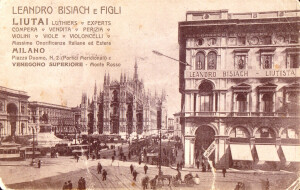
Camillo Mandelli learned the craft under Riccardo. He had trained countless skilled luthiers, including Leandro Bisiach himself. Initially, many instruments were built in the French style, but later Bisiach had more and more instruments made based on models from Cremona: Stradivari, Guarneri, Gagliano, and especially one of the last great Cremonese violin makers: Enrico Ceruti. Antoniazzi was from Cremona, where he had visited Ceruti’s workshop in his youth. Ceruti had not conformed to the style of Stradivari and Guarneri del Gesù, which was preferred in England and France, but rather to that of Bergonzi. Bergonzi’s influence is particularly evident in his double basses. Riccardo Antoniazzi built a considerable number of fine double basses modeled after Ceruti’s.

Riccardo Antoniazzi in his workshop
Riccardo Antoniazzi was arrested in 1897 for theft and, after his release, did not return to work for Bisiach but went into business for himself. Mandelli likely went along with Riccardo or worked for him. Bisiach had a virtual monopoly on the trade in stringed instruments, leaving no room for a competitor in Milan. He had become immensely wealthy through the trade in and reproduction of antique instruments, and his practices were not always above board. Many old and valuable instruments passed through the workshop, which Bisiach had his employees study thoroughly. His employees did participate in replicating these instruments, but not everyone did so willingly.
Camillo Mandelli left for Buenos Aires in 1899. That city had nearly a million residents and, with over 200,000 Italian immigrants, boasted the second-largest Italian community outside of Italy—a community that continued to grow rapidly. When Camillo Mandelli left twenty years later, nearly half of the city’s residents had an Italian surname, as Pablo Alejandro Saravi wrote with a touch of irony in “Italian Violin Making in Argentina”. Music was performed at all levels, often by Italian musicians and singers. In 1908, Buenos Aires gained a prestigious new opera house: the 3,500-seat Teatro Colón. From the very opening, many Italian operas were performed there; Verdi’s *Aida* was the first. It was one of the few theaters to have its own orchestra. Camillo Mandelli was the first violin maker to be hired by the Teatro Colón.
Violin making in Buenos Aires was of a high standard. This trend was set by Luigi Rovatti, who had begun working in Buenos Aires in 1886 after training under Enrico Rocca in Genoa. Other renowned violin makers worked in Buenos Aires: the Militello brothers (Mariano, Gandolfo, and Francesco); Giovanni Capalbo, and Matteo Bruni. In Argentina, Camillo Mandelli maintained his relationship with Leandro Bisiach. In addition to his work for the Teatro Colón and the instruments he made for his own clients, he also built instruments for his former employer, who, together with his son, had further expanded the business in Milan.
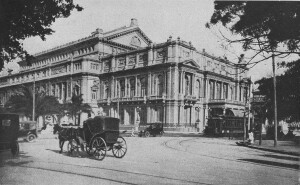
Colón Theater, Buenos Aires
Around 1920, Camillo Mandelli returned to Italy. He spent more than 15 years in his hometown of Calco, and from 1936 onward, he lived in Sesto San Giovanni, a suburb of Milan. There, Camillo Mandelli worked on a large body of work until his death in 1956. He continued to supply instruments to the Bisiach family until around 1945.

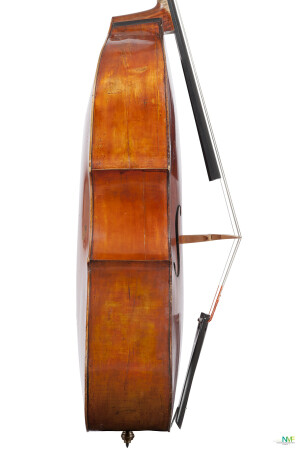
Double bass from the collection of the Musical Instrument Fund, 1929
His work was heavily influenced by Antoniazzi but developed a more distinctive style in Argentina. His double basses, with their arched backs, bear many similarities to those of Ceruti.
No matter where he worked, Camillo Mandelli was able to source high-quality wood. The curves of both the top and back panels extend almost to the very edge. He used a well-formulated varnish ranging from bright orange to dark reddish-brown to finish his meticulously crafted instruments.
Mandelli mainly built violins, but he is also known to have made a few cellos and double basses.
He burned his name into the headblock and often signed the back cover with a flourish.
He was known as Camillo da Calco, a name he also used on his labels.
Label: fidibus, fide, fidis, CAMILLO DA CALCO, made in the year 19..
By faith, in faith, faithful, made by CAMILLUS CALCENSIS, in the year of the Lord 19..
Blot, E., Italian Violin Making II - Lombardy, 2001, The Antoniazzi and Bisiach Families, Eric Blot Edizioni, Italy.
Kass P. J., 2007, The Bisiach Family, Londen.
Azzolina U., Italian Violin Making in the 1800s and 1900s, Milaan.
Codazzi, R., 2002, Lombard Violin Making in the 20th Century, Brescia.
Hamma, W., 1993, Masters of Italian Violin Making, Wilhelmshaven.
Vannes, R., 1985, Dictionnaire Universel del Luthiers, Brussels.
Brinser M., 1978, Dictionary of 20th Century Italian Violin Makers.
Henley W., 1969, Universal Dictionary of Violin & Bow Makers, Brighton.
Landon Ch., 2023, The Strad Magazine.
Saravi P.A., 2012, Italian Violin Making in Argentina, Buenos Aires.
Tarisio. The Cozio archive, bezocht in 2024.