Instrument

cello
Antonio Pelizon
Gorizia,
± 1839
played by
Jan-Bastiaan Neven
Jan-Bastiaan Neven

*1763 , Rubbia †1850 , Gorizia
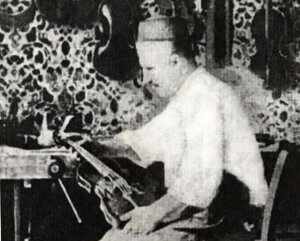
It is possible that Antonio Pelizon worked as a carpenter in Venice in his younger years and later returned to Gorizia. There, his name appears in documents in which he listed his profession as “marangone”. This is a typical Venetian term for a carpenter, usually someone who worked as a shipwright in the Venice Arsenal. In Gorizia, he joined the woodworkers’ guild. Later, he referred to himself as a violin maker. Mario Ranieri Cossàr, who has studied the work of the Pelizon family, believes that Antonio Pelizon was self-taught in the art of violin making and, early in his career, built his violins based on the instruments that traveling musicians brought with them. There was no direct Venetian influence.
In terms of music, Gorizia was a melting pot. It had been part of the Habsburg Monarchy for two centuries, located just outside the Republic of Venice, on the border of what is now Slovenia. Under the Habsburg Empire, Gorizia’s population had grown from 2,000 to about 10,000 by 1800.
The Habsburg Austrians, with their refined Viennese musical culture, regarded Gorizia as a buffer against Venice. In their eyes, Venice was dilapidated, decadent, and a shadow of its former self. However, that did not prevent music from Venice from finding its way there. Although located within the Habsburg Empire, Gorizia lay within the sphere of influence of Venetian culture. In the “Sala della Musica” of the Castello di Gorizia, musical performances were given by traveling troupes, including those from Venice. These were, however, by invitation only. In addition, Gorizia had four other venues where musical events were organized.
Antonio Pelizon, who came from a prominent family himself, fit right in in the city. The wealthier residents of Gorizia—or those who had a country home there—were often accomplished amateur musicians themselves and played in string quartets and chamber ensembles. Before Antonio went to Gorizia, there were few public concerts; music was a private affair. It wasn’t until the mid-1890s that the city got its own orchestra and concerts became accessible to everyone.
‘Gorizia was under Venetian influence,except when it came to violin making’
In Gorizia, Antonio Pelizon heard motets, masses, and psalms by Austrian composers, but those by Claudio Monteverdi and Giovanni Gabrieli were also increasingly performed there. And the traveling musical troupes also brought their secular music. The programs regularly featured string quartets by Beethoven and Haydn. Venetian “opera buffa,” chamber music, and songs from the Commedia dell’arte were well-known and beloved in Gorizia.
It was one of the few cities in Italy to have a synagogue within its city walls. It had a large Jewish community from early on, with ties throughout Europe. The Jews lived in the San Giovanni neighborhood. Unlike elsewhere, they were permitted to own property here. The community was crucial to the local economy, particularly in trade and banking.
Halfway through Pelizon’s life, Gorizia began to experience increasing musical influence from the East. Slovenian nationalism was on the rise; music teachers from Ljubljana organized concerts in Gorizia and taught music there. Around 1825, the city developed into a center for Slovenian culture. The only thing in short supply was violinists; they were mostly in Venice, which was flourishing once again under the Habsburgs.
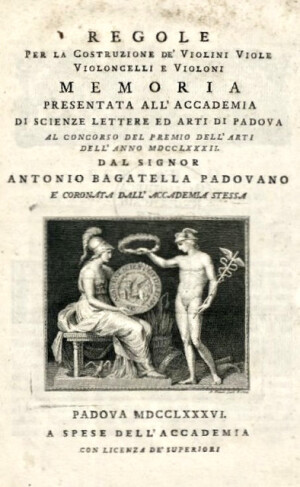
Stefano Pio, who has researched the culture of violin making in and around Venice, observes an increase in the number of violin makers in the nineteenth century in the area surrounding Venice, which he also includes Gorizia and Trieste. This was the result of the resurgence of secular musical culture in the city. The Venetian violin makers’ guild limited the number of workshops to protect the market from overproduction. Outside the city, these rules did not apply, allowing violin making to flourish in the wider region. This was made possible in part because many violin makers gained access to Antonio Bagatella’s book *Regole per la costruzione de’ violini viole violoncelli e violoni*. In it, he described the “forgotten rules” of the old masters, such as the Amati family.
He provided geometric ratios and measurements for curves and proportions, so that violin makers no longer had to rely on their eyes. Bagatelle had received an award from the University of Padua for his treatise. The first printed edition appeared in 1786 and consisted of several hundred copies. These were quickly copied and distributed. Given the work of the fledgling Antonio Pelizon, he was not yet familiar with the book at that time. It is possible that he used it later. He was self-taught, and this work was circulating in his circle.
Around the time Antonio turned thirty-five, one of the most momentous events of his career began. In 1797, Napoleon invaded Venice and put an end to the sovereignty of the Republic of Venice. Nine chaotic years followed, marked by drastic and destructive changes. Napoleon plundered Venice on a massive scale, demolished parts of the city, and banned trade with England. Venice fell into poverty. The Arsenal was dismantled in 1805, and the fleet was completely destroyed. The port came to a virtual standstill. Exporting stringed instruments to England—where high prices were paid for Italian instruments—had become impossible. In 1815, Napoleon exchanged Venice for other territories with the Austrian monarchy and ceded the entire former republic to them that year.
The heyday of Venetian violin making was over. The Austrians invested in infrastructure and education and made Venice part of the monarchy. Thanks to the free trade they facilitated, the instruments made by Antonio Pelizon—and later those made by his sons—found their way via Trieste, and sometimes via Venice again, to musicians beyond the country’s borders.
Even while Antonio was still alive, the Venetians revolted. In March 1848, they forced the Austrian troops to withdraw. Austria launched a counteroffensive. The city was besieged for a year and a half and ravaged by cholera. Two months later, order was restored. Antonio built his last instrument in 1850. It was a cello that is now considered one of his finest. Antonio Pelizon lived to be 87 years old.
In 1799, Antonio Pelizon married, and a year later he had his first son: Giuseppe Francesco (1800–1874), followed by fifteen more children, including Antonio Vincenzo Giuseppe (Antonio II, 1809–1861), Carlo (1811–1891), and Filippo (1817–1897), all four of whom he trained to become violin makers.
After his sons began working in his workshop, a division of labor presumably emerged in which each son made a specific part of an instrument. This was unlike the practice in Cremona, where a single violin maker built a single instrument. Stefano Pio had discovered this during his research into the workshops of violin makers in Venice. That division of labor and tasks had originated there and become common practice throughout the region. Mario Ranieri Cossàr also cites this as an explanation for the variations in the quality of workmanship visible on parts of the later instruments. Pelizon’s four sons succeeded him after his death in 1850, but mainly in the business side of things; none of them achieved the level of craftsmanship their father had.
Together with his sons, Antonio Pelizon was a prolific maker of violins, violas, cellos, and a few double basses. These instruments likely found their way to musicians elsewhere in Europe via trade routes through Trieste and Venice.
Thanks in part to the five Pelizon violin makers, a musical culture has flourished in Gorizia, where international violin competitions are still held today.
In Gorizia and the surrounding area, the tonewood used to make the tops of the violin family was readily available. For other types of wood, such as maple, Antonio Pelizon had to rely on what grew further away in the Balkans or the Alps. It seemed that the supply of these materials was inconsistent. Significant differences in the quality of the materials used can be seen throughout his body of work. He sometimes processed the wood imperfectly, resulting in joints between the top pieces that were not always perfectly tight. Nevertheless, the sound of his instruments was considered exceptionally good, particularly that of his cellos.
Mario Ranieri Cossàr believes that Antonio had not yet developed his own style, at least in the beginning; the differences between his instruments are simply too great for that. The only similarity among the violins he built between 1805 and 1815 is that, with the exception of a single violin, they are narrow and angular, with short, rather clumsily carved corners. That gradually changed. The angularity disappeared around 1820, and his instruments began to resemble the Amati style more closely.
The f-holes are long and, especially during the period between 1800 and 1835, were carved with little refinement. It was not until around 1840 that a clear improvement became apparent, particularly in his cellos. The carving of the scrolls also varies greatly; sometimes he left tool marks visible, but there are also very refined scrolls, especially in his cellos from after 1840.
The edge inlay on his instruments often stands out sharply due to the two very black strips. He usually used golden-yellow varnish, which he applied thinly. He finished some violins and a single viola in the manner customary in Cremona, with a black border along the scroll and the pegbox. The red varnish so characteristic of Venice does not appear in his work. Experts regard him as an unpretentious maker for whom sound took precedence over form.
Between 1799 and 1805, he spelled his name Pellizon or Pelisoni, but later reverted to the original spelling: Pelizon.
Antonio Pelizon used four different labels;
a handwritten label:
-Antonio Pelizon, published in Gorizia, 18..
And three printed ones:
-Antonius Pelizon, Gorizia, 18..
Anthony made it for Pelison in Gorizia on the 18th.
Antonius Pilizon made Goritias 18.
Pio S., (2019),Violin Makers and Players, Venice 1750 -1870, Venetie.
Bozzi P, (1997) Rodolfo Lipizer, Rome
Cossàr, M.R., (1939) Vecchia liuteria goriziana, Ancient Luthier’s Craft in Gorizia, The Pelizon Family, Cremona.
De Bonfils, M. (2012), *Vademecum del Violinista*, Bari
Vannes, R. (1999) Universal Dictionary of Instrument Makers, Spa.
Geneanet, accessed in 2023
Cozio Archive, Tarizio, accessed 2023