Instrument

violin
Francesco Ruggeri
Cremona,
± 1680
played by
Marta Florit García
Marta Florit García
*± 1630 , Cremona †1698 , Cremona
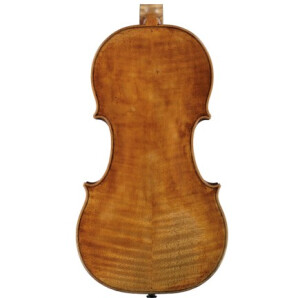
There is a document from 1685 that indicates that Francesco Ruggeri was a skilled violin maker, though his work had not yet been fully appreciated. It was written by the violinist and maestro di cappella Tomaso Vitali, who submitted a request to his employer, the Duke of Modena, for reimbursement of the amount he had spent on the purchase of a violin by Nicolò Amati.
Upon closer inspection, it turned out that the instrument had been made by Francesco Ruggeri. However, the Ruggeri was worth no more than a quarter of what Vitali had paid for it. The fact that Vitali—who was an exceptionally experienced and virtuoso violinist—had accepted the instrument as an Amati illustrates that Ruggeri was a skilled luthier. Nicolò Amati had reached a level of craftsmanship that was rarely matched in his time. Only Antonio Stradivari would later surpass this level. Vitali wanted only financial compensation; he kept the Ruggeri.
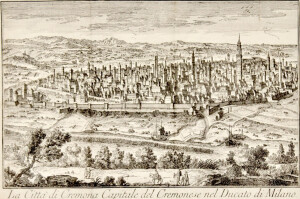
Cremona, engraving by Tommaso Salmon, circa 1750
Cremona was situated at a crossroads of borders and roads that formed a vast network connecting the Far East with the West, and Northern Europe with Turkey. There was a lively trade in specialized tools, instruments, wood, oil, minerals, dyes, glues, leather, books, and precious metals. Cremona thrived on trade. But in addition, news, stories, and music from all corners of the world were exchanged there. This included knowledge about musical instruments from the most important regions in Europe. The fact that Cremona lay on the border of a territory disputed by various rulers sometimes led to outbreaks of violence and brought daily life to a brief standstill.
The epidemic had a devastating impact on Francesco’s hometown
Trade routes made cities vulnerable. When the plague broke out in Northern Europe in 1630, the epidemic struck hard within the walls of Cremona. As a result, residents were often forced to move just outside the city. It is believed that the Ruggeri family also moved to a safer place than the city center, as Francesco was born around 1630 in the parish of San Bernardo, just outside the city walls. There are only two documents regarding Francesco Ruggeri’s life: his marriage certificate and his death certificate. A birth certificate has never been found. Given the age at which Francesco Ruggeri married in 1652, he must have been born around the time the plague had just broken out.
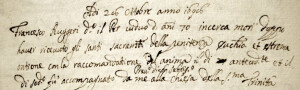
Death certificate of Francesco Ruggeri, October 28, 1698 (note: the number 8 is written differently—it is rotated a quarter turn). Photo courtesy of Carlo Chiesa.
The epidemic had a devastating impact on Francesco’s hometown. The disease, spread by traveling soldiers and merchants, took a heavy toll on the population. It is estimated that about three-quarters of Cremona’s inhabitants died as a result of the plague and the ensuing famine. Rioting, underpaid soldiers from rival factions who were marching through the region not only spread the disease but also looted and destroyed everything in their path.
Girolamo (II) Amati's possessions were looted and burned
Violin making in Cremona suffered a severe blow. The supply of materials stagnated, workers fell ill or died, and demand for instruments declined. Violin makers such as Girolamo II Amati and Nicolò Amati lost family members or were themselves struck by the disease. Girolamo (II) Amati’s possessions were looted and burned. Brescia, which was already an established center for violin making, was presumably hit the hardest. Violin making there came to an abrupt halt.

Nicolò Amati by Jacques-Joseph Lecurieux
Once the epidemic was over, most Cremonese violin makers struggled to keep their businesses afloat. Although Brescia was no longer a competitive market, the effects of the plague lingered for a long time, and most musicians were not immediately interested in expensive violins. It was not until 1641 that a recovery became noticeable in Italy, and orders for instruments began to come in again from Nicolò Amati. He ran an impressive violin-making business that had been in the family for generations and supplied instruments to courts, collectors, and musicians throughout Europe.
Among violin makers, Nicolò Amati also had a reputation as an outstanding teacher. Students came to Cremona from far beyond the region’s borders and stayed with him for shorter or longer periods. He took on apprentices from outside his family, including, most likely, Antonio Stradivari, Andrea Guarneri, and Francesco Ruggeri, who was about the same age. Under his guidance, they built instruments, not under the Amati name, but “Sub Discipline Nicolai Amati, in eius officina Cremonae”—as did Francesco Ruggeri.
The marriage between Francesco Ruggeri and Ippolita Ravasi took place in 1652 at the San Bernardo parish in Cremona. It was located in the neighborhood just outside the city walls. Once married, Francesco likely moved to the city center, where he had a workshop on Contrada Coltellai, practically next door to the Amati and Guarneri families, with Stradivari’s house just around the corner.
Being banished from the city was considered a severe punishment, one that often ended tragically
Some researchers, including Carlo Chiesa, believe—based on the fact that no documents exist proving his residency—that Francesco did in fact continue to live outside the city after his marriage. Others, including Graham Hargrave, make a compelling case that he lived within the city walls. This is because, apart from the monasteries that were also located just outside Cremona, the area outside the city walls was downright unsafe. Bandits and robbers preyed on anyone who was not under the city’s legal protection. Being banished from the city was considered a severe punishment, one that often ended tragically.
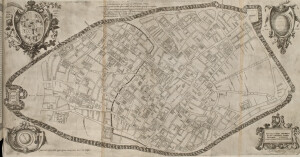
Cremona within the city walls, late 16th century
Given the danger, it is not very likely that Francesco would have chosen to live and work outside the city walls with his family. Violin makers such as Amati and Ruggeri belonged to the upper class, and it was precisely they who sought safety within the city walls. It is possible, however, that Francesco did maintain a small workshop outside the city walls, since the drying of the varnishes used by violin makers was not permitted within the city walls due to the fire hazard. Most of the houses in the city itself were still made of wood.
The relationship between Nicolò Amati and the younger Francesco was so close that Nicolò agreed to be the godfather of his son Giacinto, born in 1658, who, incidentally, would die at a young age. Francesco Ruggeri had four more sons, all of whom would become violin makers: Giovanni Battista, born in 1653; Giacinto, born in 1661; Vincenzo, born in 1663; and Carlo, the youngest, who was born in 1666.
From 1656 to 1659, Francesco presumably worked for Nicolò Amati. The expert W.E. Hill sees the unmistakable hand of Francesco Ruggeri in some of Amati’s instruments, such as a violin by Nicolò Amati from 1658. No instruments bearing a Ruggeri label from that period have been found. The first such labels did not appear until 1660. Most of Amati’s apprentices lived in his home, and lists of them were kept there almost every year. The list of associates from the years 1656 through 1659 is missing, but Andrea Guarneri, who lived next door to him, must have been one of them, as was Francesco Ruggeri. He, too, lived too close by to have been a resident apprentice. The number of instruments made by Nicolò during these years suggests that the workshop was operating at full capacity.
(...) significant similarities between the early instruments of Antonio Stradivari and those of Francesco Ruggeri (...)
Carlo Chiesa, who conducted extensive research on the 17th-century Cremonese violin makers, hypothesizes that Francesco Ruggeri began working independently in 1659 and that, as early as the 1660s, the output of his workshop increased, and that he had at least one—but likely more—assistants and apprentices. Based on several significant similarities between the early instruments of Antonio Stradivari and those of Francesco Ruggeri, Chiesa, like most other experts, that it is undeniable that Stradivari, who had initially begun his apprenticeship with Nicolò Amati, further honed his craft under Francesco Ruggeri and thus contributed to the production at Ruggeri’s workshop. The earliest known violin by Antonio Stradivari dates from 1666. On it, he writes that he was a student of Amati (Alumnus Nicolai Amati). However, the violin bearing this label does not resemble an Amati at all; rather, it bears a much closer resemblance to the work of Francesco Ruggeri.
From the mid-1970s through the late 1980s, production at Ruggeri’s workshop continued to increase. Stradivari was an established luthier who sold expensive instruments, as was Nicolò Amati. The demand for high-quality instruments that were not as expensive as those made by Amati and Stradivari grew, and it was precisely these instruments that Francesco Ruggeri built. His first cellos also appeared during this period.
Although the families were competitors, the relationship between the Ruggeris and the Amatis remained good even during that period. In 1689, Girolamo Amati II, Nicolò’s son, became the godfather of Francesco’s grandson.
From the moment Francesco’s sons were old enough, they helped out in the workshop. All instruments that left the workshop bore Francesco’s label. There are no instruments that Giacinto and Carlo later built under their own names and with their own labels, and instruments by Giovanni Battista are rare. Francesco was referred to in documents as “il Per” or “detto il Per.” This suffix meant “the stick” or “the tall one,” and he always included it on his labels. It is believed that he wanted to distinguish himself from violin makers with the same name in Brescia. For the same reason, he sometimes varied the spelling of his name and had the alternative spellings Rugeri, Ruger, or Rugier printed on his label.
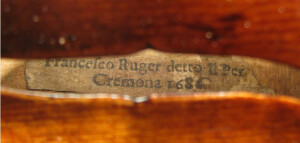
Francesco Ruger, known as "il Per." Photo courtesy of Carlo Chiesa
Starting in 1677, the Ruggeri family came to play an important role in Cremona as the number of their workshops grew. Giovanni Battista set up his own workshop in the city center and got married that same year. Francesco’s other son, Vincenzo, continued to work for Francesco until 1689, but followed his brother around 1689 to establish himself practically right next to him. He built mainly violins, as well as a few violas and cellos. It was not uncommon for his work to be attributed to his father later on. Documents show that Vincenzo became quite prosperous. He was also a close friend of Carlo Bergonzi, whom he presumably mentored. Finally, Giacinto also married. In 1692, he too settled in the city center, again not far from his brothers.
Giacinto died young. In 1697, the year of Giacinto’s death, Francesco had his will drawn up. In it, he stipulated that he would leave everything to Carlo, who was the only one who had continued to work for him.

Cello by F. Ruggeri, ca. 1680, from the Dextra Musica collection of the Norwegian DNB Savings Bank Foundation
Francesco built violins, violas, and a single double bass, but he is best known for his cellos. He built two types of cellos in different sizes, tailored to different musical styles. The larger ones were popular for the sacred repertoire, while the smaller models were mainly used for secular music. He experimented with the smaller cello models, which were new for that time. Stradivari and Andrea Guarneri continued to adhere to the standard large cello design for a long time. This small model by Ruggeri is still in use today. In his day, it was revolutionary because he made instruments that were about 10 centimeters shorter than those of other makers in Cremona. This smaller size was appreciated by musicians, presumably because it offered more freedom of movement and ease of use.
All of his instruments feature an elegant design, with short, wide, and sharply carved f-holes. The black strips of the edge inlay are wider than the center strip. His varnish ranges from deep orange to bright, transparent yellow-orange. Although Francesco generally used maple for the back and sides, he sometimes used poplar as well.
He used different labels
- Francesco Rugier (sometimes Ruger or Rugeri), known as "il Per," in Cremona, 1659
- Francesco Ruggeri, known as "il Per," Cremona, 1671
Around 1660, he sometimes added the following text to a label:
- Student of Niccolò Amati
Francis Rugerius, a pupil of Nicholas Amati, made it in Cremona.
The similarity between Amati’s and Ruggeri’s instruments led to several of Ruggeri’s instruments being sold over time as Nicolò Amati instruments. The connoisseur and collector Count Cozio di Salabue, who had purchased part of Stradivari’s inventory, also owned a cello by Francesco Ruggeri, as did another collector, the Marquis Castiglioni. Both collected only the finest instruments of their time.
Powers, W., 2000, Violin Makers: Nicolò Amati (1596–1684) and Antonio Stradivari (1644–1737). In Heilbrunn Timeline of Art History. New York
Hargrave, R., 2009, The Amati Method, Three articles about the Amati family
From the Archive: a violin by Nicolò Amati, Cremona, 1660-70”, The Strad, 2018
Kass, P. J., The Stati D'Anime of S. Faustino in Cremona: Tracing the Amati Family 1641-1686
Tarisio archive: Chiesa, C.,The Ruggeri family of violinmakers
Thöne, J., 2020, Italian & French Violin Makers, Köln
Hamma, W., 1969, Masters of Italian Violin Making, Stuttgart
Smithsonian Institution. 2016, "Violin Makers of the Ruggeri Family".
