Instrument
violin bow
Eugène Eberle
Rotterdam
played by
Sanne Lam
Sanne Lam

*1885 , Rotterdam †1936 , Rotterdam
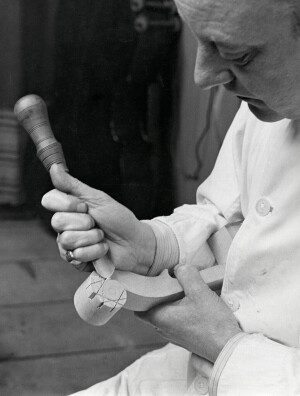
At the age of 10, Eugène began his career as a violin maker. He became an apprentice to Karoly Ferenczy Tomasowski in Rotterdam. To complete his training, he briefly traveled to visit several German violin makers. This journey ended with the man from whom he would learn more than from any of the others: Otto Möckel. Otto Möckel was one of Berlin’s leading luthiers and an expert on old master violins. He worked and studied in Möckel’s workshop for nearly three years. When he returned to the Netherlands, he worked briefly with Karel Van der Meer in Amsterdam. There he encountered a fascinating, international group of violin makers and several skilled bow makers. From them, he learned how to craft cello bows, several of which he would later make to a high standard.
After all those years of traveling, he wanted to settle down on his own. In 1904, he moved to his hometown of Rotterdam. There, toward the end of that year, he opened his own workshop and shop. In 1915, he had a son, Eugène. His son Eugène also became a violin maker and received a significant part of his training from the same luthier from whom his father had learned so much: Otto Möckel in Berlin. In 1936, Eugène I died in the city where he had worked for over thirty years. After his father’s death, his son Eugène II took over the workshop.
His father’s love for the cello was passed on to Eugène I. He built many fine cellos that are renowned for their beautiful tone. His mother had been a violinist with small hands. It is noteworthy that, in addition to copies of works by the great masters, Eugène crafted violins based on his own designs that were particularly well-suited for players with small hands. Another remarkable instrument, of which he built several after 1932, was a violin with the shoulders of a viola d’amore. He received gold medals for the two quartets he submitted to the exhibitions in Rotterdam and Milan. For most of his career, he used a golden-yellow varnish.
Henri Viotta, Lexicon of Music, Volume I, 1881; Eduard A. Melchior: Dictionary of Music; 1890. Edited by Giskes J. and Hooijen E., (2000), 400 Years of Violin Making in the Netherlands, Zutphen.
Vannes, R., (1999), Universal Dictionary of Instrument Makers, Spa.
J.H. Letzer: Musical Netherlands 1850–1910. A Bio-Bibliographical Dictionary of Dutch Composers—Utrecht: 1913.
Illustrated Music Lexicon, edited by Mr. G. Keller and Philip Kruseman, 1932. The Hague. J. Robijns and Miep Zijlstra, General Music Encyclopedia, Vol. 3, 1980, Amsterdam.
Tarisio; Cozio Archive, accessed in 2019. Amati; Makers’ Archive, accessed in 2019.