Talent

Stichting MuziekHaven
plays a
grand piano
from Steinway & Sons
from Steinway & Sons
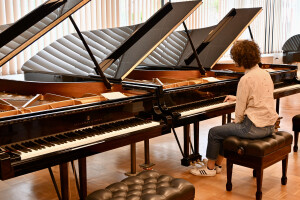
The Musical Instrument Fund traveled to Hamburg with pianists, experts, and advisors to try out six brand-new Steinway D concert grand pianos. Which of the six will find a home at the MuziekHaven in Zaandam and become the first Steinway D in the collection? Katrien, a collection assistant, wrote a report on the visit.
With their jet-black tops, six majestic concert grand pianos beckon us into the selection room. “This is heaven!” whispers one of the musicians. The Musical Instrument Fund, together with experts and advisors, has three hours to thoroughly examine six brand-new Steinway D grand pianos to determine which one will be the best fit for the MuziekHaven in Zaandam. It will be the first Steinway D in the collection.
For this exciting lineup, Frits Schutte, head of collections, can count on a team of experts. Frits: “Nathalia Milstein and Omri Epstein will be joining us, and we’re very happy about that. Two top pianists who know the MuziekHaven venue well.” Mathieu van Bellen is also on board: violinist and founder of the MuziekHaven. As an avid chamber musician, he is, above all, a very valuable listener. And we asked two grand piano experts to serve as advisors: Steinway connoisseur Emil van Stormbroek of Maene Piano’s and grand piano expert Frank Bonarius of Andriessen Piano’s.”
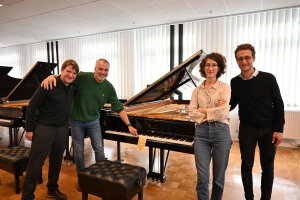
We are now on sacred ground: at the Steinway & Sons factory in Hamburg. This is where the world’s finest grand pianos are made. We’ll be searching here for a grand piano with a character suited to chamber music and tonal qualities that complement the acoustics of the MuziekHaven’s wooden church. Mathieu van Bellen: “We’re looking for a true all-rounder, a multifunctional instrument suitable for various musical styles. The timbres are the most important factor. Even when played softly, the grand piano must continue to sing beautifully. The MuziekHaven isn’t that large, so we don’t necessarily need a powerhouse.”
On the train to Hamburg, we discussed at length what the best approach to the selection process would be. Once we arrived at Steinway, we fine-tuned the plan a bit after consulting with the grand piano experts. We’ll start with a blind test. Both pianists will have time—independently of one another and entirely on their own—to familiarize themselves with the grand pianos. Frits: “It’s important that they can form their own opinions autonomously and not influence each other.” After a warm welcome from Jörg Helmke of Steinway, Omri and Nathalia take turns entering the hall, while the others wait impatiently and somewhat nervously behind, enjoying coffee and pastries.
Three quarters of an hour later, the rest of the team is allowed into the audition room. Once again, the pianists take their time playing the grand pianos. They hop from stool to stool. Lyrical Franck, expressive Rachmaninoff, delicate Mendelssohn—the bass range, the high register, the entire keyboard chromatically...
In deep concentration, with the occasional meaningful glance or sigh. The rule still stands: no comments, no discussion among themselves.
Only after this second round do the pianists share their experiences. Omri pays particular attention to the grand piano’s response—what the piano gives back to him and whether the instrument challenges him to explore it further. For Nathalie, what matters is which instrument requires the least “effort” on her part to achieve what she’s looking for. She also looks for an instrument that best suits an acoustic space with plenty of “room.” Their preferences turn out to be quite different. Their top three includes one instrument they both agree on. Mathieu: “I knew in advance that Nathalie and Omri would have very different perspectives on this. That leads to all sorts of interesting discussions, and that’s a good thing, because the grand piano will eventually be used by multiple pianists and in various styles.”
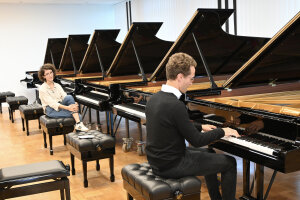
Everyone quickly agrees on two grand pianos: numbers 2 and 3 are out. One doesn’t seem to come loose completely, and the other is clearly an instrument meant for a truly large concert hall. Jörg demonstratively closes the keyboard lids. Four grand pianos remain in the running... We decide to move grand piano 1, which is standing against the wall, further into the room so we can compare the sound more fairly. Mathieu sits down next to the grand pianos, in the spot he would occupy as a violinist in his trio, listens attentively, and takes notes. As Omri and Nathalia search for words to describe what they’re experiencing, Frank Bonarius invites them to explain it while playing. That works well, especially since Mathieu is then able to summarize the nuances very effectively. The contours are already becoming a bit clearer.
Wings 5 and 1 stand out as favorites. Both have a beautiful tone, respond well to the pianist’s input, and offer a lovely, full bass range and clarity in the high notes. Grand Piano 5 is slightly more subdued, while Grand Piano 1 is natural, spacious, and a bit more extroverted. Perhaps too extroverted for the MuziekHaven concert hall? However, experts Emil and Frank indicate that this can easily be adjusted. Frank: “You can tame a grand piano, but boosting it is harder.” So, in the end, the choice unanimously falls on number 1. The instrument offers the most possibilities. You can really go all out, but the grand can also sound very intimate and continues to sing beautifully when played softly. Mathieu and the pianists are beaming; Frits is very happy with the choice, and the experts are fully behind it as well.
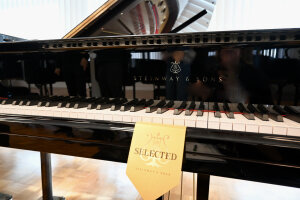
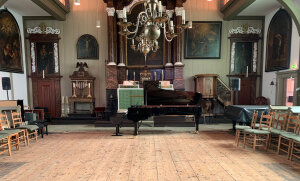
Are you curious? You can find the upcoming concerts on the MuziekHaven website. And musicians: the concert grand piano is usually in the rehearsal room, so take this opportunity and sign up!
Purchase by the Musical Instrument Fund
With the MuziekHaven in Zaandam, violinists Mathieu van Bellen and Maria Milstein have found a home base where musicians can devote themselves fully to (chamber) music. The numerous concerts featuring top pianists and radio recordings call for a truly top-tier grand piano. The Musical Instrument Fund, along with experts and advisors, recognized the need to add a Steinway D (274 cm) to the collection and thereby support the MuziekHaven. The purchase was made possible by all of the fund’s benefactors.