Talent

Carla Leurs
plays a
violin
from Giovanni Battista Guadagnini
from Giovanni Battista Guadagnini

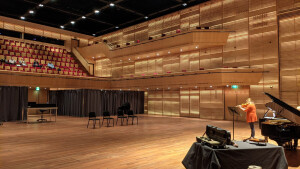
At the end of the exciting sound test the other day at “De MuziekHaven” in Zaandam, Carla Leurs dared to conclude: “The Guadagnini violin possesses the tonal qualities I’ve been searching for for a long time.” “Just wrap it up and put a bow on it,” you might say, but we’re not quite there yet...
The violin had proven its qualities in a smaller hall, but could Carla be sure that the Guadagnini would be able to convey the full range of tones she heard in her mind’s ear all the way to the back of a large concert hall? She still had her doubts on this point. Due to the pandemic, all performances in large venues had been canceled, so she hadn’t yet had the opportunity to test this in her own concert practice.
The task for the Musical Instrument Fund was therefore to organize the ultimate sound test in a concert hall that, even without an audience, could provide a realistic picture of a violin’s projection. The main hall of Het Muziekgebouw aan ’t IJ is the ideal venue for such a litmus test, and fortunately, it was available. We also managed to assemble a panel of highly trained listeners who could provide professional feedback.
Then the moment arrives. On the empty stage at the Muziekgebouw, the Steinway-D—which has just been tuned—awaits. Carla, violinist Maria Milstein, pianist Daniël Kramer, and the entire audience emerge from the wings and take the stage in hushed tones, struck by the emptiness and silence of the enormous hall. Frits Schutte, head of collections at the Musical Instrument Fund, briefly introduces the sound test: Carla and Maria will take turns performing a set of three short excerpts from various compositions on both Maria’s Bergonzi and Carla’s Guadagnini. The violins will remain anonymous, referred to as Violin 1 and Violin 2. The listeners are not permitted to exchange their observations with one another until the evaluation following the sessions.
The group quietly spreads out across the room. Most of the listeners choose the balcony; others take seats in the back of the main hall. They can make notes on a special form for each instrument, performer, and excerpt. There’s a certain tension in the air...
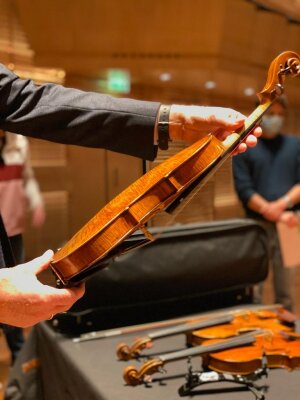
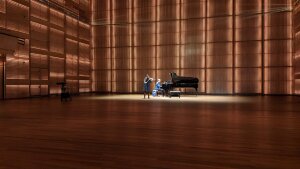
On the powerful Steinway, Daniel breaks the silence with the opening measures of Tchaikovsky’s Violin Concerto. Carla lets first violin resonate throughout the hall. The excerpts have been carefully chosen to showcase the violins in various guises: proud as a solo voice in Tchaikovsky, almost fragile in a delicate Andante by Bach, and compelling in an exciting dialogue with the Steinway concert grand piano in César Franck’s Violin Sonata.
After 20 minutes, Maria takes over. It's amazing to hear how these two wonderful violinists can play with such conviction—not only on their own instruments, but also on instruments they've never played before.
After a timid round of applause, everyone gathers downstairs in the hall to share their findings with one another in a large circle. One by one, the audience members are given the floor. A few know right from the start which instrument was being played, but most can only guess which was number 1 and which was number 2. And they’re not always right. Carla made it even more difficult by switching numbers 1 and 2 around between the different pieces. She admits that she, too, had a moment of doubt when Maria played both violins. The “blind” listening clearly contributes to an unbiased experience of the sound qualities of both instruments.
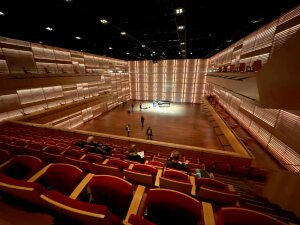
Even though everyone puts it into words in their own way, we agree that we listened to two beautiful instruments with distinctive characters. One of the listeners summed it up nicely: one violin (Bergonzi) leans more toward the bright end of the spectrum, while the other (Guadagnini) leans more toward the “dark or warm” end; both are of very high quality, but each has its own distinct tone. At the same time, the violins prove to be sufficiently “flexible” to produce “the player’s sound.” The listeners were therefore able to perceive more difference between the two players than between the two instruments.
In short, the Guadagnini passed this test with flying colors. Carla’s only doubt has been dispelled. And for the Musical Instrument Fund, this day proved decisive in confirming that the Guadagnini would be an enormous asset to the collection. If the foundation can raise the substantial amount required for this purchase, we will be able to loan Carla an instrument that will serve as a fantastic source of inspiration as she continues to develop her career as a violin soloist.
About GuadagniniGiovanni Battista Guadagnini
1711–1786Read here about the erratic life and eccentricity of Guadagnini, who is considered one of the greatest violin makers of his time.

