Instrument

violin
Giovanni Battista Guadagnini
Parma,
± 1764
played by
Ionel Manciu
Ionel Manciu

*1711 , Bilegno †1786 , Turijn
Guadagnini was born in Bilegno, just southeast of Milan. His father was an innkeeper there who, presumably to supplement his meager wages, sold bread, worked briefly as a butcher, and also built violins. He claimed to have been a student of Stradivari, but that was merely a figure of speech or bragging. He was, however, so skilled at making stringed instruments that Guadagnini would continue to call himself his pupil for a long time to come.
In 1738, Giovanni Battista moved to the nearby, bustling city of Piacenza. At that time, he was the only violin maker there and was able to make a living from his work. Two years later, his father joined him there. Guadagnini’s earliest instruments date from around 1740, shortly after his father had joined him in Piacenza. In Piacenza, Guadagnini built violins for nine years and developed a highly personal style early on. Rosengard (1999) believes that Guadagnini was largely self-taught and developed his craft in the early years with the help and guidance of violinists and cellists. In Piacenza, there were certainly at least six with whom he had contact.
One of them was the young Carlo Ferrari (1730–1789), who was born in Piacenza. Ferrari was no small figure; he was one of the most important Italian cello virtuosos, a composer, and an innovator who introduced the thumb position for the cello. It is almost certain that, with Ferrari’s help, Guadagnini developed a cello model that was very successful—slightly smaller than Stradivari’s, but wider and deeper. The collaboration between the two was so successful that they would remain neighbors for years.
Piacenza was located in a region where armies had constantly fought each other for power. When Guadagnini was 35 years old, the city and the surrounding area were ravaged once again—this time by marauding French soldiers who had deserted after the Battle of Piacenza. The two rival occupying armies had suffered more than 17,000 wounded and 6,000 dead. Guadagnini continued to work for several more years in “the crumbling city,” as Piacenza was popularly known, but there was ample reason to look for a safer place. After the fighting ended in 1749, Guadagnini left for Milan. There, he rejoined Carlo Ferrari, who had gone ahead of him a few months earlier.
Maria Theresa of Austria, the new ruler of the region, offered her Milanese subjects security, granted them a great deal of freedom, and even encouraged cultural life in the city. Music flourished once again in Milan; hundreds of concerts took place each year. Whereas musical performances had previously been the preserve of the Milanese aristocracy, the first half of the century saw an avalanche of compositions written that also appealed to a broad segment of the population. At public festivals, chamber music, opera, and symphonic music were featured equally. As a result, the demand for string instruments increased noticeably.
Milan was by far the largest city where Guadagnini would work during his career. In the mid-17th century, it had been home to a vibrant community of violin makers, including notable makers such as the Grancino father and son, the Testores, and the Lavazzas; but by the time Guadagnini arrived, the violin-making tradition had degenerated into a trade in cheap, inferior instruments, made by violin makers whom Hill referred to in 1901 as “Cheap Jacks.”
Guadagnini settled in the city center. Thanks to his friendship with Carlo Ferrari, who had good connections among the more affluent Milanese, his clientele soon came from those circles. He built instruments for the more accomplished, often wealthy amateur musicians who could afford them. The new Teatro alla Scala and the Academy of Fine Arts, which was affiliated with a large conservatory, attracted many musicians to Milan. His instruments also proved very popular among this group of musicians. Guadagnini built more than a hundred violins and six cellos in Milan.
For his instruments, he chose beautifully figured wood and finished them with a stunning orange-red varnish. They resembled neither the old Milanese style nor that of the Cremonese, but were highly distinctive. Amid the run-of-the-mill local instruments, his instruments were undoubtedly remarkable. His violin model from that period was wide and had a powerful tone. Many instruments from his Milanese period have become known by the names of their later players, such as the “Berkova.” “Gerardy,” “Teschenmacher,” “Rauer,” “Kubelik,” “Arma Senkrah,” “ex-Rothschild,” “Vieuxtemps,” and “Ysaÿe” . The violin dates from that period; in 1948, Hill wrote to Max Möller in Amsterdam describing it as one of the finest examples he had ever seen.
In 1758, Ferrari left for Paris, and Guadagnini went to Cremona for just under a year. For such a short period, he was not required to register in the city registry. Initially, this was doubted due to a lack of written evidence, but given that the two cities were close to each other and the distance between Piacenza and Cremona could be covered by road in just over a day or easily reached by boat across the Po River, most experts now consider this plausible. There are twelve violins with a label indicating that he built them in Cremona.
Ferrari had enjoyed great success in Paris and, in 1758, was asked by the Duke of Bourbon to work for him as a performing musician and composer in Parma. Guadagnini rejoined Ferrari at the end of that year. There, at Ferrari’s recommendation, the duke invited him to begin building instruments for the musicians at his court. Guadagnini was a simple, somewhat rough man who did not move easily in aristocratic circles, but on the label of the instruments he built in Parma, he was permitted to have the monogram CSR (““Celsitude Serenissima Realis”—which is the Duke’s title).
In Parma, the text on his labels began with “Cremonensis,” indicating Cremona as his supposed city of origin, rather than “Piacentius,” as had been the case in Piacenza and Milan. For his instruments, he presumably no longer had access to the finest wood that had been available to him in Milan. He built them from wood from the Po Valley, which has a less attractive grain than that from the highlands. His varnish during this period was also not the finest he used throughout his career. In general, Guadagnini’s instruments are less impressive than those from his Milanese period. In terms of sound, however, they are not much inferior to the instruments from his Milanese era.
Due to the death of his patron, the Duke of Bourbon—but perhaps also out of dissatisfaction with his ability to obtain better materials—he wanted to leave the Duchy of Parma. He requested and received a stipend to find another position, was excused from his duties to facilitate the move, and left for Turin in 1770.
His work improved almost immediately. As early as 1772, he built his first violin from vividly flamed wood and had apparently been able to obtain the materials needed to finish it with a beautiful varnish. That marked the beginning of his Turin-built instruments, which are considered among the finest he ever crafted during his career.
Of inestimable importance was his connection with the aristocratic Count Ignacio Cozio di Salabue, an obsessive collector and connoisseur in whose notes historians later found an unparalleled wealth of information about Italian violin making—including information about Guadagnini.
Guadagnini had met him in 1772, and both regularly traded in old and new instruments. Cozio di Salabue was so impressed by Guadagnini that he asked him to come work for him. Economic conditions were poor, and Di Salabue had a virtually inexhaustible fortune. In 1773, the two signed a contract obligating Guadagnini to build exclusively for Di Salabue. He produced 54 violins and three cellos—an enormous output for the three years and nine months he was in his service.
Drawing on Guadagnini’s knowledge and experience, Di Salabue—who was only twenty-four at the time—rapidly acquired a vast number of antique instruments. The most notable acquisition took place in 1775, when, after lengthy negotiations, he managed to secure instruments, molds, and tools from Antonio Stradivari’s estate.
It is not known to what extent Guadagnini was involved in the negotiations, but he certainly examined Di Salabue’s most important purchase. Almost immediately afterward, minor changes appeared in Guadagnini’s models. He incorporated elements from Stradivari that he had not used before. This resulted in instruments that rank among the most powerful in the history of violin making.
The fact that Di Salabue held Guadagnini’s instruments in high regard is evident from the fact that in 1776 he owned a collection of 85 instruments, which included not only Amatis and Stradivarius but also 29 instruments by Guadagnini. However, the erudite Di Salabue and the not-so-subtle Guadagnini frequently clashed. A letter he wrote to Alessandro Maggi in 1804 reveals his opinion of Guadagnini: “because he was a man without an education, a materialist, stubborn, impatient, (…) and who, driven by ambition, wanted his instruments to still be recognizable as his own despite the work others did on them and the varnish, I could not persuade him to make imitations of other masters’ instruments for me, not even using their own molds.” After nearly four years, Di Salabue unilaterally terminated the contract with Guadagnini.
Between 1777 and his death in 1786, Guadagnini produced a large number of instruments, some of which he may have made in collaboration with his sons Giuseppe and Gaetano. Gradually, his work became less refined, and by 1780, significant variations in quality were evident.
Guadagnini was only partly as stubborn as Di Salabue had described him. Even at the age of sixty, he still “professed” his allegiance to Stradivari and called himself “alumnus Antonii Stradivari.” He adopted some of Stradivari’s key principles, but in all the instruments he built thereafter, his own powerful personality remained the dominant feature. Not a single instrument by Guadagnini is a copy of a Stradivari.
Based once again on the letters left behind by Di Salabue, who wrote that Guadagnini had “many mouths to feed,” he must have had a large family, but only three of his sons are known by name. Giuseppe, born in 1753, assisted his father between 1770 and 1780. He then went on to establish his own career as a luthier. Giuseppe died in 1805. He was the best known of the three. Gaetano Francesco Lorenzo (1750–1817) and Carlo Pietro Antonio (1768–1816) did work with their father, but their own output was extremely limited. Descendants continued the family business until 1942.
In the literature, the development of Guadagnini’s body of work is often organized according to the cities where he lived. However, there was never an abrupt transition; it usually took place more gradually. Furthermore, within such periods, there was both a certain degree of development and significant differences between them.
Even from the first instruments he built around 1740, it is clear that he already understood his craft before he came to Piacenza. His work was precise and reasonably well-finished. On his label, he stated that he was a student of his father, Lorenzo. If he did indeed learn the craft from him, it must have been in Bilegno, since his father did not arrive in Piacenza until 1740. Between 1743 and 1745, in collaboration with Lorenzo, he created a substantial model with a larger volume than his earlier ones. He used a glossy orange-red lacquer that resembled the one used in Cremona in color but not in composition. Throughout his entire time in Piacenza, he experimented extensively.
His first violins from Milan still closely resemble the last ones he built in Piacenza. After that, the curves became flatter. He maintained this style until 1758. His finish gradually became neater, and the varnish more transparent and orange-yellow. By 1758, he had already attained an exceptionally high level of craftsmanship.
Next comes a series of ten to twelve violins that, according to the label, were made in Cremona, all in 1758. They bear a strong resemblance to Guadagnini’s Milanese violins, but the varnish is a softer orange-gold yellow. The “Briggs” violin is considered one of the finest violins from his time in Cremona.
While in the service of the Duke of Bourbon in Parma, he built several small violins that were used at court for musical pieces in which, at the composer’s instruction, they had to be tuned an octave higher than usual. Gradually, the quality of the wood available to him declined. A cello from 1763 even has knots in both the top and back plates. During this period, which lasted twelve years, his instruments are characterized by locally sourced “oppio” maple, higher arches, and a browner varnish. On his label, he states that he is indebted to Cremona (Cremonensis = from Cremona), but there is little evidence of this in his work.
In Turin, he managed to get his hands on better materials. At first, he continued to build a few violins based on his Parma model, but gradually elements of Stradivari’s style began to appear in his work. This was not yet entirely of his own volition, as his employer had made it his mission to revive the “spirit” of Stradivari. To achieve this, Dilworth believed, he pressured Guadagnini to incorporate more of Stradivari’s characteristics into his style. Di Salabue noted that he had seen Guadagnini’s work improve “before my very eyes” over the course of three years, but Guadagnini retained his unmistakably unique style until the very end. He once again applied to his instruments the almost luminous red varnish that he had used to such great effect in Milan.
Around 1781, his age seems to have begun to take its toll for the first time; his instruments became more compact, less refined, and he no longer made an effort to remove his markings or visible tool marks. He returned to the essence of violin making. With the black lines he applied around the scroll and at the ends of the corners, he paid homage to Stradivari, who did the same; they serve no other purpose. In 1783, three years before his death, he built one more instrument into which he poured all his craftsmanship; it became a violin considered among the best of his Turin period. After that, his son’s influence became increasingly evident. He built his last instrument in 1786, very shortly before his death.
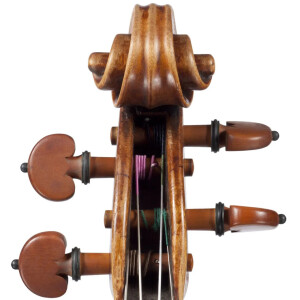
The cello in the Music Instrument Fund’s collection was built in Milan around 1750. It is a model he developed in collaboration with the cellist Ferrari, slightly smaller and deeper than was customary at the time. The Fund’s Guadagnini violin, dating from around 1764, is one of the finest instruments from his Parma period.
Kass P., 2009, Guadagnini-re-evaluated, Turijn
Blot, E., 2001, Italian Violin Making, Piedmont.
Consortio liutai & archettai, 1999, Cremona, The Life and Work of Giovanni Battista Guadagnini, Italy.
Fiori G. 1991, How a Guadagnini became a Guadagnini, Piacenza
E.N. Doring, 1949, the Guadagnini family of violinmakers, Chicago
Vannes, R. 1972, Universal Dictionary of Instrument Makers, Brussels
Tarisio, Cozio Archive, accessed 2020

