Talent

Sarah Kapustin
plays a
violin
from Giovanni Battista Rogeri
from Giovanni Battista Rogeri

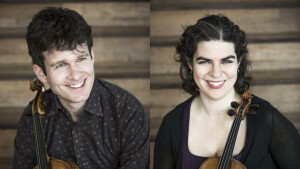
The music is playing again! Violinist Sarah Kapustin and violist Roeland Jagers will release a new album in late November featuring 500 years of exceptional repertoire for violin and viola. The duo answers four questions about their CD project, which was conceived during the COVID-19 pandemic.
Chamber music has held an important place in your lives for many years, particularly during your time with the well-known Rubens Quartet. The combination of violin and viola offers a surprisingly rich variety of sounds and timbres, and it’s clear that you enjoy playing in this ensemble. How did you come to the decision to develop this duo to the highest level?
Sarah: Over the past twelve years, we’ve occasionally performed one or two duets during our concerts with the Rubens Quartet, and that’s how we’ve come to know the wonderful repertoire for our two instruments. The COVID-19 pandemic has made us appreciate our collaboration even more, and it inspired us to record some of our favorite pieces on CD.
You both play valuable instruments on loan from the Musical Instrument Fund. Can you tell us a little about these instruments and their special qualities?
Sarah: I play an Italian violin built in Brescia around 1690 by G.B. Rogeri. The violin has a very rich and warm tone, and over the years it has truly become my “voice”—my means of expressing myself through music.
Roeland: Although my viola has a label that says “Gagliano,” it was made by Giovanni Pistucci in Naples around 1910. I’ve been fortunate enough to play this viola for fifteen years now, and I still enjoy the instrument’s warm yet clear tone every day.
The program on your CD had already been part of your concert repertoire for quite some time before this recording. Was it clear right away what you wanted to record, or did it develop organically?
Sarah: During the first lockdown, we started brainstorming about which pieces would go well together, and that’s how we came up with this collection of works. They all have a strong element of canon and imitation, and you can really hear how these techniques have evolved over the last six centuries.
Your choice of repertoire is quite unusual; you’re playing Martinu’s Duo No. 2, whereas his better-known Three Madrigals are usually performed. Ernst Toch’s Divertimento, Op. 37, No. 2, is best known for the violin-cello version recorded by Jascha Heifetz and Gregor Piatigorsky. Do you feel that these pieces are unjustly overlooked?
Sarah: Absolutely!
Roeland: We’ve always had a soft spot for repertoire that doesn’t typically appear on a standard concert program. Not a single piece on this CD is part of the standard repertoire, and yet we’ve recorded masterpieces by first-rate composers, spanning a wide range of musical styles. Toch’s Divertimento was originally written for a half string quartet, just as Sarah and I were. The composer wrote another Divertimento for the other violinist and the cellist. Funnily enough, Heifetz and Piatigorsky’s interpretation exists solely because of a misunderstanding regarding the cello part—Piatigorsky had rehearsed the violin/cello Divertimento for the CD recording. When he realized he had prepared the wrong piece, he created his own cello arrangement of the viola part!
On Sunday, November 29, Sarah and Roeland will present their CD “Reflections” at the Majella Chapel in Bussum.

