Talent

Anuschka Pedano
plays a
Viola
from Giovanni Grancino
from Giovanni Grancino
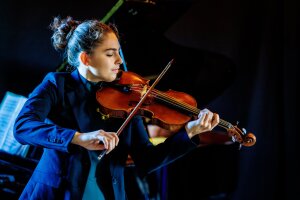
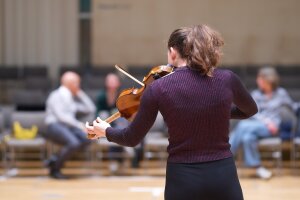
Last year, Anuschka Pedano (25) felt that the viola she had on loan from the Musical Instrument Fund no longer met her needs. We joined Anuschka in her search for an instrument that would allow her to explore greater depth and elevate her playing to a soloist’s level. In June, we completed our search: Anuschka fell in love with a viola built by Giovanni Grancino in 1699. The viola not only marks the beginning of a new chapter for Anuschka but is also a wonderful addition to the Music Instrument Fund’s collection of top-tier violas. Read more in this interview.
“My name is Anuschka, and I play the viola. I absolutely love the dark, warm tones of this instrument. The viola is somewhat overshadowed by the virtuoso violin, but that’s mainly due to the repertoire. Personally, I really enjoy showcasing the viola as a virtuoso, solo instrument. That’s a real challenge. I also really enjoy playing chamber music. I like to push the boundaries of the repertoire, but also those of the instrument itself—for example, by arranging pieces for violin or cello for the viola. My sister Maria and I do this a lot for our trio. She plays the oboe, and there’s very little repertoire available for the oboe-viola combination, so for that ensemble we’re always on the lookout for classical pieces to play. These are often pieces originally written for other instruments. We then transcribe them for oboe and viola. Of course, we know our own instruments inside and out, so we’re in the best position to judge which arrangements work for us.’
“Yes, that was really special. I was seventeen at the time. Until then, I hadn’t played such high-quality instruments. When I won the Princess Christina Competition, the jury thought I should look for a better instrument. They said, ‘Check out the Musical Instrument Fund.’’ That’s how I got in touch with Geertje, who invited me over. Then I was able to try out a number of instruments at home. I asked my teachers for advice, and eventually I settled on a viola by Gand & Bernardel. That instrument really made a world of difference. Suddenly, I could produce so many more timbres and discover so much more in my playing. Because of that, I started to enjoy playing even more.”
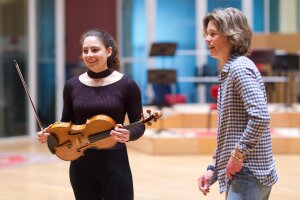
Anuschka with collection manager Geertje van der Linden
“At the beginning of my career as a violist, I was really looking for a sound that was somewhat like that of a violin. I really loved the transparency of a violin back then. I had a Gand & Bernardel viola at the time, and eventually chose a Vuillaume from the Musical Instrument Fund. Now, however, I’m actually looking for a lower-pitched sound. Last year, I tried a Storioni viola from the fund (for which Alice Sinacori was ultimately selected, ed.). It had much more punch, more power. That’s what I’ve been missing lately. The Vuillaume, for example, limited me when I played with orchestras, because I simply couldn’t project above the orchestra. The instrument didn’t project well enough, which meant I always had to work very hard. So I knew what I was struggling with and that I couldn’t properly bring out certain characteristics in specific pieces. But I only discovered exactly what it was after I’d tried many different violas.’

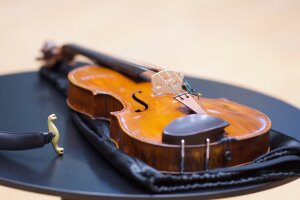
The viola, built by Giovanni Grancino in Milan, 1699.
“This instrument has a character somewhat similar to the Storioni and to another viola I tried in London. It has a variety of tonal colors and feels as though it still has room to blossom. I can fully explore this viola, which will help me grow as a musician. It’s an instrument with a lot of character that offers me so many possibilities. And not only is the sound of the viola beautiful, but so is its appearance. On the back, you can see the wood grain in such a beautiful way, and the instrument is also in very good condition.’
“Yes, it’s really perfect. The Grancino isn’t too big. For example, I also tried a viola that was very beautiful and had a wonderful sound, but it was too heavy for me to play. Then you have to weigh your options: do you want to adapt your entire playing style to the instrument because you’re not used to it, or do you go for a different instrument instead? But I don’t necessarily think it’s important for the body or string length to be a certain size. Ultimately, I mainly look at how the instrument feels and plays. It was a difficult choice, but a very well-considered one.’
“She’s usually pretty skeptical, but with this instrument, she thought the sound was really beautiful and that it suited me well. At the same time, she understands that she can’t decide for me which instrument I should play. “You have to be convinced,” was actually the most important piece of advice she gave me. Several teachers, including Marjolein Dispa, and many other musicians I play with also thought the Grancino was a real gem.”
The only reason I had any doubts about the Grancino was that it doesn’t sound very loud to the ear. Fortunately, it carries well in the hall. The instrument’s tone really stands out. At the time, I really needed others to help me make the choice. I also had to get used to not constantly straining to get more sound out of the instrument, because that wasn’t actually necessary. I have to trust that the viola produces enough sound on its own.’
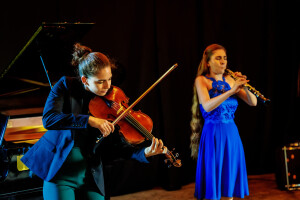
Anuschka in Maria Pedano
“Yes, I do have a strong preference for old instruments, because they already have a soul of their own. With a new instrument, you can still shape the sound exactly the way you want, but an old instrument already has that. You have to learn to work with it, and together you have to keep pushing forward. It’s actually just like a relationship: sometimes you have good days, and sometimes not-so-good days.”
For example, I realize that I still have a lot to discover and learn about the Grancino, but that’s exactly what I enjoy. The biggest challenge is to draw out the instrument’s full range of colors. Previously, the Grancino was played by an orchestral musician, so not so much as a solo instrument. That’s why my challenge is to, so to speak, ‘unlock’ the instrument and get the most out of it.”

“That bow, made by Kees van Hemert, was of course the one I’d chosen for the Vuillaume. I’d like to do another test with different bows on the Grancino. I was recently on tour in Germany and tried a violinist’s bow on my viola there. I immediately noticed that I could get even more sound out of the instrument with it. Right now, I have the Garlier on loan to try out, but I’m still not sure if this will be the right bow for me. So it’s still a search. Even the tiniest details on the bow can affect the sound of the viola.’
Anuschka submitted the request for a different bow the day before this interview. It is still being processed.
“Starting in April, I’ll be going to Berlin to pursue a master’s degree with Prof. Nils Mönkemeyer. He’s a young, virtuoso violist who performs both as a soloist and in chamber music ensembles. In Germany, they call someone like that a kammersolist. I took a trial lesson with him because his playing style is very unique and individual. He really has a style all his own. I find that interesting, because I’m often told that I have that too. Then you have someone who can guide you in that: helping you develop further, but at the same time ensuring that you retain your own style. So that you don’t end up playing exactly like your teacher. The trial lesson with him was a very good experience. I’m really looking forward to it.”
“I would love to perform the most beautiful viola concertos with an orchestra, play chamber music at the highest level with the most inspiring musicians, travel a lot, continue to learn from music, and above all, enjoy it to the fullest! And a big dream of mine is to go on tour through South America, especially in Argentina. That’s where my father is from. The Teatro Colón in Buenos Aires is the largest concert venue for classical music there. I would love to perform there so that my whole family can come and listen in that beautiful place!’
All 400-plus musicians introduce themselves to you on our website. Discover which instrument they have on loan from the Musical Instrument Fund, and read more about the instrument’s history and the maker’s life story.
our talents