Instrument

violin
William, Alfred, and Charles Voller “Brothers”
London,
± 1900
played by
Ian de Jong
Ian de Jong

*1854/1856/1865 , Londen †1935/1918/1949 , Londen
The three brothers—William, Alfred, and Charles Voller—came from the London neighborhood of Marylebone, a district whose poorer section had been known for bear and dog fights and rough wrestling matches between people. On the more affluent side was the chic Marylebone Cricket Club, and the better-off Londoners lived in wide, elegant streets. Their father, Henry Voller, was a coachman; he lived with his family in the poorer part of the neighborhood and worked for the more affluent residents in the other part of the neighborhood.
Henry Voller sought an education for his sons that would take them beyond the impoverished life they had been forced to grow up in. Across the street, on Mandeville Place, things were more upscale. That’s where the violinist Prosper Stainton lived. He counted Wagner and Berlioz among his friends and was a violin teacher at the Royal Academy of Music in London. The story goes that Henry Voller regularly drove him to the Academy in his little carriage.

Alfredo Piatti by William Voller
His sons were musical. William, the eldest (born in 1854), learned to play the viola from Prosper Stainton. Stainton was not only a violinist but also a visual artist with a keen eye for detail. From him, William learned not only to play the viola but also to observe, paint in watercolors, and sculpt. William even created a small bronze statue of Alfredo Piatti with his Stradivari cello.
Alfred Voller, two years younger than William, played the cello, while Charles (born in 1865) had learned to play the violin from Ludwig Straus, a well-known violinist at popular concert evenings in London and first violinist in “The Queen’s Band.”
After completing his violin training, William worked for several years as a music teacher until he earned enough to move out of the overcrowded city center. In 1887, he found a house on Brewster Gardens, a respectable street in the newly developed neighborhood of Notting Hill. Both of his brothers moved there with him. It is not known how he came into contact with the violin makers Chanot, but through them William developed an affinity for the craft and unofficially began an apprenticeship with Chanot.
“A walking mass of violin cases in the city center”
In the mid-1880s, playing the violin began to become all the rage in London. By 1890, there were nine magazines devoted exclusively to violin playing, violinists, and their instruments. Music schools where the barrier to entry for learning to play the violin was low sprang up like mushrooms. One newspaper noted a change in the London streetscape: a “mob of walking violin cases” had appeared in the city center. The price of old Italian and French instruments skyrocketed. It became lucrative to forge instruments.
These practices gradually became a scourge for violin makers, collectors, and players who had paid large sums for an inauthentic instrument. George Hart, at the time an expert and prominent violin dealer in London, had already taken a firm stand against this as early as 1875 with his book: *em* *The Violin: Its Famous Makers and Their Imitators* . The publication did not change much; the production of forgeries continued unabated, though the number of lawsuits against forgers did increase.

Chanot's Studio on Wardour Street
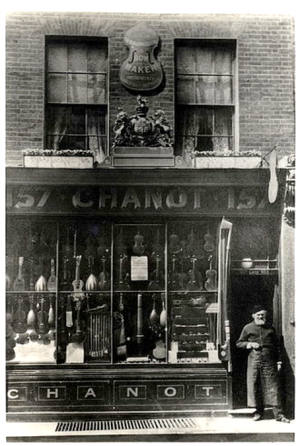
George Chanot, for whom William Voller worked, ran his violin-making workshop on Wardour Street with mixed success. It was not far from the Hill & Sons firm. His sons, Frederick and George, began working with him at an early age. In 1881, the Chanot firm had been at the center of a lawsuit over a counterfeit Carlo Bergonzi violin that he had sold as an authentic one. The fraud was uncovered by violin maker William E. Hill, and Chanot was convicted. “The Strad,” an influential magazine for musicians, devoted considerable attention to the case. The verdict overshadowed the fact that the Chanots were, in fact, skilled violin makers.
Nevertheless, Chanot maintained his good reputation, not least because the Duke of Edinburgh extended his protection to him. Chanot won prizes at exhibitions in England with his violins. Among Chanot’s clients were great violinists such as Joseph Joachim, August Wilhelmj, and Henryk Wieniawski. William Voller developed into a remarkably skilled violin maker while working with Chanot. Chanot’s sons worked alongside William Voller; George Chanot moved to Manchester, and Frederick later followed him there.
William Voller and his two brothers started their own business around 1893, but they also offered their services to George Hart. His shop on Wardour Street had been founded in 1827 by his father, and George had become a respected expert, in part because of his book. Hart owned a collection of antique instruments, including a 1741 Guarneri “del Gesù” that his father had purchased a few years before his death. In 1894, George Hart asked William Voller to make a replica of this instrument for him. The result was a remarkably faithful replica with a beautiful tone.
George Hart asked William Voller to replicate his 1741 Guarneri “del Gesù.” Kreisler: “I will never hear a more beautiful tone than that of my ‘Hart’ Guarneri.”

Source: Tarisio
The violin bore Hart’s own label, and a second label stated that it was “an exact copy of the late Mr. G. Hart’s famous violin.” The number on the label referred to Hart’s first commission to Voller, and the violin was No. 37 from Hart’s own production. In 1904, this Voller violin became Fritz Kreisler’s favorite, about which he later said, “I will never hear a more beautiful tone than that of my ‘Hart’ Guarnerius.” It was, however, the work of Voller.

Source: Tarisio
With this “Guarnerius,” the Voller Brothers had completely convinced Hart of their craftsmanship. As a result, he awarded them several commissions. Stradivari’s “Vieuxtemps” violin appeared in 1894 under the Hart & Son label, without mentioning the name Voller, but with the notation that it was an “exact copy.”
The firm Hill & Sons—originally located further down Wardour Street—and Voller had a strained relationship. William E. Hill had been convicted of forgery in 1890, so he was keen to clear his name. Voller had fewer qualms about this and operated on the borderline between what was permissible and what was not. In 1891, Hill discovered four forged Gragnanis being offered by the dealer George Duncan (1852–1935). Duncan had seen a profit in the Vollers’ forgeries and, starting in 1891, had them produce copies of Cappa, Panormo, and Testore instruments in addition to the Gragnanis, so that he could sell them as originals himself. In 1895, Hill & Sons became “The sole violin & bow makers to Her Majesty the Queen” and focused entirely on restoring their reputation; the Voller Brothers continued to make copies unabated.
“This is one of the best Stradivarius violins not built by Stradivari”
The “Balfour Stradivari” is one of the finest examples of “Voller Brothers craftsmanship.” According to Herbert Goodkind, who wrote *The Iconography of Stradivari* in 1972, this was “one of the finest Stradivarius violins not built by Stradivari”. It was offered as an “authentic” Stradivarius, not by Voller, but by the Balfour firm. William Voller had strongly urged Balfour not to sell it as a genuine Stradivari, but the buyer discovered that the Stradivari was not original and sued Balfour. During the trial, William Voller admitted to being the maker but was not prosecuted.
Hill had brought skilled French violin makers to London to work for him. From original Stradivarius instruments that Hill had been permitted to repair, trade, or had purchased himself, he had 33 different violin molds and 22 viola molds made. His employees used these to build instruments for the company. Hill was a respected expert following the publication of his books on Stradivari, the Guarneri family, and Maggini. At 35 pounds, his newly built instruments were among the most expensive in London. A “Voller,” however, was not an affordable alternative; they even charged 45 pounds per violin. Dealers would affix a counterfeit label and sell them for ten to twenty times that price.
Copies of the Vollers’ instruments ranged from assemblages made up of old violin parts to compositions of multiple authentic master instruments, which they supplemented—with great knowledge and insight—with new, handmade pieces. Many Voller instruments feature an old neck and scroll, “to enhance the sense of authenticity,” as Dilworth surmised. Some were somewhat primitive and hastily made, just as the originals were, but others convincingly demonstrate their great skill and experience.
It seems that once the brothers became entangled in the interests of merchants, they could no longer turn back, but instead had to continue down the path they had chosen. They themselves were not wealthy enough to purchase the works they were copying; for that, they had to rely on their clients, who owned the originals. They went from being experts in imitations to outright fraudsters. They faithfully reproduced every tear and imperfection in the originals in their copies. Together with their dealers, they deceived not only amateurs but also renowned connoisseurs. Silvestre-Maucotel, Gustav Bernardel, Nestor Audinot, G.A. Chanot, and F.W. Chanot readily issued their certificates of authenticity. Those who were familiar with Voller’s methods refrained from doing so.
When it became too risky to copy the works of the great violin makers, they turned to slightly lesser-known names. Gagliano and Tononi became their favorites, and as Hill himself later admitted “with breathtaking results”.
What still clings to the brothers—though it is unfairly attributed to them—is that their instruments were sold as genuine to German emigrants who fled the rising Nazi regime in the 1930s. They were not allowed to take cash out of the country and therefore invested in rare, valuable instruments. Many of them turned out to have been offered Voller forgeries instead of genuine instruments at outrageously high prices.
It is nearly impossible to determine the dates of most Voller instruments, as their name appeared too infrequently on labels. Dendrochronological research shows that the last violin was made from a tree that was felled in 1922.
Photos of William Voller from 1930 show a distinguished gentleman who bears no resemblance to the poor, anonymous violin makers from the back alleys of London among whom he was born.
As far as is known, the Vollers did not design their own model. It is therefore impossible to characterize their work, especially since their instruments were almost never marketed under their own label.
Over the years, they had developed a preference for instruments by well-known makers that could fetch high prices. Until 1909, they copied great masters such as Stradivari and Guarneri del Gesù, Pietro Guarneri, Pressenda, and Bergonzi; later, they made instruments modeled after Tononi, Gagliano, Tecchler, Mezzadri, and Ballistieri—less lucrative, but also less likely to cause problems.
According to Dillworth, they maintained a strict division of labor. All three had specialized: William handled the lacquering, Alfred made the neck, and Charles made the body.
One of the first violins they built under the Hart & Son label was a violin from 1893. It was a “Stradivari” from his late period. Not an exact copy, but a reasonably good likeness.
A “Gagliano” that they built in 1895 was a better replica than the “Stradivari” from 1893, and nearly as good as their “Guarneri del Gesu” from 1894.
A “Testore” they built around 1897 was so convincing that only connoisseurs can tell it’s a forgery.
Even today, only experts are able to distinguish the copy from the original. To make this instrument, they used the sides and neck of various old instruments. It was sold by Hart & Son, bearing their label and a note stating that it was a copy.
After 1900, they began producing more and more forgeries, intended to deceive buyers. Hart no longer wanted to be associated with these practices; George Duncan became their new client. According to F. Leonhard, the Vollers went so far as to take apart one original Stradivarius and use its parts to build three other “Stradivariuses.”
There was also interest in their work outside of England. For Hamma in Stuttgart, they built, among other things, three “Stradivarius” violins, and they also sent their violins to dealers in New York. From the correspondence between Rembert Wurlitzer in New York and Voller, we know that he paid Voller 50 pounds per instrument. The selling price was slightly less than double that amount.
The three instruments by “The Voller Brothers” in the Musical Instrument Fund’s collection are good examples of what they built on commission for Hart & Son.
Dilworth, Fairfax, Milne, 2006, The Voller Brothers, Londen.
Vannes, R., 1999, *Universal Dictionary of Instrument Makers*, Spa.
Morris M., 1920, British violinmakers, A biographical dictionary. Londen.
Heron-Allen, 1902, Violinmaking as it is and was, Londen.
Basford J. en Toft T., 2020, W.E. Hill, violinmakers 1880-1936, Sheffield.
Baker T., Dilworth T. en Fairfax A., 2001 The British Violin, Londen.
Tarisio, Cozio Archive, accessed 2021.


