Instrument

violin bow
Victor François Fétique
Paris,
± 1910
played by
Margot Kolodziej
Margot Kolodziej

*1872 , Mirecourt †1933 , Parijs
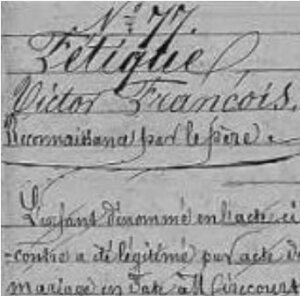
He continued his apprenticeship with Sigisbert Maline and Emile Miguel, where he refined his craftsmanship so that he could eventually put it to use at Charles Nicolas Bazin’s studio. That studio was by far the most important one in Mirecourt. It was a breeding ground for important makers. Nicolas Bazin played a key role in nurturing the talent of his employees. He granted everyone considerable freedom, but he ensured that all the bows leaving his workshop were unmistakably Bazin. By the early 1900s, Bazin’s workshop employed between 12 and 17 workers; it had grown into a professional enterprise producing between 2,000 and 3,000 bows annually, most of them of outstanding quality.
Victor François Fétique married Jeanne Madeleine Meyer in 1896; three years later, after two children had died at birth, they had another son, Marcel Gaston. Victor François followed the path of most violin makers and bow makers from Mirecourt; he, too, went to Paris. He was one of the first to join the Parisian “Maison Caressa & Français.” Although it bore that name, it was in fact the Gand & Bernardel workshop, which they continued to operate. Albert Caressa and Henri Français had taken over management in 1901, the year Victor Fétique arrived in Paris with his young family.
Under Gand and the Bernardel brothers, the workshop had already been highly regarded, but under the passionate and ambitious Caressa and Français, it grew into an internationally respected firm known for its exceptional collection of stringed instruments and bows. Victor Fétique witnessed the company’s early days and expansion firsthand, as he remained there for twelve years. During that time, he also maintained close contact with the bow maker Claude Thomassin, for whom he crafted bows. It was during this period that he developed his definitive style.
In 1913, he started his own business in Paris. His first bows were simple but well-made; a simplicity that was well suited to the economic downturn that preceded World War I. Because he struggled to make ends meet, he had to accept many commissions that paid very little.
After the war, France slowly began to recover, and the economic situation gradually allowed for increased spending. It was during this time that he first began making bows with gold mountings. He sent several of these to the 1924 exhibitions in Brussels and London. The following year, he exhibited in Livorno, and two years later in Paris. The luxurious finishes of his bows—such as tortoiseshell sleeves adorned with a gold fleur-de-lis, which he crafted for his finest bows—suggest that the subsequent years were very successful for him. In 1931, he sent his finest work to the major exhibition in Paris.
A few years after he started his own business, demand for his bows was already on the rise. Starting around 1920, not all of them were made in his workshop anymore. He would sometimes buy them in Mirecourt from reputable bow makers such as Thomassin, Morizot, and Rémi, make a few modifications, and then brand them with his mark. In addition, he also made a large number of bows himself during that time.
The bows he purchased allowed him to meet demand, but that did not immediately enhance his reputation as a bow maker. That changed around 1927, when his younger brother Jules and his nephew André Richaume also began working for him. Like Victor, Jules had been trained by Bazin, and André by Ouchard. Both had since become outstanding bow makers, as had his own son, whom he had trained himself and who had been working in his workshop as a skilled bow maker since 1925. The bows they made were often of comparable quality to Victor’s. They collaborated on some of the bows. Just how exceptionally talented the Fétique brothers were is evident from the fact that, following Victor, Jules was also selected as one of the “Meilleur Ouvriers de France.”
At that time, Victor Fétique recruited the German Paul Weidhaas. A choice that wasn’t immediately obvious in France, given the cultural and linguistic differences, but it was a wise move on Victor’s part. Paul Weidhaas was, at the time, a highly respected bow maker who had trained in Markneukirchen. He was a man who loved to travel extensively and had worked in the finest European workshops, including that of Max Möller in Amsterdam, where he had learned to make bows based on the French model! Moreover, Paul Weidhaas brought a wealth of experience and international connections to the table. This helped Fétique in his ambition to establish a good reputation abroad as well. Under Victor’s guidance, Weidhaas was able to craft excellent bows based on Fétique’s model. And as usual, Victor put his own stamp on them as well. The difference between the bows that Weidhaas made for Victor Fétique and Victor’s own bows can only be discerned by experts. Being a man who loved to travel, Weidhaas left again after a few years.
In his ambition to build a large and impressive company, his entrepreneurial spirit had gained the upper hand in recent years, and he became more casual in his choice of employees; they ensured production, but not always quality. The bows that his brother, his nephew, his son, and he himself made remained, even in later years, of consistently excellent quality. Plagued by health problems, Victor Fétique died in 1933. His son continued to run the workshop until 1977.
Connoisseurs of Victor Fétique’s work still see the influence of Husson and Bazin in his early bows; they are elegant and delicate. Later, his bows became more angular, in keeping with the style that was becoming fashionable in Paris. During both periods, Victor, his brother, and André Richaume crafted bows that are considered among the most well-balanced of their time.
The bows made outside his workshop—either by him or in collaboration with others—are of lower quality, as are some of his later bows. Gaston was so influenced by his father that it is nearly impossible to distinguish between the work of the two. This remained the case even after he took over his father’s workshop. His bows are typically round and range in color from orange-brown to red-brown. Several of his maker’s marks are known.
In addition to the employees mentioned, there were likely a few other German bow makers who worked in his workshop, but there are no sources to confirm this. Victor Fétique made bows for Paul Jombar, Caressa & Français, Chanot & Chardon, and Maucotel & Deschamps.
Millant, B., Raffin, J.F., (2000) *L'Archet: French Bowmakers, 1750–1950*. Paris.
Vatelot, E. (1976), *Les Archets Français*. Nancy.
Jacquot, A., 1912, La Lutherie Lorraine et Française, Paris.
Henley W., 1959 Universal Dictionary of Violin and Bow Makers. Amati Publications. London.
Vannes, R., 1999, *Universal Dictionary of Instrument Makers*, Spa.
Tarisio; the Cozio archives, accessed in 2019.
Geneanet, accessed in 2019.
Archives Nationales de France, accessed in 2019.


