Saint Seraphim
*1699 , Udine †1767 , Venetië
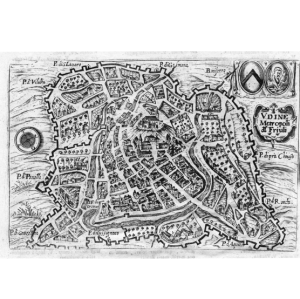
Udine and Its Hospitals
Udine was also the seat of patriarchs and of the noble Venetian families Vendramin, Dolfin, and Manin, who owned a palace in Venice and had a summer residence in Udine. They were financiers and administrators of banks, as well as of the Venetian “ospedales”—institutions that combined girls’ orphanages, conservatories, and convents. Their musical evenings—often performed by the Figlie di Coro of the ospedales—were renowned, and they hired teachers from the ospedales to provide music instruction. This was also the case with the Contarini family. They owned a palazzo in Venice and in Udine, but what mattered most to Santo Serafin and his teacher Francesco Goffriller was that the family possessed a valuable collection of stringed instruments, and Udine lacked a skilled violin maker.
The Arrival of Francesco Goffriller and Santo’s Early Years
When Santo was fifteen, violin maker Francesco Goffriller came to Udine. At 22, he was not much older than Santo. The invitation to come to Udine likely came from the Savorgnans. Francesco Goffriller had been trained by his father, who was a highly renowned violin maker in Venice. In Udine, Francesco was able to step out of his father’s shadow and work more freely than he could have in Venice.
Francesco Goffriller’s workshop quickly became a gathering place for instrument makers and musicians from the region. Shortly after Francesco Goffriller had settled there, Santo became his apprentice. He was fifteen and remained with him until he was twenty. Santo always made a point of emphasizing his origins: not only did he mention that he came from Udine, but from 1725 through at least 1750, he had the label lavishly decorated.
Drought in Udine
Although Udine was a summer retreat for wealthy Venetians, it also had a serious shortcoming: there was a severe shortage of water. The city’s residents were forbidden from washing clothes or hides within the city walls or from throwing trash into the water. Strict penalties were imposed for wasting water. Only the patricians were exempt from these rules. Consequently, Francesco Goffriller’s workshop was not located in the city center, but in Borgo Grazzano, just outside the city walls. The drought caused residents to move away, and with them, the prosperity of the less prominent citizens. And there was no room in Udine for a second violin maker.
‘Composer Marieta Morosina Priuli was likelySerafin's gateway to the powerful circles of Venice’
Seraphin's Early Years in Venice
Venice was growing, and Santo Serafin wanted to work there. A year after his father’s funeral—his father had died in 1717—he left. Santo joined his older brother Giovanni Battista, who, along with his son Giorgio, had moved to Venice several years earlier. At first, Santo worked briefly in a painter’s studio, and then as a servant for the elderly composer Marieta Morosina Priuli. Her pieces for violin and spinet were beloved by the Venetian nobility. The Priuli family was among the most influential aristocratic families in Venice and had produced several doges over the centuries. For Santo, they likely served as his gateway to Venice’s powerful elite.
Venetian guild as gatekeeper
Francesco’s father, Matteo Goffriller (1659–1742), was already advanced in age but still active when Santo Serafin arrived in Venice. It is likely that he introduced his son’s apprentice to the builders of Venice, but the guild did not allow him to be hired directly.
No violin maker from outside Venice could simply start his own business. First, one had to be admitted to the Scuola dei Marzeri, the craftsmen’s guild. Membership was a prerequisite for building instruments under one’s own name within the Republic of Venice. The Scuola Marzeri had established this strict requirement to keep competition among violin makers in Venice in check. Admission could only be considered after working for a few years under a master violin maker and passing a master’s examination.
No violin maker from outside Venice could simply start his own business. First, one had to be admitted to the Scuola dei Marzeri, the craftsmen’s guild.
Given the work Santo produced in his early years, it was most likely at Carlo Tononi’s workshop. This luthier had worked alongside Pietro Guarneri of Cremona. When Guarneri arrived in Venice in 1724, he brought with him a wealth of knowledge about violin making from Cremona, where he had worked for ten years in his father’s workshop and later for several more years as an independent luthier. Santo must undoubtedly have been familiar with him and his work. Their work was similar in refinement. As early as 1760, the Venetian historian Gradenigo, in his *Notatori*, attributed the same skill to Santo Serafin as to Pietro Guarneri.
A Workshop of Their Own: Santa Maria dei Sette Dolori
After presumably working for Carlo Tononi for about five years, Santo Serafin was admitted to the Marzeri guild in 1733 and was able to establish himself as an independent violin maker. His first workshop was located on Calle dei Stagneri, a short distance from Calle della Mandola, where Pietro Guarneri had his workshop. Pietro Guarneri, too, had had to wait a long time for admission to the guild and, like Santo, did not begin working on his own until 1733.
His first workshop was located on Calle dei Stagneri, a short distance from Calle della Mandola, where Pietro Guarneri had his workshop.
Serafin took over the workshop from Giovanni Battista Curci, a violin maker who, since 1672, had been active primarily as a dealer and sold mainly instruments from the Venetian region in his shop. Santo’s nephew, Giorgio Serafin, was already working for Curci. It is believed that Serafin also worked as an apprentice in Curci’s workshop in the years leading up to Curci’s death in 1728. Some historians also speculate that Serafin had previously been employed for a short time by Domenico Montagnana, whose workshop was located a few doors down, before he leased the business from Curci’s widow for 457 lire. Santo hung the sign above the shop, Santa Maria dei Sette Dolori.
Living with Masters and Patrons
Santo Serafin had to make his way in a city where at least 12 other violin makers were competing for commissions from professional musicians, music academies, and the wealthy families of Venice. Aristocratic families financed musical programs on a grand scale, attracted musicians, and favored violin makers who were their friends. The Vendramins and Grimani families owned most of the opera houses and possessed valuable collections of musical instruments. Trade in these instruments usually went through the violin maker. Santo also dealt in instruments, and given his economic status, he later became very successful in this venture. He was likely assisted in this by one of the Savorgnans, who belonged to the Venetian “Mecenati di ricchezza e influenza” and who helped him establish his status as a violin maker in Venice.
Gaining the favor of influential patrons was a prerequisite for success—not only for musicians but also for violin makers. Santo Serafin succeeded in this regard.
Public festivals—of which Venice hosted more than anywhere else in Europe—were colorful and spectacular events. They were all funded by the city’s aristocracy. Talented musicians were generously rewarded, while those less in demand struggled. Gaining the favor of influential patrons was a prerequisite for success—not only for musicians but also for violin makers. Santo Serafin succeeded in this regard. Around 1740, he was the city’s best-known and most successful maker. The quality of his work was not yet quite on par with that of Domenico Montagnana, but he surpassed him in his commercial endeavors.
The Venetian ospedales: music, education, and commissions
Other important patrons of Santo Serafin were the “ospedales.” These girls’ orphanages also housed the illegitimate daughters of the nobility. They received a high-quality music education to improve their prospects on the marriage market. The nobility and patricians often generously funded the ospedales. The gifted girls were taught by great violinists such as Tartini, Hasse, and Lotti.
At the largest and most famous “Ospedale della Pietà,” the standards were the highest. Vivaldi was in charge there. As Maestro di Violino, he was responsible for the procurement and quality of the violins at the Pietà. There is a Serafin violin from 1733 that was found in virtually unchanged condition and is associated by experts with the period when Vivaldi was at the height of his career at the Pietà. The Vendramins and Grimani families were the key administrators who ensured the high musical standards and maintained Vivaldi’s appointment at the Pietà for 30 years. These were families who also resided in Udine.
‘Santo Serafin was a curatorand “liutaio” (violin maker)at at least one of the ospedales’

Performance by “Figlie di Coro” from one of the hospitals
Not only girls from the boarding school, but also women “from outside” who had sufficient financial means to pay for music lessons could attend the ospedales. But only if they brought their own instrument. If they did not have one, they could purchase one from one of the Venetian violin makers, such as Serafin.
For the violin makers, working on the instruments of the ospedales also provided a source of income. Depending on musical trends, the instruments had to be replaced, modified, or maintained. It is virtually certain that, over the years, Santo Serafin came to play a role in the orchestras of at least one ospedale or became its resident violin maker.
Santo Serafin was a curator and “liutaio” (violin maker) at at least one of the ospedales. No written records of this have been found, but Giorgio Serafin—his nephew, student, and sole collaborator—referred to himself in his speech on the occasion of his appointment as official curator and liutaio at one of the ospedales, the successor to both Domenico Montagnana and Santo Serafin. For many years, Giorgio held this position at three of the four Venetian Ospedali, a role reserved for the city’s most prominent violin maker.
Family Ties, The Final Years, and Montagnana's Workshop
In the guild’s view, Santo Serafin had become too successful. They gave him the choice between paying an additional tax or having his right to work in Venice temporarily revoked. A few noble patrons prevented both from happening.
In 1745, Santo Serafin closed his business. He subsequently sold his instruments through Domenico Montagnana, for whom he also began working a year later. In 1750, Montagnana died within a single month of a “hypochondriacal illness.” His three daughters continued the business with Giorgio Serafin as the workshop manager. The terms of the contract were stringent: within six months, he had to marry Antonia Montagnana, and the proceeds from the business were to be divided among his wife and her two sisters. Furthermore, before making any decisions, he had to consult with all three of them. He was not allowed to dismiss the two “garcones”; he also had to pay for their room and board. However, Santo was permitted to continue selling his instruments under his own name. And he presumably built them in Montagnana’s former workshop as well.
Giorgio built instruments under this arrangement for seventeen years, not under his own name but under that of Montagnana. Santo had been successful, but Giorgio matched his success. In 1751, Giorgio had to pay the highest amount to date to the Guild, and despite this, he was able to afford a large apartment. Over the years, the demands of the Montagnana daughters proved to be so high that Giorgio could barely meet them. He died in January 1775, and from that moment on, the contract was amended, and Santo took over the business. This lasted only a year; on February 6, 1776, Santo Serafin died after a seven-month illness.

The Lute, Here Held by Countess Eleonore von Schlieben, by Antoine Pesne, oil on canvas (ca. 1745)
Predecessors: Martinus Kaiser and Matteo Goffriller
His own instruments were loosely based on those of Nicolò Amati, as made by Martinus Kaiser, the first Venetian violin maker, but with a Venetian refinement. As progressive as the Venetians were in the realm of new music, they were just as conservative when it came to its instrumentation. It was primarily the vedel, in all its sizes and variations, and the lute that long dominated performance practice. Until the end of the seventeenth century, the Venetians wanted nothing to do with the modern violin and cello as built by the violin makers in Brescia and Cremona. That changed when progressive musicians sought instruments that would allow them to keep pace with new musical developments. The first cello built in Venice was made by Kaiser around 1710, and five years later he built a fine violin.
Matteo Goffriller, Francesco’s father, had taken over the business from Kaiser—who had since become his father-in-law—and went on to become an exceptionally skilled violin maker. In the twenty years that followed, he was the only one in the city; drawn by his success, a stream of violin makers from outside the city followed in his footsteps. Most came from Füssen and Cremona.
These violin makers brought their own traditions with them and influenced one another. This resulted in a wide variety of models and construction styles. That diversity became a hallmark of the Venetian school. When Santo Serafin also came to Venice, only Montagnana and Francesco’s father, Matteo Goffriller, had developed their own styles.

Back of the violin from the collection of the Musical Instrument Fund (1750); a fine example of the bird's-eye figure in the maple wood
Precise, refined, and elegant
Until 1739, Santo’s work closely resembled that of Nicolò Amati, as did that of Kaiser and Matteo Goffriller, though it possessed a Venetian elegance. The meticulous way he worked, his style, and the beautifully figured wood made his instruments appealing to the Venetians, who were often very demanding. Serafin’s choice of wood ranks among the most extravagant of all 18th-century luthiers. The back almost always consists of two pieces of beautifully figured maple, sometimes with a grain pattern known as “bird’s-eye.” He worked the wood in a manner also seen in the work of Pietro Guarneri. Everything was carved from the same piece of wood, and the grain pattern of the upper and lower curves was the same, while that of the middle section was exactly reversed. He also used high-quality wood for his double basses, something that was not very common at the time.
He branded his instruments with his name, topped by a small curled ornament, clearly visible on the underside, and sometimes colored it an extra deep black. He also incorporated many “distinctive marks” into his technique, making his work clearly identifiable as a Serafin.
Around 1740, Santo Serafin built several violins based on Stradivari’s “Long Pattern” from 1690, with a slightly higher arch and f-holes that flare out widely.
Serafin used a varnish that ranged in color from golden brown to orange-red; it was transparent, deeply glossy, and soft. This set him apart from many local builders, who often incorporated dark Venetian red into their varnish.
George Hart, een expert die Serafins werk goed gekend heeft, was lovend: ‘he was chiefly famed for the exquisit finish of his workmanship, surpassed only by Stradivarius’.
‘he was chiefly famed for theexquisit finish of his workmanship, surpassed onlyby Stradivarius’
On one of his earliest labels, he declared himself a student of Nicolò Amati of Cremona. He had never known him; Nicolò died fifteen years before Santo was born. He was referring to an Amati model that he used as the basis for the violin on which he affixed the label.
Unlike Domenico Montagnana, Santo Serafin had no other apprentice or employee besides his nephew Giorgio Serafin.
Labels and Branding
Santo Serafin seems to have been full of self-confidence. Even early in his career, he used labels that rank among the most lavishly ornamented in the history of Italian violin making.
Santo was the first Venetian luthier to romanize the text on his label. He may have done so to show that he was one of the few violin makers in Venice who could read and write, but he certainly demonstrated his alignment with the tradition of the Cremona violin makers, who had already had their labels printed in Latin. He mentioned his place of origin on nearly all of his labels: “Sanctus Seraphin Utinensis”
The earliest labels featured intricate borders of garlands, shells, musical scrolls, and a violin with a bow. Later labels have borders with intertwined arabesques.
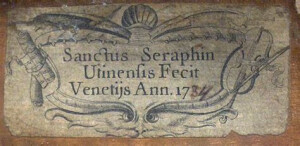
Santo Serafin label. Source: Tarisio
He explicitly refers to some labels as “Ad exemplar Hieronymi Amati / Cremonensium” (After the example of Hieronymus Amati / Cremona).
The simpler labels also state:
Saint Seraphim of Udine / Made in Venice in the Year 1740
Made by Saint Seraphinus, a pupil of Nicholas Amati of Cremona. Udine, 1680.
Saint Seraphim / Made by the Utinensis / Venice, 1729
Saint Seraphim of Utin made in Venice, 17..
Legacy
After Santo’s death, the notary drew up a deed listing the instruments he left behind. It revealed that these included a “large-pattern” Nicolò Amati viola, a Jacobus Stainer violin, an Antonio & Girolamo Amati violin, an unfinished violin by Santo Serafin himself, a violin by Domenico Montagnana, a violin by Gobbetti, a Tononi violin, and finally a violin by Pietro dalla Costa and a single bow.
The instrument that the Musical Instrument Fund has in its collection was built by Santo Serafin near the end of his life. At that time, he was working in Giorgio Serafin’s workshop and sold his instruments primarily through Domenico Montagnana’s store.
Sources
Pio, S., 2004, Violin and Lute Makers of Venice 1640 - 1760. Venezia.
Sadie, J. A,, Samuel, R., 1994. The Norton/Grove dictionary of women composers. Londen.
Fondazione Pro Canale: Strumenti Storici, Milan, n.p.
Goldfarb T., 2015, Art and Music in Venice, London.
W. Henry Hill, Arthur F. Hill & Alfred E. Hill, 1910, The Violin Makers of the Guarneri Family, 1626-1762, London.
Landon Ch., 2007, 2013, The Strad Magazine.
Vannes, R., 1981, “Universal Dictionary of Instrument Makers,” Brussels.
The Strad; In Focus 2013; John Dilworth.
De Piccolellis, G. 1885, Ancient and Modern Lute Makers, Successori le Monnier, Florence.
Jalovec, K., 1957, Italian Violin Makers, Prague.
Tarisio, Cozio Archive “Santo Serafin.” Visited in 2026.
- Auteur
- Jan Boekhout
- Date
- 1 May 2026