Instrument

cello
Romeo Antoniazzi
Cremona,
1920
played by
Monique Heidema
Monique Heidema

*1862 , Cremona †1925 , Milaan
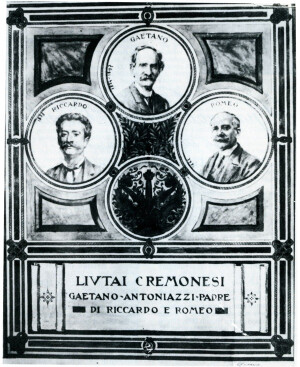
Cremona had a glorious past and was the city that produced Italy’s greatest violin makers. By the time Romeo Antoniazzi was born there in 1862, however, none of that remained. The French had proven to be excellent copyists of Italian masters, had built up an efficient organization, and had thereby outcompeted the Italian workshops. French violin makers dominated the market at that time and thus also dictated taste. At exhibitions, comparisons between Italian and French makers almost always favored the latter.
In Cremona, only Giuseppe Ceruti, his son Enrico, and a few minor luthiers were still active. The Cerutis represented the last significant link between a new generation of violin makers and the great masters of yesteryear. Until 1865, when Romeo Antoniazzi was three, his father was still working and apprenticing with Ceruti, but that year he left for Genoa with his wife and children. Presumably, Gaetano did not find what he needed to support his large family, because a year later they were already back in Cremona. They remained there until they moved to Milan in 1870.
In Milan, his father built his first violins under his own name, and Romeo’s brother Riccardo became known as the “violin professor”—a title earned both for his knowledge of the instrument and for the fact that he played from time to time in various Milanese orchestras. In 1880, Riccardo left for Nice to study the French method of violin making under Nicolo Bianchi, who had spent twenty years in Paris. In the meantime, Romeo built several fine violins in the style of Ceruti. In 1886, Riccardo returned to Milan. For Romeo, his return was a significant event; he moved in with Riccardo, who once again became his teacher. In 1888, Romeo married Palmira Clerici in Rome and registered his first permanent address in Milan.
Riccardo’s meeting with the entrepreneur Leandro Bisiach in Milan marked a turning point in the Antoniazzi family’s life. The businessman was interested in violin making and saw in Riccardo the luthier who could teach him the art of violin making. Bisiach set up a workshop modeled after the French style and proved to have boundless energy. He worked in the workshop himself and often varnished the new instruments. He expanded his business until, around 1900, it became the leading violin-making workshop in Milan, with an extensive network that enabled him to supply instruments to dealers throughout Europe. The three Antoniazzi brothers became his principal collaborators.
“According to Gindin (2018), around 1890 the Antoniazzi family crafted the finest instruments ever built in Milan.”
Bisiach’s success was remarkable; Italy was in the throes of a deep crisis. Never before had poverty been so widespread. Between 1895 and 1900, nearly two million Italians sought refuge abroad. Owners of old Italian master instruments were often forced to sell them at a bargain price to domestic and foreign dealers who scoured the country. At that time, there was little interest in newly built instruments. Only “French” instruments were in demand. Bisiach saw an opportunity in this and had the Antoniazzi family build instruments in the French style. According to Gindin (2018), around 1890 the Antoniazzi family crafted the finest instruments ever built in Milan. Bisiach sometimes also bought antique-looking instruments, which he had modified and sold as authentic pieces. He usually exported his modern instruments. Later, he became an expert in old master instruments and taught his employees to study them in detail.

Leandro Bisiach
Bisiach, who had become wealthy in a short time, bought a villa just outside Milan and a house in the city where Romeo and Riccardo were allowed to live. In 1897, Gaetano Antoniazzi died. Shortly thereafter, Romeo’s brother was sent to prison for theft. Romeo was now the only Antoniazzi remaining with Bisiach. It is likely that Bisiach no longer wanted Riccardo back after his imprisonment. It is not known what he did immediately after his release; it was not until 1904 that Riccardo appeared on the payroll of the renowned firm Monzino & Son as a violin maker and repairer. Romeo was also hired by Monzino.
Starting in 1904, Romeo built many instruments for the Monzino company. Both brothers were known as fast and skilled craftsmen; Riccardo was meticulous and precise, while Romeo worked in a more impulsive manner. Both were excellent teachers; they trained many violin makers at Bisiach and at Monzino. Riccardo’s career took off quickly. He built a number of instruments for Monzino that won prizes at the 1906 Milan exhibition. Although Romeo could not match his brother’s success, his instruments were nonetheless well received at various exhibitions.
“The period between 1910 and 1923 was his most stable time”
After 1907, Romeo presumably no longer had a permanent position, but, like most violin makers at Monzino, he was given a temporary contract. Starting that year, he also began building instruments for other firms. The period between 1910 and 1923 was his most stable time. Perhaps to help pay for his wife Palmira’s medical expenses, he built not only his own instruments but also a large number of student violins for Giuseppe Barlassina. Palmira died in 1920. With the exception of the year of her death, he also built some of his finest instruments during that period.
From the time of his marriage in 1888 until his death, he was registered at nineteen different addresses; sometimes he moved just a few months apart, and on a few occasions even three times a year. In 1910, 1912, and 1923, he lived on the same street, but always at a different house number. His longest stay at a single address was six years; the shortest, eleven days. Researchers attributed this to his difficult personality and his excessive drinking. Despite this, he commands admiration for the number of fine instruments he built and the many violin makers to whom he passed on his expertise. He died in 1925 as a luthier who had been the subject of much controversy and whose work could only be fully appreciated following recent research.
Romeo must have begun his first lessons in violin making around the age of twelve. He did not receive these lessons in a traditional student-teacher relationship, but rather spontaneously and informally from his father and his brother Riccardo. Gaetano and Riccardo had been influenced by Enrico Ceruti in Cremona, but even for them, there was no formal training to speak of. Ceruti had been the last of the traditional Cremonese violin makers. He promoted this way of working in many European cities. His work bore little resemblance to that of Stradivari or Guarneri “del Gesù,” but was based on the tradition of Bergonzi. The Antoniazzi family inherited this tradition from him.
Riccardo noticed that there was virtually no interest left in that style and turned his attention to French luthiers who had indeed used Stradivari or Guarneri “del Gesù” as their models. Upon his return from Nice, Riccardo passed on his newly acquired knowledge to Romeo without hesitation.
“He would not receive his greatest recognition until after his death. With the gold medal Romeo received posthumously, he stepped out of the shadow of his father and brother.”
The work Romeo did at Leando Bisiach’s workshop must have been varied, but not very satisfying. Unlike in Italian workshops, where an employee built an instrument entirely on his own, Bisiach had implemented a strict division of labor. Each employee made only one standardized part of an instrument. As a result, there was no room for personal input. For Romeo, who had a very impulsive and restless nature, that must have been the reason he continued to work for others as well.
At Monzino, where he started working around 1904, they were still using traditional methods. There, he was able to build an instrument largely on his own and put his craftsmanship to use repairing instruments.
According to Blot (2002), the period during which he produced outstanding work almost without interruption—and even crafted some of his finest instruments—spanned from 1885 to 1910. From 1910 until about 1923, Romeo had his own workshop where he sometimes worked for himself, but mostly for others. He built his best instruments from that period with great precision, but they lack the spontaneity of his earlier work. During the same period, he also occasionally built instruments of significantly lower quality.
He would not receive his greatest recognition until after his death. In 1949, M. Rosa of Milan, for whom Romeo had built a quartet, submitted these four instruments to the Cremona exhibition. With the gold medal Romeo received posthumously for them, he stepped out of the shadow of his father and brother.

Label on a violin from the collection of the Musical Instrument Fund, photo: Cathy Levesque
Romeo Antoniazzi marked his instruments with a label and a brand. On the label, he stated that the instrument had been built in Cremona, even though he had not been there since he was eight. The brand consisted of his initials and a small cross.
Romeo Antoniazzi influenced others primarily through his informal mentorship at Bisiach and Monzano. There, he trained many violin makers, the most important of whom were Leandro Bisiach, Ambrosio Sironi, and Giuseppe Pedrazzini. However, according to Florian Leonard (2019), the impact that the three Antoniazzi brothers had on 20th-century violin making can hardly be overestimated. Their combined efforts, he argues, restored violin making in Italy to a level of excellence not seen since the 17th and 18th centuries.
There has been much doubt about Romeo Antoniazzi’s craftsmanship. The reason was that there were many poor-quality instruments bearing his label, as well as many of inferior quality. After investigation, the explanation for this turned out to be threefold: Romeo did not have his own network of customers. Bisiach completely dominated that market. He built many of his best instruments for Bisiach, who sold them under a different name. The second reason was that the instruments Romeo built later in life were sold by Enrico Ceruti’s son as if they had been built by Ceruti himself. Romeo’s name was absent from those instruments as well. And finally, after his death, some luthiers, for their own profit, affixed counterfeit Romeo Antoniazzi labels to a large number of inferior instruments.
Gindin D., 2018, The late Cremonese Violin Makers, Cremona.
Kass P. J., 2007, The Bisiach Family, Londen.
Kass P. J., 2007, Selected World of Strings Newsletters, Londen.
Azzolina U., Italian Violin Making in the 1800s and 1900s, Milaan.
Codazzi, R., 2002, Lombard Violin Making in the 20th Century, Brescia.
Blot, E., 1994, Emilia and Romagna: A Century of Italian Violin Making, 1860–1960, Cremona.
Hamma, W., 1993, Masters of Italian Violin Making, Wilhelmshaven.
Vannes, R., 1985, Dictionnaire Universel del Luthiers, Brussels.
Brinser M., 1978, Dictionary of 20th Century Italian Violin Makers.
Henley W., 1969, Universal Dictionary of Violin & Bow Makers. Brighton.
The Cozio archive, Tarisio, bezocht in 2020.
