Instrument
violin bow
Roger Lotte
Mirecourt,
± 1950
played by
Per Benjamin Torjuul
Per Benjamin Torjuul

*1922 , Mirecourt †1989 , Nancy
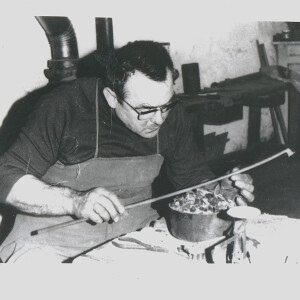
Roger François Lotte was the son of François Lotte and Marguerite Ouchard. François was a bow maker, and his mother was the daughter of Emile Ouchard, who was also a bow maker. Both his father and his two grandfathers belonged to a small group of prominent families in Mirecourt. Roger was born there in 1922. Mirecourt was a small town in northeastern France where, since the eighteenth century, most of the finest bow makers and violin makers had come from or were born. He grew up in the midst of that tradition.
His father’s workshop, where Roger began as an apprentice in 1936, had just emerged from a successful period. Five years earlier, there were still eleven employees working there. They were bow makers, including Marcel Charles Lapierre—who, while not among the very greatest, had nonetheless produced fine bows under the guidance of François Lotte—and outstanding craftsmen such as Albert Thomassin, René Bernard, and Henri Piroué.
However, François Lotte could not have sustained that success for long; the competition in Mirecourt was simply too fierce. Spread across small one-man operations and large workshops, there were still about 600 violin makers and bow makers working in Mirecourt in 1926, but that number would decline to just 100 paid employees by 1954. François and his son Roger were also unable to escape this decline; by 1936, only four bow makers were still working for François Lotte, including his son Roger.
After completing his apprenticeship, he began his career in 1940 by making bows in his father’s style. He was very productive and worked with great precision. By then, World War II had broken out, and attention shifted away from music and instruments. Only the best violin makers and bow makers were able to stay in business. Moreover, because many men were drafted into the army and did not survive the war, a great deal of knowledge was lost—including that of bow makers. Roger had to serve in the military for a short time but emerged unscathed. Despite the war, Lotte continued to make high-quality bows. They managed to do so even immediately afterward, when not only expertise but also materials remained scarce for some time. Connoisseurs can identify bows from that period on which both father and son worked.
Around 1960, Roger took over the studio. François, who had turned 69, did not completely stop working, but he did take it easy. Until his death, he could still be found in the studio every day. René Bernard, who had been François’s assistant since 1936, remained Roger’s only permanent employee. Ten years later, François died, after which Roger continued to run the studio.
Many workshops had already sought ways to explore new markets. They often found them in exports, particularly to England and America. Others turned to the factory-style production of bows. This was not infrequently at the expense of quality. Roger continued to focus on the French market and largely maintained the traditional way of working. He made bows not only for his own clients but also for highly renowned workshops such as those of Bernard Millant, Roger & Max Millant, Etienne Vatelot, and Hilaire & Apparut.
Despite the modest size of his studio, his output was considerable. This was due to the fact that Roger himself worked at a rapid pace. Remarkably, the quality of his work remained exceptionally high despite this. However, this did change somewhat over the years. He hired Richard Gerôme and Leon Jeandel to do the more labor-intensive work for him, and later R. Bernard, who began working alongside him. Toward the end of his life, his work gradually became somewhat bolder and less refined. In 1989, Roger Lotte died in the line of duty. There was no successor to take over his studio.
In the French tradition of bow-makers, it was customary for apprentices to first spend several years making bows based on their masters’ designs. Afterward, they gradually developed their own style. Roger, too, made bows modeled after his father’s, but continued to do so for a long time. These were excellent, elegant bows that bore a resemblance to the models of Charles Nicolas Bazin, for whom his father had once worked, and in which influences from his grandfather, Emile Ouchard, could be seen. It was only after he took over François’s workshop around 1960 that he made some changes to the design.
Between 1965 and 1970, he crafted exquisite bows mounted with gold and tortoiseshell. Until 1960, he used his father’s stamp; after that, he stamped his work with “Roger-François Lotte.” He also occasionally used a brand mark that read simply “Roger Lotte.”
His work remained refined for most of his life. It was only in the final years of his life that he made his bows slightly sturdier and “more modern.”
Roger Lotte used reddish-brown pernambuco wood for his predominantly round bows. Roger and François’s bows are slightly longer than usual.
Roger Lotte did not have much influence, nor did his followers. By then, the heyday of Mirecourt had long since passed. Overall, his work is highly regarded by connoisseurs. But it is particularly the bows he made between 1960 and 1975 that, in terms of refinement and precision, rank among his finest work.
Millant, B., Raffin, J.F., (2000) *L'Archet: French Bowmakers, 1750–1950*. Paris.
Vatelot, E. (1976), *Les Archets Français*. Nancy: Henley W., 1959
Universal Dictionary of Violin and Bow Makers. Amati Publications. London.
Jacquot, A., 1912, La Lutherie Lorraine et Française, Paris.
Tarisio; the Cozio archives, accessed in 2019.
Geneanet, accessed in 2019.
Archives Nationales de France, accessed in 2019.