Instrument

violin
Riccardo Antoniazzi
Milan,
1895
played by
Joshua Tavenier
Joshua Tavenier

*1853 , Cremona †1912 , Milaan
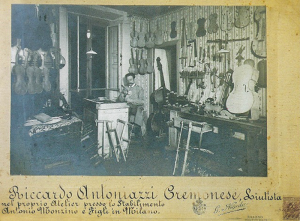
It was around 1850 that Riccardo Antoniazzi’s father, Gaetano, began making violins. He lived in Cremona, where the heyday of violin making had already passed. Only the Ceruti father and son were still working there in the shadow of Stradivari, Bergonzi, Guarneri, and Ruggeri.
Through the Cerutis, Gaetano Antoniazzi became interested in the craft and, by his own account, became their apprentice. Very few people could make a living from violin making alone; most had to take on other work as well. This was also the case for Gaetano Antoniazzi. Out of necessity, he had to take on more odd jobs than he could build violins.
Riccardo Antoniazzi was born in 1853. He was the eldest of eight children. Six of them were born in Cremona; the others in Mantua. The youngest was Romeo, who was nine years younger and with whom he would later collaborate almost continuously. The Antoniazzi family faced constant financial difficulties; Gaetano not only took on all sorts of jobs in the area, but he also moved from place to place time and again, always in search of work.
In 1855, the family moved to Mantua, where they lived at seven different addresses. Ten years later, they moved to Genoa, but returned to Cremona a year later. Everywhere they went, Gaetano worked as a woodworker, but he also built a few violins on the side. When the family settled in Milan in 1870, Riccardo moved with them.
Meanwhile, Riccardo Antoniazzi learned from his father—and presumably also from other violin makers in Mantua, Genoa, and Milan—the skills necessary to become a violin maker. Over the course of ten years, under his father’s guidance, he developed into a skilled craftsman, but the Antoniazzi family did not yet have their own business from which they could make a living solely from violin making.
Gaetano, and later Riccardo as well, built instruments for others, but their names were never mentioned on any label—a common practice at the time. It wasn’t until 1880 that Gaetano began building a few violins with his own label. The first known violin by Riccardo dates from 1883. He was twenty years old at the time and must have already built dozens of violins for others. His father still did odd jobs to supplement the family income, while Riccardo earned extra money as a violinist and lutenist in various Milanese orchestras.
By the mid-nineteenth century, little remained of Italian violin making. The French had proven to be excellent copyists of the Italian masters, had built up an efficient organization, and had thus outcompeted the Italian workshops. French violin makers dominated the market and thus also dictated taste. At exhibitions, comparisons between Italian and French makers almost always favored the latter.
To keep pace with this trend, Riccardo Antoniazzi left for Nice, France, in 1880, where the elderly but highly respected Nicolò Bianchi was working. Bianchi had learned to build violins in the French style and was known as an exceptionally skilled teacher. He had trained Scarampella and, later, Praga as well, both of whom went on to become legendary violin makers. Riccardo Antoniazzi was able to benefit from Bianchi’s expertise for only one year; Bianchi died as early as 1881. That same year, Riccardo married Catharina Viale in Nice and had his first and only son, whom he named after his father: Gaetano.
Although Riccardo had hoped to become Nicolò Bianchi’s successor, he had not had enough time to develop the skills required for the role. Another apprentice who had worked with him for a long time inherited his business, his tools, and his entire stock of wood.
After years of traveling back and forth between Italy and France, Riccardo finally returned to Milan.
Riccardo did continue to work in Bianchi’s former workshop for a few more years, traveling regularly back and forth between Milan and Nice, and in 1886 he returned permanently to Milan, where he rejoined his father and brother, who had by then become independent.
Before leaving for Nice, Riccardo had been very concerned about his younger brother Romeo. He had passed on to him all his knowledge of technology and developments in the European music world. But during Riccardo’s absence, Romeo had struck out on his own path: not the French style, but a return to that of Ceruti, Gaetano’s mentor and, above all, heir to the Cremonese masters.

Leandro Bisiach
In 1886, Riccardo met Leandro Bisiach, a man who wanted to become a violin maker but also had great business ambitions. Riccardo took him on as an apprentice, but soon the roles were reversed. Bisiach started his own company and hired Riccardo. Within a few years, Leandro Bisiach had built an empire that controlled the stringed instrument trade in northern Italy. Riccardo became the most important employee in his workshop. After Bisiach had made a name for himself, Riccardo Antoniazzi noted on his label that he had been Leandro Bisiach’s teacher. In addition to his work for Bisiach, he also began building instruments under his own name starting in 1883.
Riccardo Antoniazzi’s instruments were “non-Milanese”; they could hold their own against the finest instruments built in Europe.
Between 1880 and 1890, the Antoniazzi family built instruments that closely resembled those of the Cremonese Ceruti family. Milan wasn’t exactly known as a city that produced great violin makers; Hill had once called them “cheapjacks,” makers of cheap and inferior instruments. Riccardo Antoniazzi’s instruments were “un-Milanese” in every respect; they could hold their own against the best instruments built in Europe. Later, they were sold by others as genuine Cerutis and fetched much higher prices than they would have under their actual maker’s name. Very few instruments from that period bearing Riccardo’s own label have survived.
Antoniazzi’s early instruments are considered, by Gindin (2017) among others, to be the most interesting from a stylistic perspective because they unmistakably reveal their late Cremonese roots. In 1894, Riccardo and his father participated in an exhibition in Milan, where Riccardo won a medal but his father did not.
The Antoniazzi family lacked any business acumen, unlike Bisiach. With the exception of a few months in 1907, Riccardo was never officially and permanently registered as an independent violin maker; instead, he alternated between violin making and other crafts, almost always working for other firms.
In 1889, Bisiach had opened a large workshop alongside a successful business dealing in antique musical instruments. It appears that by the early 1890s, all three Antoniazzi brothers were already working for him and were crafting some of the finest Milanese instruments ever made (Blot, 1995). Although not entirely “pure” in style, these are perhaps the most “classical Cremonese” of the Milanese instruments since the early works of Giovanni Grancino.
Riccardo—and, to a lesser extent, Romeo—gradually gained more influence in Bisiach’s workshop. This went so far that, starting in the mid-1990s, the style of the Bisiach instruments gradually evolved along with Riccardo and Romeo’s own artistic development. The instruments they built for Bisiach became increasingly Cremonese in style, and the traditional Milanese construction method was completely set aside.
It is a fact that Bisiach bought up large quantities of old-looking instruments, which he had refurbished in his workshops to look like “genuine masterpieces,” after which he resold them under a false label. This was one of the ways Bisiach made his fortune. Because of these forgeries, he had been widely distrusted for some time. Since Ricardo had wielded considerable influence within the workshop for years, he was undoubtedly aware of these practices. He simply was not in a position to oppose them.
“You know that I’ve helped you a great deal with your art in the past … ; I made you an artist and brought you great fame through awards”
Bisiach, who had become wealthy in a short time, bought a villa just outside Milan and a house in the city where Riccardo and Romeo were allowed to live. In 1897, Gaetano Antoniazzi died. Not long after, Riccardo was briefly imprisoned for theft. This was likely the beginning of a period of discord between Bisiach and Riccardo that resulted in a rift between them. Riccardo was forced to leave Bisiach’s house. Riccardo wrote to him from prison: “You know that in the past I helped you greatly with your art …; I made you an artist and brought you great fame through awards. Now I ask you to tell my brother to send a pair of socks, as I am currently completely without any.”
It is not known to what extent he continued to work for Bisiach after his release. By then, Bisiach was located in Milan’s most beautiful spot, the Piazza del Duomo. In 1904, they ended their relationship for good, and Riccardo began working as a violin maker and repairer for the firm Monzino & Son.

Source: Benjamin Hebbert
Monzino & Son was a long-established but relatively obscure company that also sold other instruments. Riccardo had been a good teacher at Bisiach, and he also trained many others at Monzino. Monzino considered himself fortunate to be able to hire Bisiach’s most important employee and offered Riccardo Antoniazzi a contract in 1904.In 1906, Monzino commissioned Riccardo to make eleven instruments for the exhibition to be held in Milan that same year. Apparently, a great deal was at stake for Monzino, as Riccardo was allowed to decide for himself with whom he would carry out this commission. Thanks to a viola crafted by Riccardo, Monzino won first prize. Riccardo’s name was not mentioned anywhere.
Although the Antoniazzi brothers never managed to join forces to form a joint venture, Riccardo and Romeo also worked together during this period to build beautiful instruments on a large scale, each working independently. Bisiach had taken on new apprentices, including several highly talented luthiers, and began competing with the Antoniazzi brothers. The brothers likely increased their production for this reason, with the result that the quality of the instruments Riccardo built for himself declined.
Starting in 1910, Riccardo Antoniazzi’s health began to decline. He continued to work for Monzino, but did so from home. The fee he received from Monzino under contract for a violin was just slightly more than the daily wage he had earned at Bisiach. The finest instruments in Milan at that time were built by Riccardo Antoniazzi, but underpaid and underappreciated, he died in 1912.
He had been a well-known and respected figure in the music world, not only as a violin maker but also as a violinist and lutenist. In the same newspaper that published his obituary, he was referred to not only as a violin-making “craftsman” but also as a violin “professor”; his knowledge of the instrument had apparently been worth mentioning.
Throughout his career, Riccardo Antoniazzi has employed a wide variety of styles and working methods. Riccardo Antoniazzi’s early instruments are his own variations on those of Amati and Stradivari. Some are loosely based on Guarneri ‘del Gesù,’ but even those possess their own distinctive Antoniazzi character.
For Bisiach, he initially built many instruments modeled after the French style, but gradually switched to Ceruti’s designs. After leaving Bisiach, he embarked on a more experimental path that could even be called “eccentric” for its time (Gindin).
The characteristics of Riccardo’s and Romeo’s later instruments differ somewhat. In general, Riccardo’s work is superior to that of his younger brother; Romeo’s instruments are more numerous, and his production continued to increase after Riccardo’s death, though this came at the expense of quality.
Riccardo and Romeo were known for their production speed. This had no impact on the quality of the instrument itself, which remained high; it was only the finish that suffered
Even for experts, it is not always easy to definitively attribute instruments built by Riccardo to him. This becomes even more difficult, especially after 1905. While he built most of the instruments himself, he also had others make parts for him. One such person was Erminio Farina, some of whose instruments were later attributed to Riccardo Antoniazzi or sold under his name.
Riccardo and Romeo were both known for their high production speed. This had no impact on the quality of the instrument itself, which remained high; however, the varnish suffered as a result. The drying time had to be short, resulting in a thin, hard, and fragile finish.
Many builders in Milan at that time used simple, locally sourced wood, but Riccardo Antoniazzi, with the help of Bisiach—who had good business connections—was able to obtain beautiful materials.
Many of his violins are long, with beautiful edges, subtly shaped short corners, and curved, carefully carved f-holes, sometimes positioned slightly higher than usual.
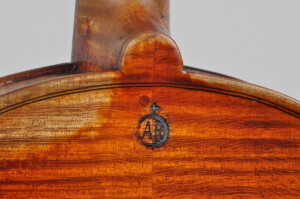
Brand: Riccardo Antoniazzi
Most of Riccardo’s instruments have large pins on the back that he used to secure the blade during the manufacturing process, just as the Cerutis did. Another similarity with the Ceruti instruments was his choice of brand mark: a small circle with a cross at the top and his initials “AR” inside it. Ceruti placed this on the label, while Riccardo Antoniazzi branded it at the top of the back plate.
On his label, he stated that he had been a student of Gaetano, his father.
Gindin D., 2018, The late Cremonese Violin Makers, Cremona.
Gindin, D., 2017, Modern Italian Violin Makers, Vol 1. Cremona
Kass P. J., 2007, The Bisiach Family, Londen.
Kass P. J., 2007, Selected World of Strings Newsletters, Londen.
Azzolina U., Italian Violin Making in the 1800s and 1900s, Milaan.
Codazzi, R., 2002, Lombard Violin Making in the 20th Century, Brescia.
Blot, E., 1994, Emilia and Romagna: A Century of Italian Violin Making, 1860–1960, Cremona.
Hamma, W., 1993, Masters of Italian Violin Making, Wilhelmshaven.
Vannes, R., 1985, Dictionnaire Universel del Luthiers, Brussels.
Brinser M., 1978, Dictionary of 20th Century Italian Violin Makers.
Henley W., 1969, Universal Dictionary of Violin & Bow Makers. Brighton.
Tarisio. The Cozio archive, bezocht in 2020.