Instrument

violin
Raffaele & Antonio II Gagliano
Naples,
± 1830
played by
Stella Zake
Stella Zake

*±1791/±1794 , Napels †1857/1860 , Napels
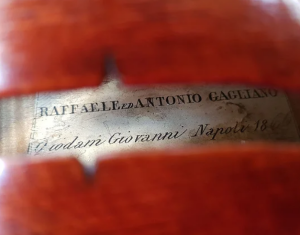
Raffaele and Antonio belonged to the fourth generation of this dynasty. The unstable conditions under which their father had been forced to work would become even more severe for his sons. Raffaele was born around 1791 (d. 1857), and Antonio around 1794 (d. 1865). Both learned the trade in their father’s workshop and worked with him until they started their own studio together.
In those years, Naples was the capital of the Bourbon Kingdom of Naples: a city with 426,000 registered residents and some 50,000 unregistered ones, larger than Rome, London, or Milan, brimming with splendor, music, and ceremonial pomp. Yet two developments would profoundly influence the lives and careers of Raffaele and Antonio: the successive shifts in political power and the rapid industrialization of the European instrument market.
The changes began in 1799 when French revolutionary troops captured the city and King Ferdinand IV fled. Pro-French republicans proclaimed the Republic in the spirit of the French Revolution, but it was crushed after two years, following which the Bourbons returned. This was accompanied by severe repression; numerous republicans, intellectuals, and artists who had “collaborated” were executed or exiled. Raffaele and Antonio likely didn’t witness much of this firsthand, but they certainly felt the aftermath all the more.
The brief influence of the French revolutionaries had the effect of disrupting aristocratic culture in the realm of music. Public interest gradually shifted from court and elite culture to more popular forms of music: romantic and historical operas, as well as music-making in taverns, folk theaters, and on the streets.
When Napoleon Bonaparte sent another army to Naples in 1806 and definitively drove out the Bourbon monarch, a new phase began. He first installed his brother Joseph Bonaparte as the ruling monarch in Naples, and later his brother-in-law Joachim Murat. Both were particularly beloved by the Neapolitans. Under their rule, the kingdom was modernized, causing the traditional social structures of old Naples to disappear for good. This atmosphere of uncertainty and rapid change undoubtedly left its mark on Raffaele and Antonio.
A major event was the forced merger of the four conservatories in Naples: the Santa Maria di Loreto, Pietà dei Turchini, Sant’Onofrio a Capuana, and I Poveri di Gesù Cristo. Between 1806 and 1808, these legendary institutions were merged into a single state institution by order of Napoleon. The school had lost its religious and charitable character. For centuries, the old conservatories had been scattered throughout the city and linked to specific neighborhoods and religious communities. Now, a single institution emerged that represented the state’s musical authority.
The merger also led to the disappearance of the separate musical specializations. Old pedagogical traditions were replaced by a system that was more technical, more competitive, and more focused on opera than on church and instrumental music. The incorporation of the Santa Maria di Loreto Conservatory into the new institute had major consequences for violin and cello students. It had enjoyed a Europe-wide reputation for instrumental training, but under state administration, that reputation largely disappeared. In the old conservatories, the Gaglianos had still been regular violin makers; after 1826, no Gagliano appears in this capacity in the archives of the new institute.
Immediately after Napoleon’s fall in 1815, the Bourbons returned to a kingdom that had undergone fundamental changes. They were not exactly welcomed back. Beneath the surface, however, a strong political subculture was brewing. Intellectuals, citizens, and military officers who had tasted greater freedom under French rule organized themselves into societies with liberal and nationalist ideals. This led to a major uprising in 1820. The city was occupied by Austrian troops. The presence of these foreign soldiers became an enormous financial burden on the Neapolitan treasury.
Between 1820 and the death of their father Giovanni in 1825, they worked together in the workshop, but given the number of instruments that survived, their output was likely not very large. Whereas earlier generations had been able to work with precious wood from the Alps and refined raw materials for their Cremona-style varnishes, they later faced increasing scarcity and difficulty in obtaining materials. They adopted their father’s distinctive style. Raffaele and Antonio then carried on the business. Sometimes together, but they also built their instruments on their own.
Lorenzo Ventapane's brothers faced stiff competition. Some sources suggest that Lorenzo was a student of their father. He built in their style, but with his own unique interpretation. His violins and cellos are of very high quality, and in his later years, they rivaled those of Raffaele and Antonio Gagliano.
While the brothers were located on modest streets such as Via del Cirriglio, labels on Lorenzo Ventapane’s instruments indicate that he was based at more prominent locations, including Calata Borgo di Loreto and later on Strada Donna Regina. Although the archives do not indicate that Ventapane was affiliated with the Real Collegio di Musica conservatory, his workshop was located just a few minutes’ walk from Via San Sebastiano, where the conservatory was situated.
Despite the unrest, the Teatro di San Carlo and the smaller Neapolitan theaters enjoyed a golden age. Between 1820 and 1835, twenty-eight operas premiered, and several were performed each week. Presumably, the two brothers benefited only to a limited extent from this. It is believed that the instruments from the previous generation were still serviceable and that they only carried out repairs.
The economic problems of the Restoration period had an immediate impact on musical life. Royal subsidies for theaters and conservatories declined dramatically, while in salons and private homes, demand for lighter, more intimate music actually grew. Neapolitan songs, guitars, and mandolins gained popularity, while the demand for string instruments declined.
At the same time, Antonio and Raffaele faced increasing competition from mass industrial production in France, Germany, and northern Italy. When their father died in 1825, the traditional workshop model of family businesses—in which the same artisanal tradition had been carried on for generations—became increasingly difficult to sustain. While Giovanni’s work was at times already less refined than that of the earliest Gaglianos, the work of Antonio and Raffaele was even more strongly influenced by commercial pressures and mass production.
The violins and cellos they built together are sometimes of modest commercial quality, while others are significantly better. The wood has a better grain and is finished with greater care. There is no discernible pattern here; it depends on the circumstances at the time. The instruments often have wide, somewhat crude f-holes, a fairly heavy construction, and a simple finish. The varnish is usually thin and of moderate quality. Some instruments have double-border inlays, while others have no inlays at all; the dark strips are painted rather than made of ebony. Only in their finest work is the inlay carefully executed. For the wood, they often used locally sourced spruce with a broad grain pattern and irregular maple of modest quality. In their commercial production, a flamed pattern was painted onto the plain back plates and rims to suggest more expensive wood. On those instruments, the edge inlay on the back consists merely of a carved groove that they filled with a mixture of glue and ebony dust rather than actual inlaid strips. Their design is typically small and somewhat asymmetrical, with heavy corners and closely spaced f-holes. Together, they built violins, cellos, and a small number of double basses.
Gradually, Antonio and Raffaele began to focus more and more on the production of gut strings, eventually becoming one of Italy’s larger companies. At the same time, they continued to build and sell instruments. The instruments from their workshop date primarily from the period between 1825 and 1857.
There are three known addresses for them: one at Strada Sedile di S. Giuseppe No. 17 on the first floor, another at Via Cirriglio No. 75, and one at Sedile di Porto.
Their label reads:
-“Raffaele and Antonio Gagliano, formerly Giovanni, Naples 1857.”
-“Raffaele and Antonio Gagliano, Manufacturers and Dealers of Violins, Violas, Cellos, Double Basses, and Musical Strings, 17 Strada Sedile di S. Giuseppe, first floor.”
Antonio also made some instruments without his brother; these are generally much better built and finished than the violins bearing their joint label. In addition to a shared workshop, Antonio also had his own workshop.
Antonio Gagliano / Made by Cirriglio / Naples 1803
Antonio Gagliano, Sedile di Porto / Made in Naples in 1824
Antonio Gagliano / Via Cirriglio No. 75, Naples / made in 1837
Raffaele is also known to have built a few violins and cellos on his own; these are simple and, according to experts, of moderate to poor quality. He cut the wood for the back plates differently than the rest of his family members and finished them with an unattractive brown varnish.
Despite the success of their string production, both brothers remained active in instrument making for many years to come. Their work marked the end of the great tradition of the Neapolitan school of violin making as it had emerged in the eighteenth century: less elitist, less refined, but adapted to the commercial realities of the nineteenth century.
Raffaele died in 1857 and his brother Antonio in 1860. Even after their deaths, people continued to come to see Naples. The architectural splendor of the Bourbons had been complemented by street lighting, new neighborhoods, and an international port. A constant artistic exchange had developed between Paris and Naples. Neapolitan opera had become more grandiose and had been influenced by French styles, but there was hardly any significant violin-making left in Naples.
The last representative of the dynasty was Raffaele’s son, Vincenzo Gagliano. He was primarily active as a musical instrument dealer and supplier of strings. When he died in 1898, the Gagliano family’s involvement in musical instrument making came to an end.
DelDonna A. R., 2020, Opera, Theatrical Culture and Society in Late Eighteenth-Century Naples.
DelDonna A. R., 2018, Opera, Instrumental Music in Late Eighteenth-Century Naples: Politics, Patronage and Artistic Culture.
Acton H., 1985, The Bourbons of Naples, Londen.
Gjerdingen R.O. – Music in the Naples Galant Style
Di Giacomo, S., 1924., The Four Ancient Music Conservatories of Naples, Milaan.
Florimo, F., 1882. The Music Schools and Conservatories in Naples, with a look at the musical history of Italy. Napels.
Acton, H., 1956, The Bourbons of Naples, 1734–1825. London.
Oliveri G., 1989, Two Centuries of Violin Making in Naples, Napels
Robinson M.F., 2001, Music in Eighteenth-Century Naples, Manchester.
Vannes, R., 1999, *Universal Dictionary of Instrument Makers*, Spa.
by Lutgendorff, 1922, Violin and Lute Makers from the Middle Ages to the Present, Frankfurt.