Instrument

cello
Pieter Rombouts
Amsterdam,
± 1710
played by
Job ter Haar
Job ter Haar

*1667 , Amsterdam †1728 , Amsterdam
The only thing we know about his early life is his baptismal record from 1667. Pieter Rombouts must have begun his training as a violin maker at an early age. This was likely shortly after his mother, Sibilla Barents, remarried violin maker Hendrik Jacobs on July 4, 1676. No further details about his life or his role in Jacobs’ workshop are known. After Jacobs’ death in 1704, we learn more about Rombouts; in 1706, he married Magdalena Kruijskerck.
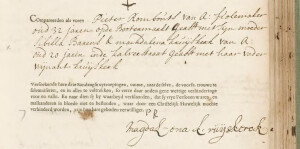
Marriage registration record for Pieter Rombouts and Magdalena Kruijskerck. Source: Amsterdam City Archives.
This marriage brought him into wealthy circles; as a result, the bride and groom received a dowry of 2,250 guilders plus 500 Carolus guilders. To put this in context: in 1711, Rombouts and his father-in-law bought a house for 4,400 guilders, which they renovated together and then resold. In the years that followed, Rombouts carried out several similar business transactions. When Magdalena died in 1750, she left behind more than 53,000 guilders in her will. Rombouts had at least four children, at least two of whom survived him. Rombouts himself was buried on September 27, 1728, a date that also marks the end of the Golden Age of Dutch violin making.
Because the Jacobs-Rombouts workshop existed for nearly 80 years, it is difficult to determine when Rombouts’s influence became visible—or even dominant—in Jacobs’s work. Contrary to the dates mentioned earlier, this likely occurred later than previously thought. In the 1690s, however, two distinct types of border treatments can be seen in Jacobs’ work, which must indicate Rombouts’ presence. It was not until after Jacobs’ death in 1704 that Rombouts began to fully implement his own style, which was generally strongly influenced by Jacob Stainer. While, with the exception of a few other instruments, we are mostly familiar with violins by Jacobs, Rombouts built a wide variety of instruments in addition to violins: viola da gamba, violas, many cellos, and even a few pochetten (pocket violins). He therefore most likely made the largest number of cellos of any luthier from the early Dutch school.

Violin by Pieter Rombouts (c. 1710) from the collection of the Musical Instrument Fund.
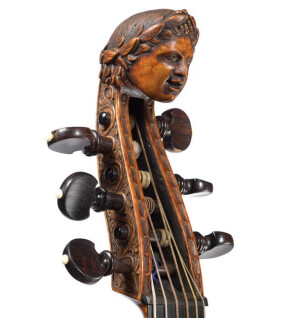
As mentioned earlier, his work is strongly inspired by Stainer but certainly features his own interpretation of the model, with many distinctive details. In particular, his tapered scrolls with thick walls and high curves, along with the sharp edgework, are distinctive and unique. His cellos are also clearly recognizable by the thick inlay used in the edgework—a detail that Jacobs introduced but which Rombouts expanded upon. Although he used many shades of varnish, ranging from bright orange to dark brown, Rombouts is best known for his intense blood-red varnish. The Musical Instrument Fund owns a beautiful violin with this vibrant red varnish.
D.J. Balfoort, 1931 *Dutch Violin Makers*, H.J. Paris, Amsterdam.
Bolink, J., Giskes, J., Lindeman, F., and Stam, S., 1999, 400 Years of Violin Making in the Netherlands, Amsterdam.
Amsterdam City Archives, accessed in 2025


