Instrument

cello
Orsolo Gotti
Pieve di Cento,
± 1900
played by
Mascha van Nieuwkerk
Mascha van Nieuwkerk

*1862 , Pieve di Cento (Bologna) †1922 , Pieve di Cento
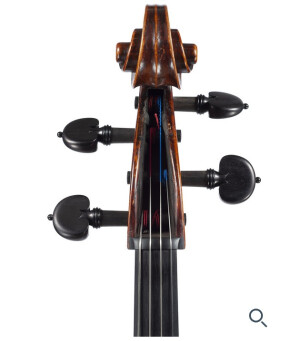
Orsolo Gotti was born in Pieve di Cento, a small town near Bologna in the Emilia-Romagna region. When Gotti was starting his career, many violin makers also had a second job. Most could not make a living from violin making alone. Gotti was no exception; he began as a carpenter and only devoted himself to violin making once he could make a living from it. He was 30 years old at the time. It was his natural talent and dedication that made him a highly skilled violin maker.
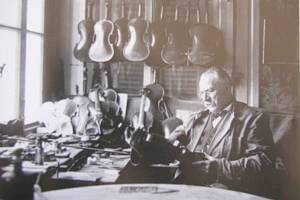
Leandro Bisiach in his studio
Orsolo Gotti’s first teacher was Carlo Carletti (1873–1941). Carletti had started out as an antique dealer, but over the years he specialized in antique musical instruments. This had brought him into contact with important luthiers such as Ettore Soffritti (1877–1928) and Leandro Bisiach (1864–1946). He was captivated by the work of these violin makers and learned the craft from them.
Carlo Carletti set up his own workshop and soon expanded to Pieve, Cento, Bologna, and Ferrara. He ran the business together with his four sons and a nephew. After Orsolo joined the company, he was eventually put in charge of the Cento workshop. Carletti built high-quality instruments that closely resembled those of his two mentors, Bisiach and Soffritti.
In 1902, Orsolo had a son, Anselmo (1902–1962). He, too, apprenticed with Carlo Carletti, after first training as a furniture maker. Anselmo proved to be very talented and later built exquisite instruments.

Luigi Mozzani's workshop. Photo courtesy of Lorenzo Frignani
Cento was also home to one of Luigi Mozzani’s (1869–1943) many studios. Mozzani was an entrepreneur, oboist, and classical guitarist. As an oboist, he had played in the New York Philharmonic Orchestra; later, as a guitarist, he enjoyed unprecedented popularity and was constantly on tour. He had taught himself to make guitars in the style of Guadagnini and had them reproduced in large quantities in his workshops. Between 1908 and 1915, Gotti and Carletti built violins and cellos for him. In 1917, Luigi Mozzani wanted to expand his operations with a large workshop where stringed instruments could be built on an industrial scale. Orsolo, his son Anselmo, and Carlo Carletti helped Mozzani set this up. In addition to stringed instruments, large quantities of guitars and mandolins were also produced there.
In the years leading up to World War I, a sense of optimism prevailed in northern Italy, stemming from an unshakable belief in progress through science and technology. Mozzani, too, was captivated by this spirit and used new techniques to build instruments on a large scale. Although Orsolo Gotti had helped him with this, he himself preferred to continue working in the traditional manner. To that end, he went to Ettore Soffritti in Ferrara, where he became acquainted with Soffritti’s remarkable meticulousness, his purity, and his striking work. He adopted much of Soffritti’s approach to his craft.

Augusto Pollastri, Gotti's last mentor
His final mentor was Augusto Pollastri (1877–1927), the most talented student of Raffaele Fiorini (1828–1898). Pollastri had become one of the region’s leading instrument makers, known for his beautiful lacquer work. From him, Gotti learned a great deal about preparing lacquers and applying them. He later used this knowledge when giving his finest instruments an antique finish.
In 1916, he opened his own workshop in his hometown of Pieve di Cento. Two years later, Anselmo joined him. Together, they built instruments based on Orsolo’s own designs; later, Anselmo helped his father build instruments modeled after those of the great masters.
Orsolo died in 1922. After his father’s death, Anselmo left Pieve di Cento and went to Ferrara to study under Ettore Soffritti, his father’s mentor. It was not until 1931 that he returned to Pieve and opened his first workshop near his father’s former studio. After working in Vienna for several years, Anselmo Gotti settled permanently in Ferrara. He did not take over his father’s workshop, which remained permanently closed.
In the Emilia-Romagna region, where Gotti was born and lived his entire life, Bologna was the center of violin making. It had become so after Italy was hit by a major slump in violin making at the end of the 18th century. In Bologna, the craft had recovered. The Emilian makers built upon the “classical period,” but now without copying the great Emilian predecessors. They developed a style entirely their own—based on their predecessors, yet strongly personalized. Raffaele Fiorini is regarded as the founder of the Emilian school. Although he himself left behind few significant instruments, he served as an inspiration to many other, sometimes great, makers in the region. His lively workshop was frequently visited by curious colleagues. The Emilian school was not limited to Bologna and Ferrara, where Gotti began, but over the years it expanded from Piacenza to Ravenna.
He reproduced some of them so meticulously and then aged them so skillfully that they would later be sold by dealers as the originals
In addition to his own model, which still bore some resemblance to Carletti’s, Orsolo made violins and cellos modeled after Gagliano, Stradivari, Amati, and Montagnana. He replicated some of them so meticulously and then aged them so skillfully that they would later be sold by dealers as the originals.

Back of a cello (circa 1900) in the collection of the National Musical Instrument Fund
Many of the violins he built based on his own design had backs made of alder or poplar, woods used by some classical guitar makers in the Emilia-Romagna region. He did, however, make the sides of these instruments from the usual maple. The sound of these instruments is generally highly regarded.
Orsolo Gotti won first prize twice at exhibitions in Rome—once in 1915 and again in 1920. Museums in Florence and Palermo have added an instrument by Gotti to their collections.
Gotti used a printed label: Gotti Orsolo, Pieve di Cento (Ferrara), with a handwritten date on it.
The cello in the Orsolo Gotti Musical Instrument Fund’s collection is believed to date from around 1900. This instrument also has a back made of alder or poplar wood (see photo).
Panorama of Modern Bolognese Violin Making: Influences and Relationships, 2002, The Scientific Committee "Il Suono di Bologna”, Bologna.
Historical Archives of the Municipality of Pieve di Cento; comune.pievedicento.bo.it.
Versari A., 2002, Modern Violin Making in the Emilia-Romagna Region. Bologna.
Blot E., 2001, 1860-1960 - A century of Italian Violin Making - Emilia e Romagna I, Cremona.
Vannes, R., 1985, Universal Dictionary of Instrument Makers. Brussels.
Brinser M., 1978 Dictionary of 20th Century Italian Violin Makers, Bologna - A living tradition of Violin Making, zp.