Instrument
violin bow
Nicolas Rémy Maire
Paris,
± 1860
played by
Daniils Čiričs
Daniils Čiričs

*1800 , Mirecourt †1878 , Parijs
At the time of Nicolas Rémy Maire’s birth, the chaos of the French Revolution had already reached the provincial town of Mirecourt. It had brought little good, but it did allow the 117 local violin makers and bow makers to finally establish their own professional guild, separate from the woodworkers’ guild to which they had previously belonged. More than half of them, however, remained destitute. The fact that they could now advocate for their own interests offered the prospect of a slightly better future.
The properties of the elite and the clergy in Mirecourt had been confiscated immediately after the start of the Revolution without any form of compensation. Part of what had been a Benedictine monastery before the Revolution served as the gendarmerie’s headquarters, while another part had been converted into a theater. There, the music of the pre-Revolutionary era was no longer performed for the elite; instead, ordinary citizens sang revolutionary songs.
Nicolas Rémy Maire’s parents worked as weavers in one of the small textile factories in the city; they were poor and could barely read or write. The citizens had only just begun to get used to the new calendar, which is why Nicolas Rémy Maire’s birth certificate stated that he was born on the 8th of Nivôse, Year IX. A few years later, it would have read December 29, 1800.
One of the most important bow makers in Mirecourt was Etienne Pajeot. He was a craftsman who was every bit as skilled as the great masters of the trade in Paris, and who was also brimming with ideas for new techniques. Around 1830, he had developed a bow model for which Jean Baptiste Vuillaume of Paris took out a patent. It was with this exceptionally gifted bow maker—whom Millant even calls “brilliant”—that Nicolas Rémy Maire began his career. By the time Nicolas had barely mastered his craft, his bows were already so good that they could easily be mistaken for those of Etienne Pajeot.
After working for several years at Pajeot, Nicolas Maire went into business for himself in 1826, and two years later he married Anne Contal, who was also from Mirecourt. Anne took an active role in the business, which was registered as “Maire-Contal” in the registry immediately upon their marriage.
Health care had been severely lacking during the revolution; nor did it improve immediately afterward. Of the nine children in the Maire-Contal family, only three reached adulthood.
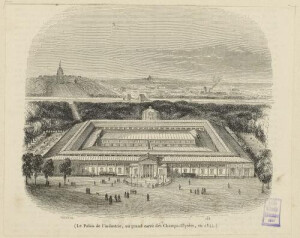
The economic crisis that struck France in 1830 also hit Nicolas and Anne’s business hard. Their company went bankrupt that very same year. By the mid-1840s, they appeared to have fully recovered. In 1844, Nicolas Maire registered for the Exposition Universelle in Paris and stated in his application that he produced approximately 4,000 bow strings per year, generating a gross income of 15,000 to 16,000 francs, and employed 15 workers. This exhibition was a major event, organized at Napoleon’s behest to showcase his grandeur. He invited 60,000 participants to display their achievements in their respective fields. Nicolas Rémy Maire also received an invitation. The Exposition remained open for a year and attracted 11 million visitors. J.B. Vuillaume won gold, and Gand & Bernardel Frères won a silver medal for their entry. Nicolas Maire’s bows were praised for their resemblance to the finest bows by Etienne Pajeot, who, incidentally, did not participate because his reputation was already well and truly established.
It is likely that during that exhibition, Maire met colleagues from Paris who put him in touch with the major workshops in the capital, including Maison Gand, which had emerged from the crisis unscathed.
In 1849, his friend and mentor Pajeot died; Pajeot had been the focus of much of his work in recent years. Almost immediately after Pajeot’s death, he moved part of his business to Paris, where he opened a shop on Rue de Viarmes, but he continued to maintain his workshop in Mirecourt until at least 1853. Given the large number of ceremonies at which he served as a witness, he must have been exceptionally well-liked, but he was apparently not a good businessman, for in 1853, Maire-Contal in Mirecourt was once again declared bankrupt. Nicolas Maire was now able to focus entirely on their Paris location.
Anne Contal withdrew from the business, but her son François took her place. From 1853 to 1866, the company was therefore known as “François-Maire.” Thanks to the fact that he had worked at Pajeot for many years—loved by some, hated by others, but recognized by everyone as a master craftsman—he began working for some of the capital’s biggest names, most notably Jean Baptiste Vuillaume, but also for Maison Gand & Bernardel Frères and George Chanot.
After 1866, his son left, and the company changed its name back to “Maire.” Shortly before his death, Nicolas moved to Montmartre, at 10 Rue Burq, where his son-in-law, Etienne Hildibrand, had a workshop. Nicolas Rémy Maire died there on June 17, 1878. After his death, Anne sold the household goods—including all the unsold bows—to Maison Chanot & Chardon.
Given that Nicolas Rémy Maire had worked alongside Etienne Pajeot for many years, it is not surprising that, in the early years after he established himself as an independent craftsman, he made bows that were virtually indistinguishable from those of his mentor.
From the moment he opened a shop in Paris, his bows took on the more common, metropolitan style of Claude Fonclause, a rather prominent contemporary with whom Nicolas Maire had worked alongside at Etienne Pajeot.
Over the years, Nicolas Rémy Maire perfected his craft. Between 1840 and 1855, he used exquisite wood and often incorporated multicolored mother-of-pearl, gold, and ivory, but he rarely developed his own designs. Instead, he often crafted them according to the client’s wishes. For Gand, Pajeot, and certainly for Vuillaume, the quality of his bows was impeccable.
Nicolas Rémy Maire was an outstanding craftsman, but he needed challenges to produce work of the highest quality. Technically speaking, Maire’s bows are always flawless. In Millant’s opinion, his best bows are comparable to the finest ones made in the 19th century.
The bows in the Musical Instrument Fund's collection both date from around 1850–1860 and are a good example of the work he produced during his time in Paris.
Millant, B., Raffin, J.F., (2000) *L'Archet: French Bowmakers, 1750–1950*.
Tarisio, Cozio Digital Archive, accessed in 2021.
Vatelot, E. (1976), *Les Archets Français*.
Henley W., 1959 Universal Dictionary of Violin and Bow Makers. Amati Publications. London.
Geneanet, accessed in 2021.
Archives Nationales de France, accessed in 2021.

