Instrument

violin
Nicolas Lupot
Paris,
1808
played by
Erten Deniz İspir
Erten Deniz İspir

*1758 , Stuttgart †1824 , Parijs
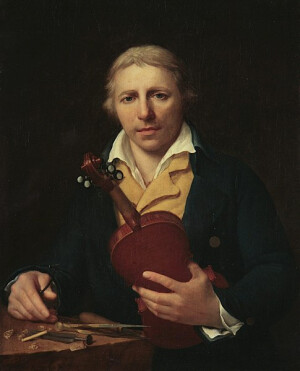
During his youth, Nicolas lived near the court of Württemberg, first in Stuttgart and later in one of the outbuildings of Ludwigsburg Palace. The duke did everything in his power to ensure that his court surpassed the opulence of Versailles. To that end, he not only had a concert and theater hall built, but also employed two court composers, his own concertmaster, and his own violin maker.
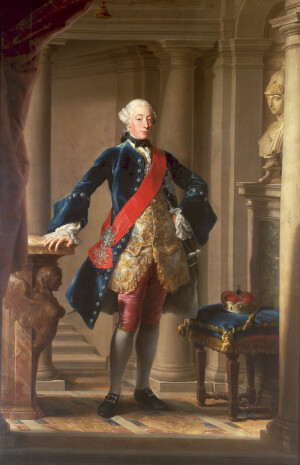
Karl Eugen of Württemberg
Karl Eugen von Württemberg’s tastes were conservative and leaned toward the prevailing Baroque style. His taste extended not only to music but also to the entire court entourage, which was organized in that style. His composers were commissioned to write music in the Baroque style; the duke would not tolerate newer variations. It was in this environment that François Lupot worked and built his instruments, tailored to the music being performed there. It was there that Nicolas received his first lessons from his father. In 1768, the same year that the first court composer, Jommelli, was dismissed by the duke, François Lupot also left. He had worked for fourteen years for the music-loving but authoritarian duke.
Their new home was Orléans. There, Nicolas initially made his first instruments under his father’s guidance, and from 1782 onward, he did so independently. François and his son built violins, harps, lutes, theorboes, and bows in the prevailing style. Nicolas would remain with his father for 36 years before moving to Paris in 1796 to work for François-Louis Pique.
This was preceded by a period of exploration. François-Louis Pique was a renowned violin maker, and one of his clients was Giovanni Battista Viotti, who owned a Stradivari from 1709. Viotti was influential—not only as a virtuoso violinist, but also as a composer and director of various French and English opera companies. He preferred his Stradivari, which allowed him to play with a warmer—but above all, more powerful—tone than on Baroque-era instruments, using a different technique. He taught this to his students as well, including Rudolph Kreuzer and Marie-Pierre Baillot. Thanks to these highly regarded musicians, the new Italian instruments quickly gained great prestige. François-Louis Pique recognized the success of the new violin preferences championed by Viotti and began building violins based on the Italian school.
The French Revolution: even the fiddles of days gone by were no longer in vogue
During that transformation, François-Louis Pique was looking for someone who could work with him to meet the demand for new instruments. It was Michel de Woldemar who recommended Nicolas Lupot to Pique for that purpose. At first, Pique offered to sell a few of Nicolas Lupot’s instruments. He then sent wood so that Lupot could build violins for him. Finally, he invited him to come to Paris. During this period, Nicolas Lupot witnessed in Paris the enormous changes in French society that had led to the French Revolution, in the midst of which he now found himself. Nothing had remained the same; the elite no longer existed, and the citizens were now in charge. Even the violins of the past were no longer in vogue; Stainer and Amati models were out, while those by Stradivari and Guarneri were preferred. These were better suited to the new revolutionary music. While Viotti played a leading role in Paris in changing performance practice, Pique closely followed suit with his new instruments. During the four years he worked for Pique, Nicolas Lupot learned to craft instruments tailored to the new tastes of performers and audiences.

Four years later, in 1798, Nicolas Lupot established himself as an independent violin maker in Paris. He quickly gained a strong reputation as a maker of fine instruments built in the Italian style, and his varnish could rival that of the Italians. His admiration for Stradivari was clearly evident in his work; in 1824, a book was published containing conversations between Abbé Sibire and Nicolas Lupot in which he expressed his admiration for the instruments of Stradivari and those of Guarneri.
In 1806, he moved his workshop to Rue Croix-des-Petits-Champs, also in Paris. He continued to work there for the rest of his life. This period is generally regarded as his finest.
His mastery is widely recognized: he received awards at the Concours du Conservatoire de Musique and was appointed Honorary Luthier to Louis XVIII
His contemporaries recognized him early on as a master of his art; beginning in 1797, the grand prize for the finalist of the Concours du Conservatoire de Musique was a violin by Nicolas Lupot. This tradition would continue for years. Starting in 1816, Nicolas Lupot even supplied all the string instruments for this conservatory.
Political upheaval had brought France, in succession, the Enlightenment, the Modern Era, Napoleon, and—after his fall—Louis XVIII, all of whom had brought about changes in musical culture. When Louis XVIII restored the monarchy in 1814, Nicolas Lupot’s reputation was such that, just one year later, he was appointed Luthier Honoraire de sa Majesté le Roi Louis XVIII at the Chapelle Royale of the French court.
In 1782, Nicolas Lupot married Marie Christine Devreau. They had no children of their own but adopted Cornélie Squimbre, the daughter of friends. Around 1802, Cornélie married the violin maker Charles-François Gand. He joined Nicolas Lupot’s workshop that year and continued to work there until he left for Versailles in 1812. When Lupot died in 1824, his son-in-law Charles-François Gand inherited the business, including the court appointment and membership in the Académie. Gand would continue to run the workshop for two years before opening his own workshop in Paris together with Lupot’s other apprentice, Auguste Sébastien Philippe Bernardel.
Nicolas Lupot’s work spanned several periods. Few of the instruments he made during his time in Stuttgart have survived. The period from 1782 to 1796 in Orléans is considered his transitional phase. His instruments were based on models by his father and by Amati; from 1796 onward, he was strongly influenced by Pique and Stradivari. After 1798, his work became more independent of other makers, and he ultimately reached his most mature style after 1806. In addition to his own model, Lupot also built instruments based on Stradivari and Guarneri during this period. He used four different labels during his time in Orléans and six during his time in Paris. His body of work is considered the very best in France.

Label: 1815–1824. Photo courtesy of: Gaël Français
Nicolas Lupot had three influential students: Charles-François Gand, who worked with him from 1802 to 1812, and Auguste Sébastien Philippe Bernardel. Starting in 1798, his brother François II worked in his studio. He was later joined by Pierre Silvestre.
Both violins in the collection of the Musical Instrument Fund date from Lupot's heyday.
Milliot, S. and Perrin, N. 2017, Lecture 3; European Stringed Instrument Making Day. Cordes sur Ciel.
Carlson B., Schmitt J. F., Moroder I., Leonhard F., Italian & French Violin Makers - Vol. 1, 2001, Cologne.
Vannes, R., 1999, *Universal Dictionary of Instrument Makers*, Spa.
Henley W. , 1959 Universal Dictionary of Violin and Bow Makers. Amati Publications. London.
Jaquot, A., 1912, *Lorraine and French Violin Making*, Paris.
Sibre, A. 1824, *La Chélémonie, or The Perfect Luthie*. Paris.