Instrument

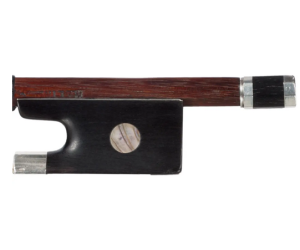
violin bow
Nicolas Auguste Eugène Maline
Paris,
± 1895
played by
Daniel Rowland
Daniel Rowland

*1855 , Mirecourt †1917 , Choisy le Roy
Nicolas Auguste Eugène was the only son of Nicolas Maline and Thérèse Ruffière. His parents lived and worked in Mirecourt, where Nicolas Auguste was born in 1855. As a bow maker, his father had been trained by Guillaumey Maline and presumably also by Etienne Pajeot, and had worked for many years starting in 1840 for the renowned Jean Baptiste Vuillaume. There he had learned to make the bow model that Vuillaume had developed. When he started his own business, he initially continued to make the Vuillaume model frequently, but over the years he would become increasingly influenced by the work of Dominique Peccatte.
When the French Republic was proclaimed in 1848, Nicolas Maline was drafted into the army of Louis Napoleon. He was undoubtedly a distinguished soldier, for in that same year he was knighted as a Chevalier de l’ Ordre National de la Légion d’Honneur. During his absence, work in his studio came to a virtual standstill. After completing his military service in 1850, he married Marie Anne Grandcolas, and five years later their son, Nicolas Auguste Eugène, was born. By then, Nicolas had become independent and, in a short time, had built up his own thriving workshop with several employees. Starting in 1848, the stamp he used to brand his bows featured a scaled-down image of the Croix de la Légion d’honneur behind his name.
Nicolas Auguste, as was customary at the time, apprenticed with his father. Like his father, he continued to make bows according to the Peccatte school, but with a slightly rounder tip and a more angular shaft. In their workshop, they made bows not only from the customary pernambuco but also from other woods such as snakewood, letterwood, and brazilwood.
Starting in 1870, just as Nicolas Auguste had completed his training and begun working as a full-fledged bow maker alongside his father, a difficult period began. Napoleon had declared war on Germany but was defeated and taken prisoner. As a result of the defeat, France was forced to pay Germany reparations that all French people considered unreasonably high. Taxes rose sharply, and the French had much less disposable income. The music scene also suffered as a result. Due to anti-German sentiment in France, music by any German composer was no longer performed. Maline’s workshop, which had once been so prosperous, received so few commissions that Nicolas could only manage the workload with his father’s help. It was only when the Société Nationale de Musique—founded to promote French music—began organizing concerts throughout the country that Maline once again benefited from the resurgent musical culture. The Belle Époque that had thus begun also brought prosperity to Maline. The workshop recovered, and within seven years, Maline had rebuilt a thriving business. Several bow makers were once again employed there, including his uncle and cousin. With their help, Nicolas Auguste took over the management of the workshop when his father died in 1877.
A year after his father’s death, Nicolas Auguste married Marie Josephine Bernard and, in 1885, had a son, Joseph Emile, who would later become a violin maker. The business prospered until around 1900; the bows they made were of good quality and in high demand. But after the emergence of several large workshops in his area—such as that of the charismatic and influential Charles Nicolas Bazin—he was unable to respond to this competition, and the business gradually went into decline. After the turn of the century, Nicolas Auguste even found himself forced to close his workshop. He found a job as a bow maker in the Cuniot-Hury workshop.
Maison Cuniot-Hury was a renowned company that employed about 12 bow makers in 1906. Nicolas Auguste had known Eugène Cuniot from the time when Eugène was working as an apprentice bow maker for his father. Cuniot allowed his employees a certain degree of freedom. A few worked in the style of Bazin or Ouchard, while others followed their own unique approach. It is not known until what year Nicolas Auguste worked at Cuniot-Hury, but in 1917 he registered as a resident in Choisy-le-Roy, near Paris. Sources mention that he continued to make bows there for his uncle and cousin, but this cannot be confirmed. After that, all traces of him are lost.
The bows that Nicolas Auguste made around 1870 show that he was a student of his father; his bows display clear similarities in style, but are slightly less refined. From that period, he is known to have made violin bows in the Vuillaume style and a few cello bows in the Peccatte style. The latter have a slightly rounder ferrule and a more angular shaft. He continued to make that model until 1875.
After 1875, he changed the design of his bows. He witnessed the rise and success of Charles Nicolas Bazin and was so influenced by it that his designs began to resemble Bazin’s. During this period, there are still a few known cello bows by him based on Peccatte’s designs, featuring an elegant “swan-neck” frog. His work is of high quality, and his craftsmanship is precise.
Very few bows by Nicolas Auguste Eugène Maline are known to exist. Bows from his prime are highly sought after. Until the end of his career as an independent bow maker in Mirecourt, he stamped his bows with his father’s brand.
The bow in the collection of the Nicolas Auguste Eugène Maline Musical Instrument Fund was likely made by him during the middle of his second and final creative period.
Millant, B., Raffin, J.F., 2000, *L'Archet: French Bowmakers, 1750–1950*. Paris.
Childs P., 1986, The bow makers of the Peccatte family, New York.
Vatelot, E., 1976, *Les Archets Français*. Nancy.
Tarisio, Cozio Digital Archive, accessed in 2019.
Geneanet, accessed in 2019.
Archives Nationales de France, accessed in 2019.
Mesdemarches.culture.france, accessed in 2019.