Nicola (Nicolò) Gagliano
*± 1710 , Napels †± 1785 , Napels
Four of Nicolò’s sons also became violin makers. The new Teatro San Carlo, built to be the most beautiful and largest in Europe, attracted countless musicians to Naples. The demand for stringed instruments became so great that there was enough work for them in Naples to support a family. The Gaglianos were not the only ones, but they were the city’s most important violin makers.
Nicolò Gagliano must have been very productive throughout his life; a remarkably large number of instruments made by him still exist. He built his first violin around the age of 17, and his last one 58 years later. He died in 1785. Nicolò’s influence would be evident in the work of other Neapolitan makers for more than a century.
Life and Career
Of the thirteen violin makers produced by the Gagliano family, Nicolò—the second and middle son of Alessandro Gagliano—was the best known and most influential. His brother Gennaro, eight years his senior, is less well known but was also a violin maker. Connoisseurs now consider his work to be slightly more refined than that of the other Gaglianos. We know little more about Carlo, his other brother, than a few violins that bear his name.
When Nicolò’s father, Alessandro Gagliano, began his career, there was hardly any Neapolitan violin-making tradition to speak of. However, many instruments were built in and around the city—not by Neapolitans themselves, but by lute and violin makers from the German city of Füssen.
German architects had flocked to Naples in large numbers by the end of the 17th century. Like Venice and Rome, Naples was a cultural metropolis at that time. Music filled every street corner, and for those who could afford it, life there was carefree and joyful. There was intellectual debate on every conceivable topic, and a royal court that encouraged new compositions, where operas and ballet performances drew massive crowds. The city’s four conservatories supplied the composers, singers, and instrumentalists. Consequently, the demand for instruments was high. German instrument makers such as Magnus Lang, Matthaus Selloß, Jacob Stadler, and Georg Kayser met that need. They brought with them high-quality instruments and a high standard of craftsmanship. Over the years, the early Neapolitan style of instrument-making blended with the German style to form a new and highly recognizable Neapolitan style.
Nicolò’s father was undeniably inspired by these luthiers from Füssen. It is not known from whom he learned the craft. He himself claimed to have been an alumnus (student) of Stradivari, but he was not a student of Antonio’s; the differences in their construction methods and in their instruments are simply too great for that. It cannot be ruled out, however, that he did learn a great deal from Antonio’s son, Omobono Stradivari. Omobono had worked with his father for about six years and, at the age of eighteen, was sent on a study or trade trip. In 1697, he arrived in Naples. There, much against Antonio’s wishes, Omobono stayed for over two years. Omobono lacked even a fraction of his father’s talent and ambition, but he had seen firsthand how things were done in Antonio’s workshop in Cremona. Experts speculate that Omobono spent some time in Alessandro Gagliano’s workshop, where a few German violin makers were presumably also working.
Even before Nicolò was born, his father—the only violin maker in town—had a small but steady source of income. Records from the archives of the Neapolitan conservatory, Santa Maria di Loreto, show that from 1701 to 1722, Alessandro performed repair work on their instruments for a fixed salary. Santa Maria di Loreto was the most important of the four Neapolitan conservatories. As early as the late 16th century, orphaned boys were introduced to music theory there and learned to play an instrument or sing. In Alessandro’s time, the Santa Maria di Loreto’s ties to the Church had largely been severed, and others could also be trained as professional musicians for a fee. The conservatory was often led by established composers. The “Loreto” offered three main programs: voice (it was the premier training program for castrati), violin, and composition. The standard of instruction was so high that even then it was regarded as one of the best music schools in Europe.
Nicolò was born around 1710 as the second of Alessandro’s three sons. He likely learned a great deal from his father, but given the differences between the instruments made by father and son, he must also have received instruction from other luthiers. His body of work bears such a strong resemblance to that of Antonio Stradivari that some of his violins were mistakenly considered authentic Stradivarius instruments. However, Nicolò’s presence in Cremona has never been proven. Nicolò and his oldest brother, Gennaro, worked for some time in their father’s workshop until they set up their own businesses. The demand for instruments in Naples was apparently so great that there was plenty of work for the Gagliano family of luthiers.
When Nicolò completed his training, he was given a one-year contract at Santa Maria di Loreto, just like his father. “Magnifico Nicolò Gagliano was paid three ducats and 3.15 grana by the Bank of S. Eligio as wages for six months of work, which corresponds to his annual stipend of 7.2.10 ducats for the task of repairing the violins, cellos, and double basses of the Conservatory and the Holy House of Loreto, in accordance with what had been agreed upon and which was carried out to satisfaction”. Twenty years earlier, his father had received the same salary for the same work.
In 1744, Nicolò was given a second permanent contract. It was with “I Poveri di Gesù Cristo.” This conservatory was a former almshouse where excellent music instruction was now provided. It was part of “Il Figlioli Filippini,” a powerful religious order with strong ties to the Vatican. At Santa Maria di Loreto, vocal instruction was very important; at the Poveri, singing was forbidden. Nicolò was tasked with repairing all the string instruments at the Poveri and performing related duties. He was paid slightly more there than at Santa Maria di Loreto: 8 ducats. Nicolò would maintain the instruments at this conservatory for fourteen years. In 1758, he received his final salary. He was compensated for extra work: ”1 ducat for Maestro Nicola Gigliano for repairing a completely broken cello (“rotta é tutta scassata”) that belonged to one of the children (figlioli).
Around 1724, Nicolò married, and the first of their four sons was born: Ferdinando (1724–1781), followed by Giuseppe (1725–1793), Antonio (1728–c. 1807), and Giovanni (1740–1806). All four became violin makers. Ferdinando did not stay long in his father’s workshop. He was trained by his uncle Gennaro and subsequently worked independently. Nicolò did train his second son, Giuseppe, himself, but Giuseppe, too, did not stay long. He worked together with Antonio, his youngest brother, in their own workshop. There was plenty of work for all the Gaglianos.
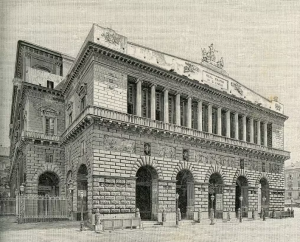
This trend only intensified initially when, in 1734, a new monarch, Carlo of Bourbon, settled in Naples with a large entourage. He was a megalomaniac and had strong ideas about what the grandeur of a great European court should look like. To further his own glory, he commissioned, among other things, the construction of the “San Carlo,” an opera house that was to become the most beautiful and largest in Europe. As a result, even more musicians were drawn to Naples. According to the writer and member of the Academy of Sciences, Charles de Bosses, Naples had quickly become the musical capital of the world. The violin makers of the Gagliano family were not the only ones, but they were certainly the most important violin makers in Naples.
Due to Carlo of Bourbon’s failed economic reforms, the city had become poor and overpopulated by the time Nicolò turned thirty. Prosperity was increasingly reserved for fewer and fewer Neapolitans. A large segment of the population suffered from severe hunger, and ten years later there were 9,000 homeless people. Yet Nicolò was exceptionally productive during that period. Many instruments have been discovered that were built between 1740 and 1750. Poverty reached its lowest point in 1764. In that year alone, thousands of Neapolitans died from malnutrition and disease. Consequently, very few instruments by Nicolò survive from the 1760s. Nicolò was able to make a living from his work for the conservatories and from the instruments he built. His clients likely consisted mainly of a small upper class of the population.
Given the large number of instruments by Nicolò that have survived, he was very productive for most of his life. He made the earliest violin that has been found when he was around 17 years old; the latest one dates from 1783. He died two years later.
Nicolò Gagliano’s influence on Neapolitan violin making can hardly be overestimated. It spans a period of 120 years, during which much of his work can be seen reflected in the work of others. The best-known example is undoubtedly the Ventapane family, of which Lorenzo (1790–1845) is the finest representative.
Label: Made by Nicholas Gagliano, son of Alexander, Naples 1775.
In addition to his label, Nicolò often placed a small piece of paper with a religious text inside an instrument.
Work and Influence
To connoisseurs, it is clear from Nicolò’s work that he was very familiar with that of Antonio Stradivari. Nicolò did copy his model, but he did so with an unmistakably unique style of his own. Despite this, many of his violins were mistaken for those of Antonio Stradivari.
His father used excellent wood from the local area; the wood that Nicolò and Gennaro used later came from northern regions.
Nicolò’s instruments were exceptionally well-proportioned, featuring an unusual headstock with a narrow, curled scroll and an elongated keybox.
To finish their instruments, Nicolò and Gennaro used a yellow undercoat over which they applied a red-orange oil varnish. For the glue joints on the inside, they used beech wood. And like most Neapolitans, they made the outer layers of the rim inlay not from thin strips of painted wood but from black cardboard.
Given the large number of instruments that left his workshop, Nicolò likely had several apprentices and employees; Tomaso Eberle (1727–1792), who came from the Füssen area, is the best known of them.
The instrument in the collection of the Musical Instrument Fund is a magnificent example of what he built during his prime.
Sources
Di Giacomo, S., 1924. I quattro antichi conservatori di musica a Napoli (The Four Ancient Music Conservatories of Naples), Milan.
Florimo, F., 1882. The Music School of Naples and Its Conservatories, with a Look at the History of Music in Italy (The
Music School and Conservatories in Naples, with a look at the musical history of Italy). Napels.
Acton, H., 1956, The Bourbons of Naples, 1734–1825. London.
Oliveri G., 1989, Two Centuries of Violin Making in Naples, Napels.
- Auteur
- Jan Boekhout
- Date
- 24 September 2022