Instrument

violin
Matteo Goffriller
Venice,
1699
played by
Lucien Renette
Lucien Renette

*± 1659 , Bressanone †1742 , Venetië
Matteo Goffriller was born around 1659 in the town of Bressanone, which is located near Bolzano. Little is known about his early life other than that he learned to make instruments from Mattias Albani, a violin maker from Bolzano whose influence extended as far as Rome. The Albani family largely dominated the violin-making market in the region, forcing Matteo to look for a place with better opportunities for a successful career.
Venice offered the best opportunity for that. The city attracted musicians with the allure of its colorful, exuberant life. It was an urban existence set to music. Aristocratic families owned opera houses and, in some cases, valuable collections of instruments. They played and sang themselves and appreciated skilled musicians. The separation of church and state was blurred there. The Doge, who was elected by the people, presided over both spiritual and political affairs. Public festivals—of which there were more in Venice than anywhere else in Europe—were musically vibrant and spectacular events. Venice never had fewer than six opera companies, which together performed a total of thirty-four weeks a year.
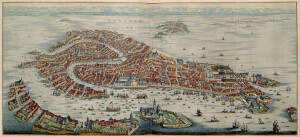
Venice, 17th century, map by Joan Blaeu
Between 1700 and 1750, Venetian audiences saw and heard ten or more new operas each year. Venetian nobles, religious brotherhoods known as Scuole, and academies financed the musical programs on a large scale. Talented musicians were generously rewarded. On holidays, church services were less like religious ceremonies and more like grand instrumental and vocal concerts. German-speaking instrument makers—who were generally far more skilled in their craft than builders from other regions—had therefore flocked to the city in large numbers from an early stage.
Matteo turned out to be a perceptive, talented man with a deep understanding of violin making and the related fields
In 1685, Matteo Goffriller moved to Venice. To find work in that city, he had to comply with the strict requirements that the Ordine dei Marzeri (Guilds) imposed on newcomers. He had found the lute maker Matthias Kaiser—for whom his sister had once worked—willing to hire him as an apprentice in his workshop. Kaiser also introduced him to the complex Venetian social scene. Kaiser, who came from the same region as Matteo Goffriller, had already established a good reputation in Venice. Matteo may have assisted Kaiser in building a few lutes, but he soon built his first Venetian violin in Kaiser’s workshop.
Matteo proved to be a perceptive, talented man with a deep understanding of violin making and the trade in general. This made him one of the city’s most prominent luthiers. A year after his arrival, in 1686, he married Kaiser’s daughter. Their wedding took place at the Chiesa di San Giovanni Grisostomo and was attended by many of their compatriots living in Venice. His son Francesco was presumably the first of the twelve children that Matteo and his wife had. As a boy, he became his father’s apprentice and built his first violin as early as 1709.

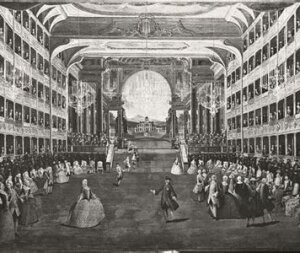
San Giovanni Grisostomo Theater, Venetië
Matteo’s earliest instruments can no longer be traced. Because he did not want to comply with the strict requirements of the guilds, which demanded high dues, and to avoid Venice’s taxes, he sold them without mentioning his name on the instrument or on a label. It was only after he joined the Ordine dei Marzeri in 1689 that he was able to take over the workshop of a German luthier and, for the first time, affix his own Venetian label to his instruments. His shop was located between his father-in-law’s shop and the San Giovanni Grisostomo theater, where concerts were held for the more affluent Venetians. After his father-in-law’s death in 1694, Matteo inherited his business and presumably merged the two workshops.
Despite the fact that there were many violin makers working in Venice, Matteo Goffriller had no serious competitors over the next twenty-five years. Matteo Goffriller rose to become the leading Venetian violin maker and thus exerted a major influence on the makers who had settled in the city over the years. Matteo Goffriller could afford to build violins on commission.
Another significant portion of his commissions came from the Ospedales, of which the Ospedale della Pietà was the most famous

Giovanni Legrenzi
One of his clients was Giovanni Legrenzi (1626–1690), the new Maestro di Capella of St. Mark’s Basilica and Monteverdi’s successor. Legrenzi had arrived in Venice the same year as Goffriller. Shortly after his appointment, the number of instrumentalists at St. Mark’s was expanded from 12 to 34. Giovanni Legrenzi also decided to replace the various sizes of six-stringed “viols” that still dated from the Baroque period with “modern” instruments in his orchestra. Legrenzi was particularly in need of cellos that could better support the new music. Giovanni Legrenzi lived to see only a short time of the reform of his Capella; he died in 1690, but Matteo had work for a long time to come.
Another, by no means insignificant portion of his commissions came from the Ospedales, of which the Ospedale della Pietà was the most famous. It was a combination of a girls’ orphanage, a conservatory, and a convent. Under Vivaldi, who was in charge there, music education at the Ospedale della Pietà had reached a very high level. Large audiences attended their performances. A new oratorio or concert was composed for virtually every holiday. The Ospedales possessed a large collection of their own instruments, which, as the musical style and corresponding tuning changed in the early eighteenth century, had to be adapted or even replaced.
Guarneri and Tononi opened their own workshop in the city and attracted many customers. They became Matteo’s most formidable rivals
Around 1705, Matteo Goffriller had so much work that he had to expand his workshop by hiring a few more employees in the years that followed. Francesco left his father’s workshop and started his own business in 1709, but it was likely Santo Serafin (1699–ca. 1758) and Francesco Gobetti (1675–1723) who joined Matteo. Attracted by the opportunities in Venice, other skilled luthiers also came to the city. Carlo Annibale Tononi (1675–1730) came from Bologna and Pietro Guarneri (1695–1762) from Cremona. Both arrived in 1717. The experienced Pietro Guarneri brought with him a wealth of knowledge about violin making from his Cremonese family, with whom he had worked for ten years, but he also knew a great deal about how his former fellow townsman Stradivari had built his empire. Tononi brought knowledge of violin making from Bologna. Both makers were influenced by Matteo Goffriller, but were not yet direct competitors of his.
Around 1725, that changed. Guarneri and Tononi opened their own workshop in the city and attracted many customers. They became Matteo’s most formidable rivals. Not long after their rise to prominence, Matteo Goffriller’s health began to fail. His health deteriorated around 1730, leaving him barely able to work during the last twelve years of his life.
Matteo Goffriller died in 1742. His influence on Venetian violin making can hardly be overstated. This is evident in the work of virtually all Venetian violin makers who came after him.

Violin by Matteo Goffriller, 1699, Collection of The Netherlands Musical Instrument Foundation
In Venice, Baroque instruments continued to be built predominantly until 1650, with a great deal of freedom in their design. The designs varied according to the prevailing ideas of the time. A truly strict, unambiguous violin-making tradition, such as that in Cremona, did not emerge until several years after Goffriller’s influence. But even when he was already building “modern” instruments, his instruments still varied considerably according to the individual wishes of his clients. In Venice, the pitch of the music was significantly higher than in other parts of Europe. During the second half of the eighteenth century, the tuning was lowered from the customary A’=465 to 440, a difference of a half-step. This necessitated adjustments to existing instruments, but in most cases, they had to be replaced entirely.
His trademark became a vibrant reddish-brown varnish, the formula for which he had likely learned from Albani. It was a soft varnish that he applied generously, causing it to often develop craquelure. This color became a hallmark of instruments from the Venetian school well into the nineteenth century.
Around 1709, Matteo Goffriller must have already seen instruments made by his contemporary Stradivari. The violin he built that year bears a strong resemblance to Stradivari’s “Lady Tennant” from 1699 and to the “Dancla” from 1703.
Between 1712 and 1721, he built mainly violins. After that, he began producing his successful cellos, which were relatively small in size. He chose excellent materials for most of his instruments. His instruments—and his cellos in particular—are second only to those of Stradivari; musicians sometimes use the metaphor “boiling oil” to describe the intense sound of his cellos.
Goffriller’s work was virtually unknown until the 1920s. His instruments were attributed to Bergonzi, Montagnana, or even to Guarneri and Stradivari.
He likely built the instrument in The Netherlands Musical Instrument Foundation's collection shortly after he opened his own workshop.
Goldfarb T., 2015, Art and Music in Venice, Londen
W. Henry Hill, Arthur F. Hill & Alfred E. Hill, 1910, The Violin Makers of the Guarneri Family, 1626-1762, Londen
Landon Ch., 2007, The Strad Magazine
Vannes, R., 1981, “Universal Dictionary of Instrument Makers,” Brussels.
The Strad; In Focus 2013; John Dilworth
Tarisio; the Cozio archive, bezocht in 2020