Instrument

violin
Marten Cornelissen
Northampton,
1986
played by
Diego de la Cruz Tortosa
Diego de la Cruz Tortosa

*1936 , Apeldoorn †2021 , Northampton (VS)
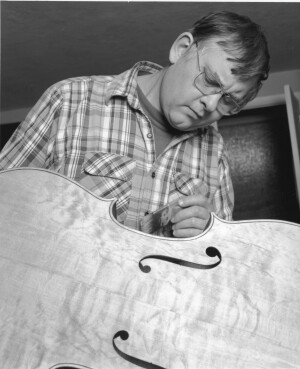
He entered a competition in Belgium with one of his violins, where he stood out. At the urging of one of the judges, Marten went on to study with a violin maker in the Czech Republic. He proved so talented that, shortly thereafter, he placed second at the Concours International de Quatuor à Cordes in Liège. At the invitation of a friend, Marten traveled to the United States, where he began working as a violin maker. There he met his wife and settled with her in Northampton, Massachusetts. They saved up to buy materials for his instruments. He soon caught the attention of classical musicians, who saw his instruments as a worthy substitute for the old Italian or French ones that had become unaffordable. Even renowned musicians who played on old master instruments greatly appreciated his work. He built some 600 instruments, including guitars, violins, violas, and cellos.
Marten Cornelissen passed away in 2021. His personality and work made him a particularly beloved craftsman, especially in the United States.
Marten Cornelissen. Photo: John Mc Lachlan
In the family where Marten was born, the radio, the church, his mother’s beautiful voice, and a few classical records shaped his musical ear.
Gerrit Marten Cornelissen, born in 1936 and named after his grandfather, was the oldest of four children. His father was a machine fitter, and his mother took care of the family. When his father was sent to a labor camp in Germany during the war, his mother was left behind with three young children. That brought the family closer together.
After high school, Marten had to fulfill his military service. By a lucky coincidence, he ended up in the Air Force Military Police. This was a perfect fit for his interest in airplanes, which had been sparked by the experiences—both fascinating and frightening—of his earliest childhood, when, during World War II, large numbers of German planes flew over Apeldoorn on their way to England to carry out their destructive missions. As a boy, he built scale models of those planes. Armed with that skill, he went on to make guitars as well. He didn’t learn to build and play the violin until later.
‘That marked the beginning of whathe himself called his “true calling”’
Immediately after high school, Marten started working at Van Gelder Papier in Apeldoorn. There, he trained to become a technician. Around the age of 20, he came across a broken violin. Instead of taking it to a luthier, Marten decided to repair it himself. That marked the beginning of what he himself called his “true calling”: becoming a luthier. In his spare time, he built about ten violins, first using his own violin as a model, and later drawing on books about violin making, from which he also learned the techniques for crafting them.
In 1963, Marten competed unsuccessfully in an international competition for violin makers, which he described in a 2019 interview as an “experience that was as motivating as it was humiliating.” “It inspired me greatly, but I also realized very clearly that I still had a lot to learn.”

Vladimir Pilař
Josef Vedral from The Hague advised him to take lessons from Karel and Vladimír Pilař in the Czech Republic. Karel Pilař was one of Josef’s former students and a leading representative of the “Krkonoše School” of violin makers. He was known for his restoration work and for the modifications he made to improve the sound of violins. Many leading players sought him out for this reason. Karel Pilař had trained his son Vladimír himself.
Vladimír successfully competed in international violin-making competitions and was a much-sought-after jury member. Vladimír built violins in the style of the old Italian masters, but was also well-versed in the new insights that modern science had produced. He applied these to his work as much as possible. Combined with his in-depth knowledge of the ancient Eastern European violin-making tradition, he crafted master instruments with a full and powerful sound.
Martens' apprenticeship with the Pilař father and son lasted no more than six weeks. During that time, under the guidance of Karel and Vladimír, he built a violin and absorbed as much knowledge as possible from the two luthiers. In the process, a warm friendship developed between Vladimír and Marten.
Once back in Apeldoorn, Marten decided to make this craft his profession. Using the knowledge he had gained from the Pilařs—father and son—Marten built his next series of violins. Encouraged by Vladimír Pilař, Marten submitted four violins to the international Concours International de Quatuor à Cordes in Liège in 1966. For this, he won a silver medal. Three years earlier, Vladimír Pilař had won second prize at the same competition.
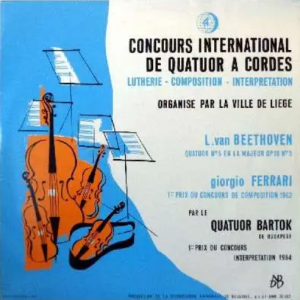
LP cover of a recording from the Liège String Quartet Competition (1964 edition)
In Liège, Marten met a dealer in stringed instruments who invited him to come work for him in Kansas City. In 1966, at the age of thirty, Marten left for the United States. There, he met Cornelia Blair, whom he married later that same year.
That same year, Marten also met Philipp Naegele, a musicologist who had graduated from Princeton University and was teaching violin at the small but prestigious Smith College in Northampton. The chamber music concerts he gave were of an exceptionally high standard. Since 1950, Naegele had been part of a group of exceptional musicians associated with the renowned Marlboro School and the festivals organized by Serkin and Busch. After Marten moved to Northampton with Cornelia and started his own business, Philipp Naegele introduced Marten to musicians in his circle.
At that time, there was still no school for violin making in America, and skilled violin makers were few and far between. Things were going very well for Marten; he built up an impressive client base, but he was homesick. Every year, Marten would travel to the Netherlands to visit family and friends. Cornelia often accompanied him. Sometimes Vladimir Pilař would come to Apeldoorn, and they would discuss Marten’s work as close friends. Orders for instruments came not only from the United States but also from the Netherlands. Marten brought those with him on his annual visits. In between visits, he sent them by courier. It is estimated that he delivered more than 50 instruments in the Netherlands.
During one of his visits to Apeldoorn, he received a phone call asking him to come to the Amstel Hotel in Amsterdam the next day. Yehudi Menuhin was waiting for him there. To his surprise, Menuhin invited him to build a viola for him. Menuhin received the instrument with great appreciation. After the recording session in which Yehudi Menuhin had used Martens’ viola, he wrote to him to say how pleased he was with it.
Later, Marten became friends with Bernhard Greenhouse, the cellist of the Beaux Arts Trio. Their friendship lasted until Bernhard’s death. Bernhard Greenhouse owned the Stradivari “Countess of Stanlein” cello. A “medium B model” cello from 1707, which had formerly been part of Paganini’s collection. Having the instrument close at hand gave Marten the opportunity to study it extensively, after which he made a copy of it at Greenhouse’s request. He later built several other cellos for him, which Bernhard Greenhouse also spoke of with great praise.
Around the age of 65, Marten lost a large part of his eyesight. He could no longer perceive depth. It seemed as though he would no longer be able to do his work. Thanks to his tremendous mental resilience, he worked with a fellow violin maker to devise a way to keep working. From then on, he went on to build nearly 100 instruments until he was 85.
Marten Cornelissen was a prolific luthier; at the height of his career, he built one violin a week unfinished, that is, finished to the point where it was ready to be varnished.
For his first violins, he replicated a 1709 Stradivari, the dimensions of which he had found in a book. He continued to follow his great role model later on as well, but as he acquired more of Stradivari’s instruments, he also added other models to his body of work.
Marten based at least 80 cellos on Stradivari’s “Countess of Stanlein.” It was his so-called “medium B model” cello from 1707. He also enjoyed building the Montagnana model cello, which was likewise based on Stradivari’s B model but was 1 cm shorter.
‘That's like a newbornbaby with wrinkles from old age’
Marten firmly believed that the modern violin had a future. He detested the practice of applying a varnish that made an instrument look older—a technique that many luthiers had regularly used over the centuries and that was not uncommon even at that time. “That’s like a newborn baby with wrinkles of old age.”
Marten had learned from Vladimír Pilař how sound is produced in an instrument, but later developed his own approach to it. The weight and natural tone of each individual component were evaluated and adjusted, and corrected where necessary. Marten used a clear reddish-brown varnish that beautifully highlighted the wood’s grain.
Marten initially used American wood for his instruments. By the mid-1970s, he felt that this was no longer sufficient, so he began sourcing wood in Europe. After his visit to Apeldoorn, Marten traveled on to Ohlstadt, Germany, to select wood from the Schuh company, which would become his regular supplier. At Schuh, Marten purchased wood from the Balkans, which he found more suitable than the American wood.
In addition to violins, violas, and cellos, Marten Cornelissen also made bows for a short time. These featured a clean, geometric design, an almost triangular ferrule, and a shaft with a strikingly wide lower section. He stamped the bows with “CORNELISSEN.” His brother Henk Cornelissen, a bow maker in Aardenburg, used the same stamp. As Marten’s reputation grew and he sometimes had to wait months to fulfill orders, he devoted all his time to his instruments; he no longer allowed himself the time to make bows. Martens made the bows from pernambuco wood that he obtained from his brother, who used high-quality wood.
Marten left behind just under 600 instruments, many of which are still in use by prominent musicians in the Netherlands and the United States.
The instruments in the Music Instrument Fund's collection provide a good cross-section of its work.
The Strad; January 2021.
Geneanet, accessed in 2022.
Special thanks to Peter Kerseboom and Kees Schild.


