Gand & Bernardel Brothers
Eugène Gand and the two Bernardels achieved success immediately after joining forces. They built instruments primarily for top-tier professional musicians and affluent amateurs. For the truly wealthy collectors, the firm even had a previously unseen collection of instruments by Stradivari and Guarneri, which had been acquired over two generations primarily by the Gands. Over the years, the firm gained such acclaim that the French government commissioned them to build all the instruments for the orchestra of the Palais de Trocadéro. After Gustave Bernardel withdrew from the firm, it continued as “Gand & Bernardel.” The company’s ultimate success exceeded even the originally high expectations.
The End of Maison Gand Frères
In 1866, Charles Adolphe Gand, violin maker and entrepreneur of the firm “Maison Gand Frères,” died. He was only 54 and had been the linchpin of the family business. Together with his brother Charles Eugène, he had taken over the business from their father, who had turned it into the prestigious “Maison.” It was located in a magnificent, five-story building on Rue Croix des Petits Champs in Paris. They were known as the Luthiers (violin makers) of the Opera, Luthiers of the Conservatoire, and Luthiers of the King’s Music. Their clientele included great musicians such as Joachim, Sauzay, Vieuxtemps, and Sainton. They already enjoyed a fine reputation, but it was definitively established when they managed to repair or replace the precious stringed instruments of the French court, which were kept in the Tuileries Palace, after an enraged mob, incited by the Paris Commune in 1848, had destroyed most of the collection. The Tuileries themselves had gone up in flames.
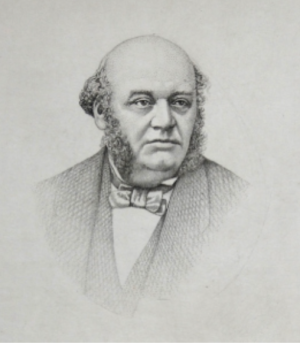
Charles Adolphe Gand. Photo courtesy of Gaël Français
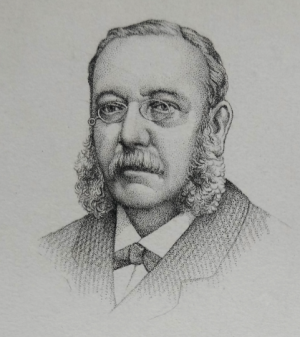
Charles Eugène Gand. Photo courtesy of Gaël Français
Collaboration with the Bernardel brothers: Gand et Bernardel Frères
After Charles Adolphe’s death, the pressure of having to lead the large company unexpectedly fell on Charles Eugène’s shoulders. However, he did not feel up to the task; he needed a partner who had already proven himself in the field—preferably someone with a background similar to his own. He found such a person in Sébastien Bernardel, who had been trained by Nicolas Lupot at the same time as his own father. However, Sébastien had just decided to retire and had named his two sons, Ernest Auguste and Gustave Adolphe, as his successors. For the brothers, a partnership with Gand presented an excellent opportunity to combine the Bernardel family fortune with Gand’s reputation to form a new company. Gand knew the brothers well and agreed.
A few months after Charles Adolphe’s death, the new company was registered in the commercial registry under the name: “Maison Gand & Bernardel Frères.”
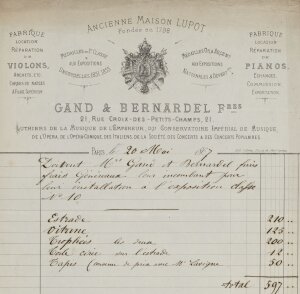
Gand & Bernardel Frères. Source: Archives of the Musée de la Musique, Paris
Leaving the House Where I Was Born
Charles Eugène’s second major decision was to sell his childhood home on Rue Croix des Petits Champs—with its large studios and showrooms—which his father had acquired forty-five years earlier from his colleague Koliker. Maison Gand & Bernardel Frères continued its operations across the street, in Bernardel’s more modest building.
The positions of Luthier de l’Opera, Luthier du Conservatoire, and Luthier de la Chapelle Royale combined yielded little more than 900 francs a year, but they did confer great prestige. Eugène Gand’s father and brother had held this coveted position for many years, but it did not automatically pass to the new firm. It was not until late 1867 that the appointment was finalized, primarily based on the fact that Charles Eugène Gand was one of the finest violin experts of his time.
Stradivari and Guarneri “del Gesù” Auction Collection
Under Charles Adolphe, Eugène had played a fairly modest role in the firm, but in the new company he proved to be an exceptionally skilled businessman. The two Bernardels managed the workshops, which employed only skilled craftsmen. The company’s catalog consisted of instruments from its own workshop and instruments built by contemporaries but bearing the Gand & Bernardel Frères label. But there was also a separate section: “Catalogue descriptif des instruments de Stradivarius et J. Guarnerius,” featuring 252 instruments by Stradivari and Guarneri ‘del Gesù’. It had been compiled in 1870 by Eugène Gand. Such an impressive collection for sale had never before been offered on the market.

View of the 1867 Paris World's Fair, Edouard Manet
The Exposition Universelle in Paris had been a major event drawing crowds of people since 1844. But in 1867, Napoleon, “Emperor of the French,” wanted to show the world how well France was doing after years of his dynamic leadership. He organized the event on a grand and impressive scale, inviting 60,000 participants to showcase their achievements in their respective fields. Maison Gand & Bernardel Frères also received an invitation. The Exposition remained open for a year and attracted 11 million visitors. J.B. Vuillaume won gold, and Gand & Bernardel Frères won a silver medal for their entry.
In 1870, France went to war with Germany. Completely against all expectations, the war ended a year later with Napoleon’s imprisonment. The French Empire fell, and the Third French Republic (1870–1940) began to take shape. The new republican rulers sought to create a different kind of society, but even within that context, Gand and the Bernardels were able to hold their own. Gand even managed, despite the renewed class divide, to gain a foothold in the social and musical life of the haute bourgeoisie.
Despite the renewed class divide, Gand even managed to penetrate the social and musical life of the “haute bourgeoisie”
Gand was a welcome guest at the grand musical gatherings that the Parisian aristocracy had resumed organizing, to which the finest musicians from the international music scene were invited to perform. There he also met wealthy collectors such as André Wilmotte and David Laurie. Together, they purchased 47 instruments by Stradivari and Guarneri from Gand & Bernardel Frères over the course of a few years.
Trocadéro Palace
The Palais du Trocadéro, a building with four concert halls constructed in the Moorish and Neo-Byzantine styles, was built for the 1878 World’s Fair. After Gand and Bernardel won gold medals for their instruments that year, the French government commissioned them to build more than 80 instruments for the newly formed orchestra of the Palais du Trocadéro. In doing so, they disappointed J. B. Vuillaume, who had been counting on this commission, for the first time.

Gustave Bernardel. Photo courtesy of Gaël Français
Gand and Bernardel Company
In 1886, Ernest Bernardel retired, and a new phase began for the Maison, which was henceforth known as “Gand et Bernardel.” Charles Eugène Gand and Gustave Bernardel continued to run the company together until Charles Eugène Gand died in 1892 after a brief illness. During the service held on the occasion of his funeral, the entire orchestra of the Opera performed. The ceremony was covered by most Parisian newspapers. His death even received attention in England. There, Alfred Hill, who had known him well personally, wrote praisefully of him: “em”“Although Eugène Gand was involved in the day-to-day operations of the company, he rarely missed a day at his workbench and varnished most of the instruments himself.” Eugène Gand had made Maison Gand & Bernardel Frères the most important in France. Three years earlier, Antoine Vidal had already written of him that he “was one of the most prominent French violin makers of our time”.
Work and Influence
In the 20 years that the firm existed, some 1,000 stringed instruments and bows came out of their workshops. Most were of refined quality and built according to the French tradition. There was no single, recognizable Gand & Bernardel model, but all of their instruments were based on the great Cremonese violin makers of the previous century. They usually used a light brown to light red varnish, though a deeper red finish was also available. The distinctive red color used by Lupot was also available, but only by special order.
Gand & Bernardel Frères was also known for its bows, which were crafted by the finest makers of the time, such as Charles Peccatte, Vigneron père, Pierre Simon, Joseph Henry, Claude Thomassin, and François Nicolas Voirin. They supplied their bows to the firm, often without being employed by it, but their work influenced production in the workshop to such an extent that the differences between a workshop bow and the original are not always easy to discern. All the bows sold by the firm bore the Gand et Bernardel Frères brand mark, regardless of who had made the bow.
Maison Gand & Bernardel Frères used three labels for their stringed instruments. The first, used between 1866 and 1870, bore the title “Luthiers de la Musique de l’Empereur et du Conservatoire.” Between 1871 and 1886, the label read only “Luthiers du Conservatoire de Musique,” and after they had built the instruments for the Palais de Trocadéro, that fact was also included on the label.
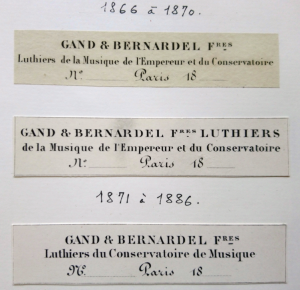
Photo courtesy of Gaël Français
The viola in the Music Instrument Fund’s collection dates from 1877. That year, Gand & Bernardel Frères received the prestigious commission to build the instruments for the new Orchestre de Trocadero.
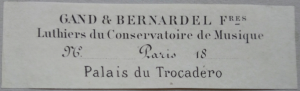
Photo courtesy of Gaël Français
Sources
Milliot, S., and Perrin, N. 2017, European Stringed Instrument Making Day. Paris.
Thöne J, 2008, Italian & French Violin Makers, Dubai.
Carlson B., Schmitt J. F., Moroder I., Leonhard F., 2007, Italian & French Violin Makers, Keulen.
Vannes, R., 1999, *Universal Dictionary of Instrument Makers*, Spa.
Millant, R., 1979, J-B Vuillaume: His Life and Work. Hill & Sons, London.
Henley W., 1959 Universal Dictionary of Violin and Bow Makers. Amati Publications. London.
Jacquot, A., 1912, La Lutherie Lorraine et Française, Paris.
Tarisio; the Cozio archives, accessed in 2020.
Geneanet, accessed in 2020.
Archives Nationales de France, accessed in 2020.
Archives of the Musée de la Musique, accessed in 2020.
- Auteur
- Jan Boekhout
- Date
- 26 November 2020