Instrument
violin bow
Lothar Seifert
Bubenreuth,
± 1970
played by
Adinda van Delft
Adinda van Delft

*1932 , Kirchberg †2015 , Bubenreuth
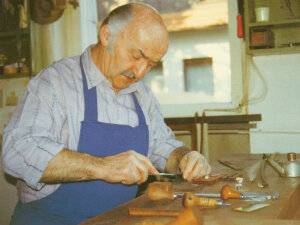
He opened his own workshop in Kraslice. Before World War II, there were about 3 million Germans living in and around Kraslice. After the fall of the Third Reich, they were all forced by the Czechs to leave Kraslice. They were brutally expelled, often severely mistreated, and all had their property confiscated. Thousands lost their lives during those days. The Seifert family was also forced to leave the town. At the initiative of the mayor of Bubenreuth, a large number of the expelled violin makers and bow makers were able to settle in Bubenreuth, including the Seifert family.
Lothar Seifert initially worked for an unknown walking stick maker, but in 1950 he opened his own workshop again in Bubenreuth. In and around the village—which, due to this migration, had grown from 700 to 2,900 residents in just a few years—a well-functioning cooperative model emerged among small and large instrument and bow makers. Lothar Seifert and the other newcomers were able to join this cooperative without much difficulty. To sell their work, they were largely dependent on the dealers in Markneukirchen.
Around the time Seifert arrived in Bubenreuth, Albert and Ernst Roth, two prominent entrepreneurs in the musical instrument industry, moved their company from Markneukirchen to Bubenreuth. This marked the beginning of the gradual shift from cottage industry—which relied on small-scale operations and skilled craftsmanship—to factory-style industrial production.
As early as 1955, hundreds of thousands of instruments were being shipped annually from the region between Bubenreuth and Schönbach to destinations all over the world, not least to the United States, where many representatives of German instrument makers were based.

Source: seifert-bogen.de
Lothar and his two sons’ business grew, but they remained one of the few families to stay aloof from the emerging trend of mass production. Like the makers from the Raab, Sandner, and Schuster families, Lothar Seifert continued to craft his canes primarily by hand, exporting them all over the world through sales representatives. He passed away in 2015, and his son has continued to run the business to this day.
Lothar Seifert built canes based on designs by Voirin, Simon, Tourte, Peccatte, Knopf, and Bausch.
Kraus, F. 1935, The History of the Sudeten Germans, Open Press, Liberec
Archives of the Mittenwald Museum of Violin Making, accessed in 2024
Vannes, R., 1999, *Universal Dictionary of Instrument Makers*, Spa.
The Smithsonian Institution, ‘The Violinmakers of Bubenreuth’
Tarisio, Cozio Archive, accessed in 2024


