Instrument

viola
Lorenzo Storioni
Cremona,
1778
played by
Alice Sinacori
Alice Sinacori

*1744 , Cremona †1816 , Cremona
Lorenzo’s career coincided with the gradual decline of Cremonese dominance. Many competing centers of violin making had emerged in Europe, but the Cremonese makers suffered at least as much from the fact that, in the second half of the 18th century, Italy was almost constantly embroiled in wars between the Austrian and French rulers. On top of that, they suffered under “reforms” that crippled the country’s economy and cultural life. Those in power imposed heavy taxes to finance their wars. The guilds that had once governed the country’s violin makers so strictly yet effectively had been replaced by ecclesiastical institutions whose interests differed from those of fostering craftsmanship.
Despite all that, Lorenzo Storioni was a remarkably prolific luthier; not least because he was one of the few violin makers left after most of the others had left Cremona and moved to Venice, Bologna, Mantua, or Rome—even Turin.

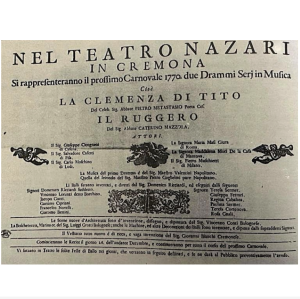
Announcement of the 1770 performance of Michelangelo Valentini's "La clemenza di Tito" at the Teatro Nazari in Cremona
Cultural life, however, had not come to a standstill. The Ariberti Theater was the city’s central hub for music. When it was converted into a religious “oratorio” at the behest of the ecclesiastical authorities, a group of nobles raised funds to have a large, secular theater built. In 1747, the new Teatro Nazari was completed. Almost immediately, numerous opera and ballet performances were staged there, and the theater thus attracted musicians. Shortly after Lorenzo Storioni’s 26th birthday, Wolfgang Amadeus Mozart gave a concert there with his father, and they attended a performance of La Clemenza di Tito by Valentini, which they greatly appreciated. This marked the rebirth of a vibrant musical culture in the city.
In 1786, Storioni took Giovanni Roti on as an apprentice. A year later, Lorenzo Storioni moved into the house owned by Count Gaetano Mina-Bolzesi, located on Contrada Coltellai, near Piazza San Domenico and just around the corner from Antonio Stradivari’s former home.
The entire Storioni family lived there from 1787 to 1794, along with Nicola Bergonzi (1754–1832), who was ten years their junior and already had three children of his own. Nicola was the youngest member of the large Bergonzi dynasty, but had received little training in the family tradition. He did, however, have some experience, as he had built his first instrument—a violone, a model that was already outdated for its time—as early as 1777. Presumably, he received too few commissions, because after ten years of working independently, Nicola went to work for Lorenzo Storioni.

Count Cozio di Salabue
Even before the collector and connoisseur Count Cozio di Salabue purchased Paolo Stradivari’s legacy of Stradivari’s work, Nicola had managed to acquire some of Stradivari’s working drawings and molds. He may have inherited them from his grandfather, Carlo I Bergonzi, who had worked in Stradivari’s workshop during the last years of his life and had finished Stradivari’s instruments.
Before working for Lorenzo, Nicola Bergonzi used Stradivari’s drawings of small cellos for his own instruments. There are a few cellos that both makers most likely worked on together. In 1794, Nicola Bergonzi went back into business for himself, this time in the house next door at number 1334. Lorenzo and Nicola remained neighbors until 1804.

Technical Drawing of a Stradivarius
Bolzesi later built a new palazzo on the site where Storioni's house had once stood; it still houses one of the world's finest violin-making academies.
In 1775, Cozio de Salabue described a viola d’amore by Lorenzo Storioni that he unquestionably built based on Antonio Stradivari’s drawings. This makes it plausible that Storioni not only had access to part of Stradivari’s legacy through Nicola Bergonzi, but also possessed it himself. Storioni presumably also had access to the technical knowledge of Del Gesù, for whom he built many instruments.
In recent years, Storioni undertook many trips outside of Cremona; the longest lasted eight years. It is not yet known where he went or why he undertook these trips. However, after 1804, no more instruments by him are known to exist. He had already transferred his business to G.B. Ceruti two years earlier. Presumably due to low demand for instruments, Nicola Bergonzi had already permanently stopped building instruments by 1802 and became a merchant of fine fabrics in 1804. Ceruti subsequently became the leading violin maker in Cremona.
At first, Storioni sought inspiration from non-Cremonese contemporaries, such as Tommaso Balestrieri and Giovanni Battista Guadagnini. He briefly explored the Cremonese tradition, but as he grew older, he broke away from these strict principles and began to experiment more in the spirit of Del Gesù. In addition to his students Giovanni Battista Ceruti and Giovanni Rota, he may also have trained Giovanni Francesco Pressenda.
His first instruments date from around 1768. Lorenzo strove for exceptional tone quality, but elegance was not his strong suit: barely symmetrical f-holes, positioned differently on each soundboard, narrow and roughly finished edge inlays, and less refined detailing on his solid scrolls. Perhaps the most striking feature is the difference in wood quality between the front and the back. After 1778, his instruments were often made of locally sourced maple without a beautiful “figure”; the top, on the other hand, was usually of excellent quality.
Lorenzo strove for exceptional sound quality, but elegance was not one of his strengths
Because Cremona had become isolated by regions where wars were raging and diseases were rampant, the supply of maple from the mountains—which he needed for his instruments—became virtually inaccessible. Storioni’s varnish, which differed in composition from the traditional Cremonese oil-based lacquers, was usually a deep yellow with a reddish tint and quickly became brittle. Virtually all of his instruments are distinguished by a beautiful and, above all, powerful sound.
Lorenzo Storioni made violins, violas, cellos, and double basses. His earliest instruments date from around 1768. From then until about 1780, he used a handwritten label reading “Laurentius Storioni fecit Cremonæ 17..”; after that, he had his labels printed. The second version of the label reads “Cremona” instead of “Cremonæ.” His last known instruments date from 1796.
Gindin D. 2002, The late Cremonese Violin Makers, Cremona
Reuning, Ch., 2010, Carlo Bergonzi: Discovering a Great Master, Cremona.
Rosengard D., 2010, Carlo Bergonzi and his sons, Cremona.
Brandon Frazier, 2007, Count Cozio di Salabue, Memoirs of a Violin Collector.
Gindin D. en Rosengard D., 2002, The Late Cremonese Violin Makers , Cremona.
Vannes, R., 1985, Universal Dictionary of Instrument Makers, Brussels
Dilworth J., The Strad, vol. juni 1995, Cremonese Mistery Man.
Oxford Music Library Archives, accessed in 2024
Tarizio, Cozio Archive, accessed 2024