Instrument
violin bow
Laberte-Magnié
Mirecourt
played by
Irene Piazza
Irene Piazza

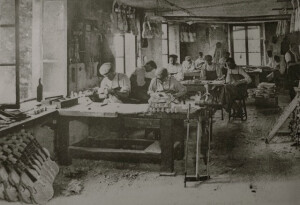
Around the turn of the century, Auguste, Maurice-Émile, and Marc established a division dedicated to crafting instruments that were just a little better than what they had been producing up to that point: the “Atelier des Artistes.” George Apparut took charge of it in 1902. Apparut was a violin maker with an impressive track record. He had worked for Paul Blanchard in Lyon and for Mougenot in Brussels, but was best known for winning gold medals at exhibitions in Nancy, Brussels, Metz, and Paris. Apparut enjoyed sharing his knowledge and ran a school in his own workshop where he trained young violin makers. Several of them went on to win awards. At Laberte, he was highly regarded for his extensive practical and theoretical knowledge. In addition to the simple violins with fanciful names like J. Didelot—which were still being built at Laberte—the company received a new boost in quality with Apparut’s arrival.
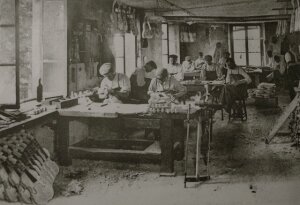
Laberte-Humbert Frères Workshop, Mirecourt, early 20th century
Marc married Thérèse Drouin in 1904, and they had a son, Philippe. In 1909, shortly after his son’s birth, his wife died. Three years later, Marc remarried. With Francine Thouvenin, he had a daughter in 1916. Both children later worked in the business—Philippe as a violin maker and Rose handling the administration.

Source: Ethnological study by Hélène Claudot-Hawad on the instrument makers of Mirecourt (Vosges, Lorraine), 1980–1982
In 1919, Laberte Frères merged with the firm “Fourier Magnié,” which had been manufacturing commercial instruments since 1775. Together, they continued as “Laberte et Magnié.” Marc Laberte advertised: “Etablissements Laberte-Humbert Frères, Fourier Magnié réunis”. George Apparut went back into business for himself in 1923, but sold the rights to use the awards he had won to Marc Laberte, who was in charge of the company. In the 1927 catalog, these awards were therefore listed as having been won by the firm itself.
The factory was still producing a great many instruments, though they were not particularly high-quality. Around 1920, Marc Laberte began purchasing some of the finest instruments in the history of French and Italian violin making, including those by Antonio Stradivari, Guarneri “del Gesù,” Giuseppe Guarneri “filius Andreae,” Francesco Ruggeri, Nicolas Lupot, Jacob Stainer, and Jean-Baptiste Vuillaume.
Marc Laberte also purchased a large number of other rights from manufacturers. From Paul Mangenot, who had been well known in Mirecourt since 1890, he acquired the rights to the term “à la Ville de Cremone.”

A page from the catalog
The 1927 catalog was published under the name “Laberte et Magnié, À la Ville de Cremone, ateliers de lutherie depuis 1780.” Within a few years, Marc Laberte also purchased the rights to use the names Didier Nicolas, Joseph Nicolas, Honoré and Juste Derazey, and Paul Mangenot commercially—all skilled violin makers who were unable to survive, or could barely survive, amid growing competition.
The antique instruments the company had purchased were carefully studied and replicated in the workshop by outstanding violin makers. Around 1925, they sold copies of Amati, Guadagnini, Santo Serafin, Bergonzi, Pressenda, Guarneri, Magnini, and Lupot. Among the makers who crafted them were Camille Poirson and Charles Brugère. And with great success. Marius Casadesus, Benedetti, Maurice Maréchal, and Maurice Hewitt purchased these Laberte instruments and praised them as well. In addition to a facsimile label of the original maker, the instrument also included a label reading: “Marc Laberte, Maître Luthier.”
The department where bows were made also received a new boost around 1930. Together with the Somny brothers, Marc Laberte developed several new models. The student-grade bows were given the fanciful names V.J. Ferelli and G. Fournier; for the higher-quality bows, highly skilled bow makers were hired. The 1930 catalog featured replicas of Tourte, Voirin, Lupot, and Peccatte. Marc also made his own bows; these were stamped “Marc Laberte.” Bows that met the higher quality standards were also marked with his brand.
By 1939, the company—with 500 employees—had grown to become the second-largest of its kind in France. Their competitor, J. Thibouville-Lamy (J.T.L.), which was also based in Mirecourt, was by far the largest, with 1,000 employees who produced 150,000 instruments per year.

Shortly after the start of World War II, the company was raided by the Germans. The stock of instruments was taken, and most of the tools were destroyed. Immediately after the war, the company resumed operations, but many of the instrument makers had not survived the war as soldiers. The economy was focused on rebuilding the country, not on music. Marc Laberte had made the company successful by continually producing better instruments; Marc’s son Philippe tried to do the same in the postwar period. Immediately after the war, Marc made one more attempt to make a name for himself internationally, not under the name Laberte-Magnié—which Americans found unpronounceable—but under his own name. In New York, he had the company represented by Buegeleisen & Jacobson, Inc., which handled distribution in the U.S. and Canada. They advertised there until at least 1949, when Philippe changed course.
With Philippe as director, Laberte mainly produced instruments intended for more accomplished musicians, but this was not very successful. Marc Laberte died in 1963. The company closed in 1969 after Philippe’s death.
Over the years, instruments appeared under the following names: Compagnon, Mansuy, F. Couturieux, Bertholini, Breton, Borelli, M. Deconet, Marquis de l’air d’oiseaux, H. Denis, D. Soriot, H. Clotelle, N.F. Fournier, J. Didelot, J. Leclerc, Chipot-Vuillaume, J. B. Vuillaume, G. Didion, E. Henry, and for bows, G. Fournier and V.J. Ferelli.
Some names were fictional, while the rights to others had been purchased. The reproductions of the great masters of the past were also replicas but were free of copyright.
Vannes, R. 1985, *Dictionnaire Universel des Luthiers*, Spa
Vatelot, E. 1976. *Les Archet Francais*. Paris
Raffin, J. F.; Millant, B., 2000. L'Archet. Paris.
Terrier, R., *The Splendor of French Violin Making*. Accessed in 2024
Visited Geneanet in 2024