Instrument

double bass
Joseph Xavier Jacquet
Mirecourt,
± 1840
played by
Frances Inzenhofer
Frances Inzenhofer

*1810 , Mirecourt †1867 , Mirecourt
Even after completing his training, Joseph Xavier Jacquet continued to work for several years in Pillement’s workshop, where he specialized in double basses for the Parisian market. In 1837, he married Cécile, the daughter of Joseph Pillement. Thanks to the dowry she brought with her, she became a co-owner of the business, which was then officially named Jacquet-Pillement. Both names appeared on the stationery and on the labels. Among the connections he gained through his in-laws were some impressive names in the world of violin making: Voirin, Maucotel, Gand, Bailly, Sartory, Mougenot, and Eury.
Family ties played an important role among the violin makers of Mirecourt
In 1838, his son Gabriel Xavier was born, the first of five children, three of whom would become violin makers. Gabriel Xavier joined his father’s business, while the other two sons, born ten and twelve years later, went into business for themselves. They, too, specialized in double basses. Xavier Gabriel regularly sold his instruments under his own name, but more often they were sold—just like those of his brothers—under other names, including that of Joseph Xavier’s son-in-law, George Mougenot, in Paris.
Family ties played an important role among the violin makers of Mirecourt. More than half of the town’s working population was involved in some way in the construction of musical instruments—organs, clarinets, and, in particular, string instruments and bows—and they were often related to one another.
The alliances between families of violin makers were primarily for mutual benefit. This was not a luxury, but a necessity. At the beginning of the nineteenth century, competition among violin makers was fierce. Industrialization in Germany and France led to an overproduction of inexpensive instruments. The makers’ incomes declined, and their livelihoods became increasingly precarious. Those who could afford it went to Paris; the makers who stayed behind forged relationships with them so they could sell their instruments there through them. Family came first, and so did those who could distinguish themselves.
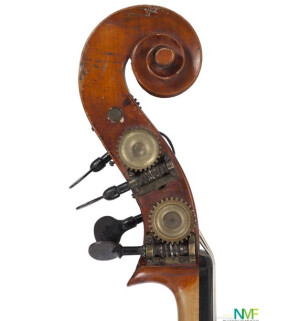
Starting in 1860, Joseph Xavier sometimes gave his double basses imaginative headpieces; his son Gabriel took it a step further and made it his trademark. Until around 1840, he built double basses with a curved back; later, he increasingly built them with a flat back. After Xavier’s death, his son often built “modern” double basses—instruments whose shape was derived not from a viola da gamba, but from a cello.

Jacquet-père double bass, Music Instrument Fund collection
After Joseph Xavier's death in 1867, Gabriel Xavier took over the business, later assisted by Joseph Xavier's grandson, Moise-Gabriel.
Few instruments by Joseph Xavier Jacquet are known to exist; it is believed that most were sold under other names.
By far the majority of the double basses made by Jacquet-père, as he was known, were modeled after the viola da gamba; the instrument had no pronounced angles and a back without a break. He used high-quality, often beautifully figured maple for the back and fine-grained silver fir for the top. He finished his instruments with a reddish-brown to golden-yellow varnish. Most of the double basses were three-stringed and were later fitted with a fourth string and an additional tuning mechanism. Joseph Xavier Jacquet branded his instruments on the inside with “X. JACQUET.”
Vannes, R., 1999, *Universal Dictionary of Instrument Makers*, Spa.
Guilbert, A., 1845, *History of the Cities of France*, Paris.
Claudel, J.P., 1983, Chronicle of a Town in the Vosges: Mirecourt During the Revolution, Paris.
www:archives.recherches.vosges.fr, accessed in 2024
www:luthier-mirecourt.fr, accessed in 2024
www:geneanet.org, accessed in 2024