John (I) Guillamí
*± 1699 , Barcelona †1767 , Barcelona
Contreras had access to the Italian instruments used at the court of Philip V; Joan Guillamí, who had begun his career ten years earlier, had acquired his knowledge elsewhere. There is no doubt that he was able to study Stradivari’s instruments. Not only did he build faithfully according to Stradivari’s later models, but he also constructed his instruments using the same methods employed by Stradivari.
The Family
The first member of the Guillamí family to presumably open a workshop in Barcelona was Joan Guillamí i Nin. His name appeared as early as the sixteenth century in the guild records of Barcelona’s woodworkers.
Rafael Guillamí, the father of Joan I, began his career as a furniture maker in Barcelona but also spent much of his life building guitars. The guild register states that he also made violins, but no stringed instruments by him are known to exist. Joan began his apprenticeship with his father. There he undoubtedly learned to make guitars, but the guild’s strict rules required that an apprentice also continue his training for three years with another luthier. It is not known with whom he did this, but he must have had access to the stringed instruments from Cremona that had been brought to Spain in the past.
Influence from Italy
Large parts of Italy, including Cremona, were under Spanish rule in the seventeenth century. Instruments made by the finest Cremonese violin makers found their way throughout the Spanish Empire, of which Barcelona was the most culturally significant city and where the archduke’s court was based. Instruments by Antonio Stradivari and other Cremonese violin makers were purchased for the orchestras of the Spanish court.
The Woodworkers' Guild
In Barcelona, the guilds were the pillars of economic and political power. Every craftsman had to be a member in order to carry out his trade. Instrument makers, woodturners, furniture makers, and rope makers were all members of the same guild: the “Gremi de fusters de Barcelona.” Among the first violin makers in Barcelona’s 17th-century woodworkers’ guild were Rafael Guillamí—Joan’s father—alongside Josep Massaguer and Miquel Bofill.
The guild leaders and examiners wielded almost unlimited influence
Rafael Guillamí, Joan’s father, was already a man of distinction when Joan was born. He was prohom, president of the “Gremi de fusters de Barcelona.” The prohoms and the examiners of the guilds wielded almost unlimited influence and were also held in high esteem in the city. Rafael Guillamí held both positions; he served as an examiner for the guild from a young age and later became a prohom.
Twenty years after Joan had started his own business, he succeeded his father in the guild. His work as a violin maker—and also as a teacher—was so highly regarded that he enjoyed great prestige among Catalan instrument makers even during his own lifetime. In 1745, he became an examiner, and two years later, he was elected prohom of the guild.

The Family of Philip V, Louis-Michel van Loo, 1743
More Italian influence
When Joan was just four years old, Barcelona experienced a musical revival that would resonate for years to come. Archduke Charles of Vienna had had himself proclaimed King of Barcelona following a complex power struggle. Out of a love for Italian opera, he had brought Italian singers from his Viennese court to Barcelona, and the works of Antonio Caldara and Giuseppe Porsile were performed there more often than those of Catalan composers. This new art form remained popular even after the change in power. Barcelona acquired its own opera orchestra, but it was the chamber music ensembles in particular that were popular among the large groups of amateur musicians in Barcelona.
Shortly before Joan’s 12th birthday, the residents of Barcelona had risen up against their rulers. A grueling battle ensued; the city was besieged by 20,000 soldiers and fell. The residents were spared, but the court and many important institutions were relocated to Madrid. The new ruler, Philip V, found the city bankrupt, with the result that progress in just about every area came to a standstill.
Our Own Workshop and the Competition
Until 1721, Joan trained with a violin maker who remains unknown to this day, and then began working in his father’s workshop. Three years later, he was admitted to the guild and was permitted to establish himself as an independent maker. He found a workshop on Carrer de Escudellers, which opened onto the main square of Ciutat Vella. There, in 1725, he built the earliest violin of his making that has been found, and he continued to work there until 1767, the year of his death.
Despite the guild’s efforts, there were many counterfeiters in the instrument-making and trading industries until the mid-18th century
Throughout Europe, competition among guitar makers and violin makers was fierce. When the French violin maker Nicolas Duclos sought to establish himself in Barcelona in 1740, the guild there protested vehemently. Before Duclos was allowed to build instruments under his own name, he had to pass proficiency tests administered by the guild’s examiner and pay a fee to join the guild.
Despite the guild’s efforts, there were many counterfeiters in the instrument-making and trading industries until the mid-18th century. It was only when a few influential, wealthy families—such as the Xuriachs, Pedrosas, Vinyoles, Boisselots, Oms, and Bernareggis—took charge that this practice disappeared, and they became the key players. The guild’s power waned, and these families took the lead in bringing about the changes that led to an industrialized manufacturing process, much like what occurred in Germany.
Music Culture in Barcelona
After the change of power in 1714, music remained largely unchanged for years; new influences from outside Spain were scarce. The Baroque period—including the use and construction of its characteristic instruments—lasted about ten years longer in Barcelona than in the rest of Europe. Until the mid-eighteenth century, the music of Palestrina and Victoria remained the standard there. The court had moved to Madrid, causing the lavish balls to disappear, as well as the grand musical performances that had once shaped the city’s cultural life. Folk music became popular again.

New developments in music presumably brought violin makers a great deal of work—enough to make a living. Between 1720 and 1750, when Joan Guillamí was at the height of his productive career, the fandango emerged in Barcelona—a dance song accompanied by guitar and violin. The danced fandango was popular among the Spanish aristocracy and was incorporated into zarzuelas—one-act plays with a satirical and sometimes political character—and became part of operas and ballets. Later, a purely musical version of the fandango emerged, in which the violin usually supported the singer’s melody. The violin was also increasingly used to accompany other songs and dances. In addition to Joan Guillamí, there were four other violin makers in Barcelona between 1700 and 1770, a city that had a population of over 120,000 during that period.
In 1739, his son Joan (II) was born. He was trained by his father and began building instruments under his own name as early as age fourteen. However, they lacked the refinement that had characterized his father’s instruments.
Influences from Cremona, Naples, and Genoa
John Dilworth, who has researched the work of Joan Guillamí, considers it highly likely that he was not only able to study the Cremonese instruments, but also had access to instruments built in Genoa as well as those that came from Naples via Genoa. The merchants from Genoa had good ties with the Spanish, and with those in Barcelona in particular.
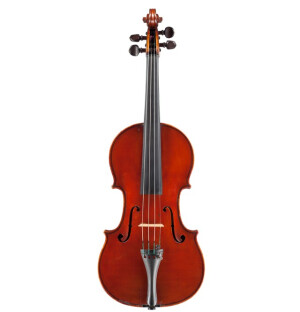
Father and son worked with no more than two models: the smaller one is derived from the Neapolitan school, while a larger model is strongly influenced by Stradivari. The models in which the Italian influence is evident are also Italian in construction, finish, and varnish; the neck and scroll differ from this, bearing the closest resemblance to the Genoese school. Father and son were so consistent in their use of this form that they employed it throughout their lives for both violins and cellos.
His cellos are based on Stradivari’s “large pattern” and are made from high-quality materials. Like his violins, they are exquisitely finished. In addition to violins and cellos, he also built a few double basses.

Father and son used the same brand mark: GVILLAMI, which they applied to the lower leaf next to the stack. Image courtesy of Tarisio
Because the guild restricted the importation of wood, the Guillamís used wood from the Spanish Pyrenees. Peter Ratcliff, who conducted dendrochronological analysis of the wood they used, was unable to draw a definitive conclusion about its exact origin. The tops of many instruments have developed cracks over the years, meaning that very few Guillamí instruments remain in pristine condition. Several tops of their violins were replaced in the twentieth century.
Joan Guillamí used two printed labels:
“Ioannes Guillamí me / fecit in Barcelona 1725”
“Ioannes Guillamí / me fecit in Bar. / anno 1760”
Sources
Contreras J, Dilworth J, 2014, The Golden Age of Violin Making in Spain, Barcelona.
Patrimoni musical Català, visited in 2023
Pinto R, New contributions from the 18th-century Catalan luthiers.
Vannes, R. (1999) Universal Dictionary of Instrument Makers, Spa.
Geneanet, accessed in 2023
- Auteur
- Jan Boekhout
- Date
- 24 July 2025