Instrument

cello
Jacob Weiss
Salzburg,
± 1740
played by
Evan Buttar
Evan Buttar

*1672 , Brüx †1742 , Salzburg
It is not known when Jacob Weiss went to Salzburg. The city was located 280 km south of his birthplace. He did not begin building violins until he was around thirty, after he had learned the craft from Joann Paul Schorn in Salzburg. Schorn had been the violin maker for the royal court in Innsbruck and was appointed first violinist of the archiepiscopal court orchestra in Salzburg in 1696. In addition to his job as a lute player, Schorn also worked as a violin maker in the city until his death in 1716.
There is no record of Jacob Weiss’s residence in Salzburg prior to 1710. His marriage certificate indicates that he was living in the city at least as early as 1710. That year, he married Ursula Mayr, daughter of Andreas Ferdinand Mayr. His father-in-law was the lute maker and violin maker for the archbishop’s court orchestra, just as his own father had been before him. Before his marriage, Jacob presumably worked for several years under Ursula’s father. In 1710, Jacob Weiss built his earliest known violin. He lived and worked in his father-in-law’s house until 1730, when he moved into his own home with a workshop on Sigmund Haffner Gasse, also in Salzburg.
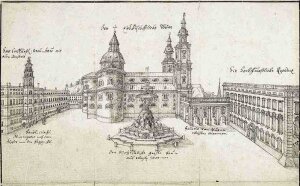
Salzburg Residence Square, circa 1710
When it came to music, Salzburg was the most important city in the Habsburg Empire; it was later referred to as “Music Turned to Stone.”
The archbishop resided there; he was the second most influential person in the country after the monarch. The musicians at his court were well-trained and served as teachers for the other musicians. Hundreds of performances of secular and sacred music were given each year, often at a very high level. Important composers such as Biber, Muffat, and Caldara worked there. Many of the court orchestra’s old string instruments had been modified or replaced with modern ones, often by Jacob Stainer or by contemporaries who built in his style. This was necessary to be able to perform works written for ever-larger ensembles. Jacob Weiss faced little competition within the city. Jacob Schorn had already died in 1716, after which only the son of Andreas Ferdinand Mayr remained, along with, as far as is known, two other violin makers.
Jacob Stainer’s violins—highly arched and with a mellow tone—were in vogue virtually everywhere in Central and Northern Europe. The Archbishop of Salzburg had commissioned several of them for his orchestra when Stainer made his debut there in late 1644. Stainer became one of the most influential violin makers north of the Alps; after his death, his instruments were scattered throughout Europe and were copied by most violin makers.

Single-stringed instrument
The stringed instruments attributed to Jacob Weiss differ from those. They are flatter and show more influence from instruments built south of the Alps.
Jacob Weiss died in 1742, the year Leopold Mozart had his first composition performed in Salzburg and was promoted to violinist in the court orchestra.
Only a few of Jacob Weiss’s stringed instruments are known to exist: three lutes, two viola d’amores, a six-stringed mandore, a monocord, and a cello.
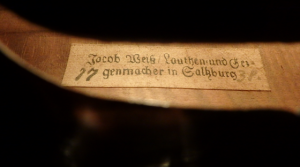
He numbered his instruments on the inside. Unlike most other violin makers of that time, he had his labels printed:
"Jacob Weisz / Lute and Violin Maker in Salzburg, 1738"
Source: Tarisio
Austrian Music Encyclopedia 1/2006
Hopfner, R., 2005, Schorn, Family. In: Austrian Music Encyclopedia, Austrian Academy of Sciences, Vienna.
Austrian Specialized Information Service 2024
Consortium European Research Libraries, bezocht 2024
Vannes, R., 1999, Universal Dictionary of Instrument Makers, Spa