Instrument

violin
Hippolyte Silvestre (Christian)
Paris,
1888
played by
Pieternel Tils
Pieternel Tils

*1845 , Sommerviller †1913 , Neuilly-Plaisance
Sommerviller, where Hippolyte Jean Chrétien was born, was an inconspicuous village of 600 people on the Meurthe River, near Mirecourt. His father, Jean Baptiste Chrétien, was a tailor there, and his mother, Catherine Silvestre, worked in a textile factory; Hippolyte Jean was their only child. It was a hamlet where most of his relatives on both his father’s and mother’s sides were from. Hippolyte Jean Chrétien, just as his uncles had done years earlier, went to nearby Mirecourt at a young age to train as a violin maker. It is not known who his teacher was, but it is known that after three years he went to Lyon to continue his training with his uncle Hippolyte Silvestre.
The firm “Silvestre Frères” was a household name among musicians in Lyon and far beyond.
J.B. Vuillaume
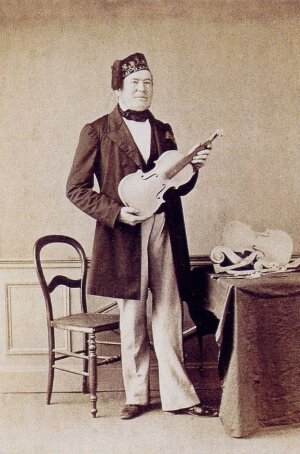
Hippolyte Silvestre was an apprentice to the renowned violin maker J. B. Vuillaume in Paris and quickly rose to become one of his regular employees—a distinction reserved only for the most talented. Hippolyte and his brother Pierre ran a business together in Lyon on one of the city’s most beautiful squares, close to the Académie des Beaux-Arts and the large, new opera house. The firm “Silvestre Frères” was a household name among musicians in Lyon and far beyond.
Until 1848, Hippolyte Silvestre and his brother Pierre had run the business together, turning it into a renowned company and winning awards for their instruments. After that, Hippolyte returned to Sommerviller, while Pierre continued on his own. It was only after Pierre’s death that Hippolyte returned to Lyon to continue the business. When the young Hippolyte Jean Chrétien was nearing the end of his apprenticeship in Mirecourt around 1860, his uncle Hippolyte took him under his wing and continued his training. Hippolyte Silvestre’s refined craftsmanship produced instruments that ranked among the finest in French violin-making. Hippolyte Jean Chrétien was trained in that tradition.
At the age of fifty-three, Hippolyte Silvestre retired. Hippolyte Jean Chrétien, who was barely twenty, was allowed to take over the now highly successful company. As the new owner, starting in 1865, he included “Neveu de Hippolyte Silvestre” as a designation on his stationery and labels. That same year, he adopted his mother’s surname and began calling himself Hippolyte Silvestre as well; he signed his letters “H.C. Silvestre.” A year after becoming independent, he hired Sebastien Deroux, who would remain his employee until 1869; Paul Blanchard joined in 1872, and in 1876 he hired Paul Serdet, who stayed until 1893.
Hippolyte's work became so good that in 1872 he entered an exhibition in Lyon for the first time. With his two violins, he won a silver medal. Encouraged by this success, he entered another exhibition a year later, this time in Vienna, and won a gold medal.
In 1878, he married Elise Magnoux, who was twelve years his junior; their daughter Juliette was born a year later.
All of his international contacts were made through his long-standing business connections in Paris. Shortly before turning forty, he moved to the capital.
Like many violin makers who had made a name for themselves, he established contacts with violin makers and dealers abroad. In London, in particular, the work of skilled French violin makers was in high demand. Paul Bailly, a friend of the family, had set up shop on Wardour Street, practically next door to W. E. Hill & Sons. Hippolyte Jean became acquainted with this internationally renowned expert and dealer in valuable instruments and did business with him regularly. It soon became clear to Hippolyte Jean Chrétien—partly thanks to W. E. Hill—that Lyon was not the most favorable city for growth. All international contacts were made through his long-standing business connections in Paris. Shortly before his fortieth birthday, he moved with his wife and daughter to the rue Faubourg-Poissonière in the capital, where many great violin makers were based. His shop was practically next door to the famous Alcazar and diagonally across from the Paris Conservatory.
The success of French violin makers also had a downside: instruments were being counterfeited on a massive scale. Some violin makers who discovered this filed lawsuits, but the legal costs hardly outweighed the benefits. To unite the interests of the violin makers, a small group of them, including H.C. Silvestre, founded the Chambre Syndicale de la Facture Instrumentale de Musique de France in 1890. H.C. Silvestre became its first secretary.
By the end of the nineteenth century, the market for new instruments in Western Europe had become saturated. Violin makers had previously explored the Anglo-Saxon countries and found business partners there; Hippolyte Jean Silvestre, however, turned his attention to Eastern Europe. In 1887, he undertook business trips to Budapest and Prague. A year later, he wrote to Charles Dvořák, whom he had met in Prague, asking him to help him find 60 to 100 kilograms of horsehair for bows—an enormous quantity, even for violin makers with a large clientele.
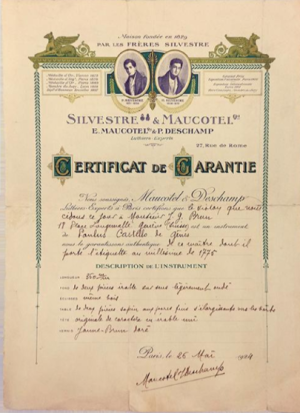
In 1891, he went to Moscow. There, he met Ernest Maucotel. Ernest had been a student of Paul Bailly, who had trained him in the finest French tradition, and had already been working in Moscow for six years with his uncle, E.A. Salzard. Hippolyte Jean was impressed by Ernest Maucotel’s craftsmanship and invited him to take charge of his workshop in Paris. In 1894, his former colleague Paul Serdet also came to Paris and set up shop just a few doors down from his business. Ernest Maucotel worked for Hippolyte C. Silvestre for nine years. They then became partners and named the business “Silvestre & Maucotel.” Their partnership lasted until Hippolyte Chrétien Silvestre died in 1913. Ernest Maucotel continued the business, together with Paul Deschamp, at the same location.
In recognition of his achievements, Hippolyte Jean Chrétien was named a Chevalier of the Légion d’Honneur.
Staff:
Sébastien Auguste Deroux (1866–1869) Paul Blanchard (1872–1876) Paul Serdet (1877–1893) Auguste Delivet (1887–1892)
Hippolyte, Pierre, and Hippolyte Jean built mainly violins, less frequently violas, and only a few cellos. It is not known how many cellos Jean built, but he was very productive. It is believed that the number was around 400. In Lyon, he based his work on a few models by Stradivari and, on rare occasions, on those by Andrea Guarneri.
In Paris, he initially continued in that vein, but over time he began to specialize more in instruments based on those of Venetian makers such as Serafin, Montagnana, and Goffriller.
His instruments demonstrate exceptional craftsmanship; they are refined in every detail and are considered among the finest built in France at the end of the nineteenth century. Their quality is evident not only in their construction and finish, but also in their sound.
Like Hippolyte and Pierre, he usually used a beautiful, dark red varnish that he applied in such a way that it made the instruments look slightly older.
The violin that the Musical Instrument Fund has in its collection is a good example of the kind of instruments he built when he had only recently begun working in Paris.
Three of his labels are known:
H.C. Silvestre, nephew, in Lyon in 18.. No. ...
H.C. Silvestre in Paris, 18..
H.C. Silvestre's nephew in Paris in 18.. No. ...
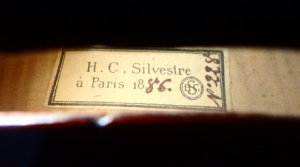
Source: Tarisio
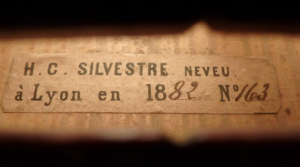
Milliot, S. and Perrin, N. 2017, Lecture 3; European Stringed Instrument Making Day. Cordes sur Ciel.
Thöne J, 2008, Italian & French Violin Makers, Dubai.
Carlson B., Schmitt J. F., Moroder I., Leonhard F., 2007, Italian & French Violin Makers, Keulen.
Vannes, R., 1999, *Universal Dictionary of Instrument Makers*, Spa.
Henley W., 1959 Universal Dictionary of Violin and Bow Makers. Amati Publications. London.
Jacquot, A., 1912, La Lutherie Lorraine et Française, Paris.
Tarisio; the Cozio archives, accessed in 2021.
Geneanet, accessed in 2021.
Archives Nationales de France, accessed in 2021.