Instrument

cello
Hippolyte Silvestre
Lyon,
1865
played by
Geneviève Verhage
Geneviève Verhage

*1808 , Sommerviller †1879 , Sommerviller
Sommerviller, the village where Hippolyte was born in 1808, was an unremarkable village along the Meurthe River with a population of just under 600.
His father, Pierre Silvestre, had been a Benedictine monk in Lunéville until 1795 and, after leaving the order, had tended the vineyards of his former abbey. In 1800, he married Christine Baraban of Sommerviller, and in 1801, his first son was born. In 1804, Pierre Silvestre changed careers and became a teacher of French language and literature at a small school in Saint-Nicolas-de-Port that he had founded himself. After a few years, he became a teacher in Vézelise and eventually moved to Mirecourt, where he began teaching the same subject. The family did not have much luck, as four of their six children died shortly after birth. Pierre, Hippolyte’s father, also died young; Hippolyte was eight and his brother sixteen.
After his father’s death, Hippolyte was taken in by his uncle Laurent Blaise, one of the many skilled violin makers in Mirecourt. He began his training as a violin maker with him around the age of twelve. His brother Pierre had already gone before him to Blaise’s workshop and would continue to serve as his role model for many years to come.
When Hippolyte was fifteen, his brother Pierre left for Paris to complete his training as a violin maker under Nicolas Lupot. Hippolyte stayed behind with Laurent Blaise in Mirecourt.
Pierre must have been a skilled craftsman from a young age, for Nicolas Lupot was already a master of his craft in his day; he was the violin maker for Napoleon’s Imperial Chapel, and even after Napoleon’s fall, he remained in the service of the new rulers as “luthier de la Chapelle Royale.” A few years after completing his apprenticeship, Pierre became one of Lupot’s permanent employees.
Over the course of ten years, Vuillaume’s firm grew into a company that produced about 150 instruments and 600 bows per year

J.B. Vuillaume
By around 1827, Hippolyte had completed most of his training with Laurent Blaise. Blaise was a good teacher, and Hippolyte proved to be talented. He was allowed to continue his training with Jean-Baptiste Vuillaume in Paris. Vuillaume was a charismatic figure who had numerous innovations in violin making to his credit and inspired his employees to achieve extraordinary results. He was also a shrewd businessman. When Hippolyte began working for him, the company was on the cusp of tremendous success. Within ten years, Vuillaume’s firm had grown into a business producing some 150 instruments and 600 bows per year—a volume virtually unmatched in Europe at the time. After five years, Hippolyte rose to become one of Vuillaume’s permanent employees.
Nicolas Lupot died in 1823. It was not Hippolytes’ brother Pierre Silvestre but Charles François Gand who took over the business. Gand succeeded Lupot as violin maker at the Chapelle Impériale and also became the violin maker for the Paris Conservatory. Pierre Silvestre remained with this founder of the Gand dynasty for another five years before striking out on his own in 1829. A better preparation for an independent career was hardly conceivable; at Lupot’s, he had learned the art of violin making to the highest degree of refinement, and under Gand, he had seen how a business should be run. Pierre did not start his own business in Paris, where competition was fierce, but in Lyon. Hippolyte needed another two years to gain sufficient experience at Vuillaume before he followed Pierre to Lyon in 1831.
Hippolyte and Pierre started a new business together in Lyon on the Place des Terreaux. It was located on one of the city’s most beautiful squares, which was also home to the Académie des Beaux-Arts and City Hall. A new opera house opened its doors that same year and was just a stone’s throw away from the firm “Silvestre Frères.” It drew musicians and music lovers from all over Europe to the city.
Lyon was the second-largest city in France, but until the year Hippolyte Silvestre moved there, it had only an old and too-small opera house, and music was performed mainly in a few small venues. The rich cultural life that Hippolyte had been accustomed to in Paris was lacking. Yet Lyon was a good choice; it was on the rise. After the Revolution and Napoleon’s rise to power, the number of amateur musicians playing at a high level grew, and, in keeping with the fashion of the time, they also performed many short symphonic works. The city had fiercely opposed the Revolution and was now reaping the rewards of that stance.
Between 1825 and 1850, investments were made in opera and other orchestras, in an academy of fine arts, and in music schools that trained many amateurs and professionals. The city was also internationally renowned for the manufacture of various types of musical instruments, though there were hardly any violin makers there. Demand for violins exploded in the first half of the 19th century as Lyon developed into a regional capital thanks to its favorable location near borders that had become accessible via Napoleon’s newly constructed roads. For musical instrument merchants, Lyon became a paradise. Paris did remain the center of violin making, but far from the capital, the Silvestre brothers faced virtually no competition.
Hippolyte and Pierre quickly turned the company into a great success; their instruments were highly regarded throughout France. In 1844, the brothers participated in the Exposition Nationale in Paris and won a medal. That was the first of a series of entries that consistently earned them high praise.
They remained together until 1848. After that, Hippolyte left and returned to Sommerviller, the village where he was born and had spent the first two years of his life. Pierre continued on his own in Lyon.
In Sommerviller, Hippolyte moved into his former family home, had a workshop built, and established himself there as an independent violin maker. Presumably, only a small number of musicians had their instruments built directly by him. It is likely that he sold most of the instruments he built during that period in Paris to dealers with whom he had an agreement.
Pierre died in 1859; Hippolyte returned to Lyon to take over the firm, which had by then grown into a large company. He remained there until 1865, after which his nephew, Hippolyte Chrétien (1865–1884), took over. After his death, the business closed.
Hippolyte built mainly violins, less frequently violas, and only a few cellos. Pierre built just under 350 instruments; the number of instruments built by Hippolyte is unknown, but it is presumably much smaller. He based his work on a few models by Stradivari and, on rare occasions, on those by Andrea Guarneri.
His instruments demonstrate exceptional craftsmanship; they are refined in every detail and are considered among the finest built in France during the nineteenth century. Their quality lies not only in their construction but also in their sound. Instruments by Pierre are just a little more sought after than those by Hippolyte.
The Silvestre brothers’ work was already well-loved in their own time. Albert Jacquot (1853–1921) mentioned them in his overview of French builders.
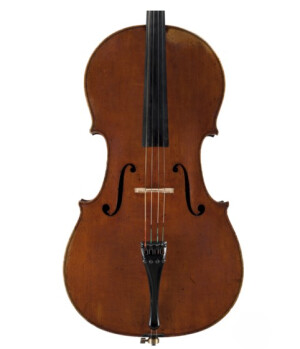
Hippolyte usually used a beautiful, dark-red varnish that he applied in such a way that it made the instrument look slightly older.
The cello that the Musical Instrument Fund holds in its collection is one of the few cellos made by Hippolyte and likely the last one he built in Lyon. It is a magnificent example of the model that the Silvestre brothers made famous.
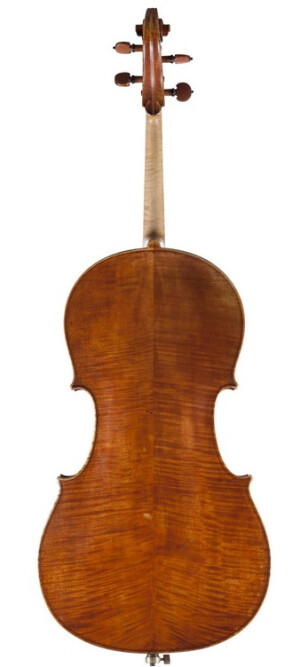
Cello by Hippolyte Silvestre from the collection of the Musical Instrument Fund
Milliot, S. and Perrin, N. 2017, Lecture 3; European Stringed Instrument Making Day. Cordes sur Ciel.
Thöne J, 2008, Italian & French Violin Makers, Dubai.
Carlson B., Schmitt J. F., Moroder I., Leonhard F., 2007, Italian & French Violin Makers, Keulen.
Vannes, R., 1999, Universal Dictionary of Instrument Makers, Spa.
Millant, R., 1979, J-B Vuillaume: His Life and Work. Hill & Sons, London
Henley W., 1959 Universal Dictionary of Violin and Bow Makers. Amati Publications. London.
Oudard, G., 1926, *Mirecourt, the City of Violin Makers*, Mirecourt; Jacquot, A., 1912, *Violin Making in Lorraine and France*, Paris: Tarisio; the Cozio Archives, accessed in 2020.
Geneanet, accessed in 2020.
Archives Nationales de France, accessed in 2020.