Hilaire Darche
*1862 , Brussel †1929 , Brussel
Hilaire collaborated with N.F. Vuillaume, the violin maker who had trained his father. He became an expert in period instruments, a “Luthier du Conservatoire” in Brussels, and a much-sought-after jury member.
His instruments were beloved by concert musicians. He built them primarily in the style of Guarneri del Gesù and Guadagnini.
More about Hilaire Darche
Hilaire’s grandfather, Nicolas Darche (1771–1850), was born in the northern French town of Mirecourt, where most French violin makers came from or had begun their training. Nicolas, too, had become a violin maker there. At that time, there were so many violin makers working in Mirecourt that, if they wanted to earn a sufficient living from their craft, most of them had to practice their profession elsewhere. Most went to Paris, which was the center of musical culture. Their lives there were difficult, often impoverished, and Paris was chaotic.
Françoise Vuillaume, Hilaire’s grandmother, had seen how her brilliant brother Jean Baptiste Vuillaume had become successful in Paris, but Nicolas François Vuillaume, her other brother, had fled the chaos of Paris and eventually moved to Brussels. Following his example, Nicolas Darche—along with two other brothers—chose Brussels over the French capital. Together with Claude François, his oldest brother, he started a business in 1845 that they registered as “Maison Darche frères” and which they expanded over the years to include three additional violin-making workshops. That marked the beginning of three generations of Darche violin makers.
Belgium was still a young nation; having gained independence in 1830 and sandwiched between the Netherlands and France, it did not have its own musical culture. François-Joseph Fétis (1784–1871), who became director of the Brussels Conservatory in 1833, played a leading role in the country’s musical development. Commissioned by the government, Fétis wrote the “Plan d’organisation de la musique dans le Royaume de Belgique.” He argued that Belgium was in a state of “decline” in the musical sphere and that its musical rebirth was not a matter of waiting patiently, but rather a “project” that, under his personal leadership, could enable Belgium to make its mark on the international stage of musical culture. To this end, he had assigned the Brussels Conservatory a central role. Two departments were to take the lead: piano and violin.
Hilaire’s father, Jacques-Joseph, had benefited from this. He had been trained as a violin maker by Nicolas François Vuillaume, joined the family business in 1852, but was able to start his own business in 1854 due to the growing interest in violin playing in Brussels. That year, he met Eugenie Bauval, whom he married shortly thereafter. They had two children: Hilaire was born in 1862, followed a year later by Joseph.
Hilaire was born in the same year that the third and fourth branches of Maison Darche frères opened. The third store was located at 11–13 Rue de Laeken. Jacques-Joseph was able to celebrate Hilaire’s birth with the opening of a new, fourth store, also on Rue de Laeken, diagonally across from the other location. The Darche family was clearly successful.
Hilaire’s father fell ill in 1867 and died shortly thereafter. He was 35, and Hilaire was only 5. His mother did not remarry, but continued to care for the two children with financial support from the family.
Following in his father’s footsteps, Hilaire also wanted to become a violin maker. He left for Paris at the age of sixteen and became an apprentice to Charles Gaillard. Gaillard was a leading violin maker and a celebrated figure among musicians. He had trained under Charles Gand and built violins in the style of Guarneri and Stradivari. After establishing his own workshop on Rue Notre-Dame de Rouvrance, he worked entirely in the style of his mentor. His instruments were refined and therefore highly sought after. Hilaire Darche worked for four years with Charles Gaillard on Rue Notre-Dame de Rouvrance. Sources later mentioned that Hilaire continued his training with Didier l’aîné, but the latter had already died thirty years earlier.
Brussels was hit hard by a financial depression. The “Maison” did not survive the crisis and was shut down. Once he had trained to become a skilled violin maker, Hilaire could no longer return to the family business, but went to work for Nicolas François Vuillaume, from whom his father had learned the trade.
Nicolas François Vuillaume had worked for many years in Paris alongside his celebrated brother Jean Baptiste, but had fled the chaos of the city. In Brussels, Nicolas François thrived. His workshop grew, and he was able to hire employees. Hilaire Darche was his first, followed by Charles Darche and later Nicolas (II) Darche. Nicolas François Vuillaume was the leading figure in violin making in Belgium and enjoyed a fine reputation as a violin maker, connoisseur, and restorer. Hilaire Darche worked for Vuillaume for nearly five years and continued to work in the workshop for several more years after Nicolas François Vuillaume handed over the business in 1875 to Georges Mougenot (1843–1937), a student of Nicolas (I) Darche.
The financial crisis in Belgium even led to a popular uprising in 1886, but that did not stop Hilaire from starting his own business that same year—the “Maison H. Darche aîné”—at 86 Boulevard Waterloo.
In 1894, he merged with his brother. The “Maison J. Darche aîné” and the “Maison H. Darche jeune” continued their operations as “Maison Darche Frères” on Rue de la Montagne, according to advertisements in Brussels newspapers. From that point on, in addition to stringed instruments, they also sold pianos and organs.
Eugene Ysaye was a central figure in the Belgian violin world. This virtuoso violinist was appointed principal professor at the Brussels Conservatory in 1886. He was friends with the greatest musicians of his time and enjoyed unprecedented popularity. Under his leadership, the conservatory’s violin program achieved a high standard of training. The violin classes grew, and Brussels’ affluent residents played in small ensembles or orchestras. In 1894, Ysaye formed his own quartet and organized a concert series that would continue in Brussels for seventeen seasons. Eugene Ysaye and Hilaire Darche knew each other well. On Ysaye’s recommendation, Joseph Jacob, the cellist of the Ysaye Quartet, had a cello built by Hilaire Darche.
Hilaire Darche built many instruments for musicians. Vannes notes in his *Dictionnaire Universel* that Hilaire Darche’s instruments were particularly popular among concert musicians. The wealthy and collectors preferred to buy old Italian or French instruments. For the Darche Frères firm, the trade in these instruments became at least as important as the production of new ones. Hilaire became an expert in the field of antique instruments.
In 1892, Hilaire became president of the Belgian Chamber of Commerce for Violin Makers. Five years later, he was invited to serve as a judge for the violin-making competition at the World’s Fair in Brussels. He also participated, outside the competition, in the exhibitions in Liège and Ghent, where he likewise served as a judge. Three employees of the Darche firm won a bronze medal. In 1910, Hilaire submitted instruments to the Exposition Universelle in Brussels, again as an uncontested entry. His closest associates, Joseph Henri and Camille Boulangeot, each won a gold medal.
In recognition of his craftsmanship, Hilaire Darche was appointed “Luthier du Conservatoire Royal de Musique Bruxelles” in 1900, a position that George Mougenot and Nicolas François Vuillaume had held before him.
In keeping with French tradition, the student who won the annual final exam competition at the Brussels Conservatory was awarded a violin built by the Luthier du Conservatoire. Hilaire Darche built these violins throughout his tenure. In 1907, Hilaire and Joseph Darche jointly established a fund from which a prize was awarded each year to a violinist who had made a significant contribution to music. The fund still existed in 2022. One year after his appointment, Hilaire was knighted as a “Chevalier de l’Ordre du Roi Léopold.”
Hilaire was never officially married, but he did have a daughter. One of his former employees, Louis Lagarenne, returned from Mirecourt in 1908 and began a relationship with her. Hilaire gradually stopped working and handed the studio over to Louis Lagarenne. In 1915, the company was registered in his name. Hilaire Darche died in Brussels in 1929. After 1915, Lagarenne continued to build many instruments, which he labeled with Hilaire’s original label. Only the brand mark on the inside reveals the maker: “≤i≥’H. Darche à Bruxelles é La Garenne Bruxelles’.”
Hilaire also carried bows in his product line. He had them made in Paris by Eugene Nicolas Sartory, one of the most renowned bow makers of his time. He branded these bows with “H. Darche Brussels.”
Work and Influence
Hilaire was a prolific violin maker whose body of work included violins, violas, cellos, and a few violas d’amore. While working for N.F. Vuillaume, he had the opportunity to study many fine old Italian instruments, including those by Guarneri del Gesù and G.B. Guadagnini. Once he struck out on his own, he built his instruments following their example. Around 1890, he added several models by great French makers to his repertoire.
Like many violin makers who had their roots in Mirecourt, Hilaire Darche also had “unfinished” violins built there on a fairly regular basis. His employees then applied the finishing touches to them.
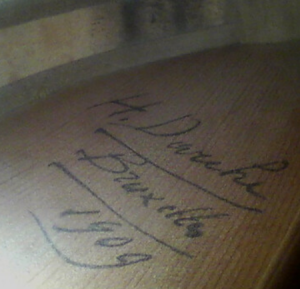
His instruments are generally made of excellent materials. He finished them with a deep reddish-brown varnish. Before merging with his brother, Hilaire branded his instruments on the inside with “H. Darche Bruxelles,” and afterward with “H. Darche aîné.”
Label: “Hilaire Darche. Luthier / of the Royal Conservatory of Brussels / Year 1908”. He signed his own instruments on the inside of the top near the neck; the workshop-made instruments lack the signature.
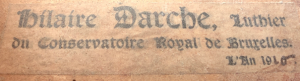
Photo courtesy of Tarisio
Sources
"Dictionary of Musical Instrument Makers in Wallonia and Brussels from the 9th Century to the Present" by Malou Haine, Nicolas Meeùs, and Pierre Mardaga.Cité de la Musique/Musée de la Musique, Violins, Vuillaume, a 19th-Century French Master Luthier, 1998, Paris.
Millant, R., 1979, J-B Vuillaume: His Life and Work. Hill & Sons, London.
Henley W., 1959 Universal Dictionary of Violin and Bow Makers. Amati Publications. London.
Vannes, R., 1999, Universal Dictionary of Instrument Makers, Spa.
Tarisio; the Cozio archives, accessed in 2023.
Geneanet, accessed in 2023.
National Archives of Belgium, accessed in 2023.
- Auteur
- Jan Boekhout
- Date
- 11 January 2023