Instrument

cello
Giovanni Grancino
Milan,
1703
played by
Joris van den Berg
Joris van den Berg

*1637 , Milaan †1709 , Milaan
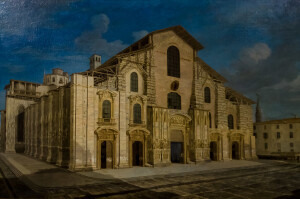
Until shortly before Giovanni Grancino’s birth, the plague had ravaged the population of Milan. Nearly half of the 120,000 inhabitants had succumbed to it. His father, Andrea Grancino (c. 1617–c. 1680), was among the other half.
Another survivor was Francesco Borromeo, Cardinal of Milan. He appointed Michelangelo Grancino, the brother of Andrea Grancino, as “Maestro di Cappella” of his cathedral and asked him to breathe new life into music, which was already much more advanced elsewhere in Italy than it was in Milan. As a result, a Grancino became the most influential figure in Milan. Andrea Grancino clearly benefited from this when he decided to become a violin maker.
It is not known how Andrea Grancino earned his living before he began working as a violin maker. It is documented, however, that in 1646 he opened a workshop in his home on Contrada Larga (now Via Larga), a short distance from the cathedral and the palace of the archbishop and cardinal. Presumably persuaded by his brother Michel Angelo, Andrea began his career as a violin maker. His son Giovanni was born nine years earlier, in 1637, as his second or perhaps third son. Given that Giovanni built his first instrument as early as 1647—when he was eleven years old—it seems likely that Andrea gave him his first lessons at a very young age. Experts believe that Giovanni subsequently received further training from a skilled luthier.
Although no documents have been found in the archives of Milan or elsewhere to substantiate his existence, it is undisputed that Giovanni had a brother, Francisco, with whom he collaborated beginning in 1655. Violins made between 1655 and 1680 often bear an authentic label bearing both of their names. Giovanni and Francesco built violins and violas together for over ten years. Cellos were primarily made by Giovanni.
The few violins from the early years bore Andrea’s label. Even later, when his sons began assisting him, this did not change. From his early period, only a few instruments by Giovanni are known; he usually built them together with Francesco.
No instruments have been found belonging to a possible third son, Paolo. For a long time, he remained a mysterious luthier, but in a study conducted by Claude Lebet, Paolo Grancino’s name was found on a 1665 list of Andrea Guarneri’s associates, most of whom also never went on to have their own workshops.
Andrea’s instruments are still relatively simple and show no recognizable influence from other makers. That changed after his son Giovanni began building more instruments himself starting in 1660. Cozio di Salabue, a great connoisseur and collector of antique instruments, later wrote that Andrea and his son “built some magnificent instruments,” even though the materials from which they were made were very simple.
Around 1700, Giovanni Grancino and his brother, assisted by a growing number of employees, produced a large number of instruments. Their most talented collaborator was Carlo Giuseppe Testore (1665–1738), who had started out as their apprentice. It was likely due to his influence that the Grancinos’ instruments were finished with greater precision after his arrival.
In the years following Grancino’s early career, more violin makers settled on Contrada Larga. Among them was Bartolomeo Pasta (1640–1706). This maker arrived from Cremona in 1673 and had worked in Nicolò Amati’s workshop a few years earlier. He was viewed on Contrada Larga as an unwelcome competitor, but Giovanni was undoubtedly curious about the knowledge he brought with him from the city considered the cradle of Italian violin making. Pasta moved in with Testore, who had by then proven his talent to Andrea and Giovanni. The suspicion that Bartolomeo Pasta worked briefly for Grancino after his arrival in Milan has not been confirmed, but it is certainly plausible. Although Giovanni largely continued to adhere to his own views, some influence from Amati can be seen in his work after that time.
In 1673, Giovanni’s son Giovanni Battista (1673–ca. 1720) was born. He was trained in his father’s workshop, where he soon began to play an important role. Instruments made by the father and son are indistinguishable from one another. The instruments from that period bear only the label with Giovanni’s name. It states that the instrument was built in the workshop on the “Contrada Largha in Milano al Segno della Corona,” just as was indicated on his father’s label.
After 1680, Francesco disappears from the record. Where he went is just as unknown as his contribution to the studio.
Shortly before Giovanni’s death in 1709, his son Giovanni Battista became involved in a conflict that would have far-reaching consequences for all members of the family and for the studio’s survival. After being wounded himself during a brawl, his rival died a few days later from the injuries Giovanni Battista had inflicted on him. Giovanni Battista was imprisoned and charged with manslaughter. Before the judge could render a verdict, his father died. Giovanni Battista’s actions found no mercy in the eyes of the judge, who sentenced him to death. All of his possessions—including the house, the workshop, and his father’s instruments, which he had inherited after his father’s death—were sold in 1709. The proceeds went to the surviving relatives of his slain rival.
Everyone—not only his wife and two children, but also Giovanni’s widow—was forced to leave the family home. Giovanni Battista escaped and went into hiding. He presumably continued to build instruments, but no longer labeled them. The authenticity of instruments that do bear a label with his name is disputed. In 1716, he was pardoned. Grancino’s reputation had been so tarnished that neither of his sons saw any point in becoming violin makers.
Carlo Giuseppe Testore had already moved to the other side of the city in 1697 and set up his own business. Grancino’s workshop had its guild license revoked. It was not until around 1760 that Ferdinando Alberti reopened the workshop. Testore remained the city’s leading builder until the arrival of the Guadagnini family.
In the early period, Andrea Grancino and his sons were not visibly influenced by any of the renowned instrument makers from Cremona, Brescia, or Venice. This is not surprising, since Milan was a city without a serious musical tradition and in decline. The once-proud city, which had been under Spanish rule for years, was situated in an isolated region and had been bled dry by heavy taxes. Violin makers from outside the city were not permitted to work there without the permission of the guild, which was under Spanish authority. Moreover, the authoritarian Spanish regime had stifled any new developments. The church was pretty much the only place where music was still being made, and where string players had a role solely to support the choirs. A violin maker would have had the greatest difficulty earning a living there.
This was further exacerbated by the plague. Nowhere in Italy did it strike harder than in Milan. The “Plague of Milan,” as the disease was called, also prevented violin makers from applying to the guilds for a license. Milan thus became, even more so than before, an inward-looking stronghold. It was not until after 1632, when the disease had run its course, that the city slowly began to recover. That recovery was due to the ancient, aristocratic Borromeo family, which, beginning in 1650, took the initiative in virtually all cultural and social spheres. It was Cardinal Borromeo who appointed Michelangelo Grancino as the new driving force behind music in the city.
In the early years, Andrea and Giovanni Grancino built their instruments primarily from simple, locally sourced woods. Importing wood from outside Spanish territory was costly, if not impossible. It was not until Spanish rule came to an end that this became possible.
Their body of work from the 1670s–1680s consists mainly of violas. It was not until around 1690, when the business was flourishing and drawing on new outside influences, that Giovanni could afford better wood with a more attractive grain. From that point on, he also began building more violins and cellos. Just before the turn of the century, the Amati-like style evolved into one that subtly reflected the influence of other Cremonese luthiers. This brought him success and allowed the business to grow. His violins and violas became more elegant, but his cellos retained their traditional form.
The cellos Grancino began making around 1690 form an important part of his body of work. They were usually large in size. They are beautifully crafted, and their sound quality ranks among the very best. Some experts describe his finest cellos as masterpieces.
After 1670, the first violins with a moderately figured maple back began to appear; these backs were sometimes made from a single piece, but could also consist of two pieces. After 1700, the wood became of higher quality.
The Grancinos initially used an orange-red varnish, which became a deep yellow starting in 1690. That remained the distinctive color for the family’s instruments.
Both instruments in the Music Instrument Fund’s collection are fine examples of what Giovanni Grancino built during his prime. The influence of the great Cremonese luthiers is clearly evident in his work.
Chiesa C., 1996, Violinmakers at the Contrada Larga in Milan.
Kass, P. J., 1989, Stringed Instruments by the Milanese Violin Makers of the Contrada Larga.
Santoro, E., 1989, Violin Makers and Violins, Cremona.
Lebet, C., 1985, Dictionary of Instrument Makers, Brussels.
by La Laurencie, L., 1930, Inventory of the Blancheton Collection at the Paris Conservatory Library, Paris.
de Piccolellis, G., 1885, Ancient and Modern Violin Makers: Biographical and Critical Notes, Florence.
Tarisio; Cozio Archive, accessed in 2020.


