Instrument

violin
Giovanni Danieli
Two ,
± 1780
played by
Pieter Streefkerk
Pieter Streefkerk

*± 1705 , Padua of Vicenza †± 1785 , Padua
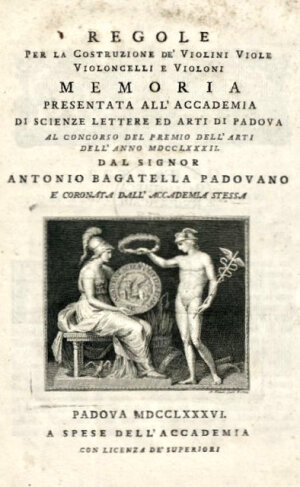
Antonio Bagatella (1716–1802), who was ten years younger and with whom Giovanni Danieli later shared a workshop, was also well acquainted with the Füssen luthiers. His book *Rules on the Construction of Violins, Violas, Cellos, and Double Basses* was partly based on their interpretation of Amati.
Some researchers believe that Giovanni Danieli apprenticed with—or spent the early years of his career working for—Pietro I Bagatella, Antonio Bagatella’s uncle. Bagatella also worked in Padua, built violins with high arches, and invented a varnish that was very deep and lustrous—a varnish that researchers have also found on some of Giovanni Danieli’s violins.
Giovanni Danieli came into contact with Antonio Bagatella when he was asked to repair Bagatella’s violin. The recommendation to have Danieli do the work came from the violinist and violin teacher Giuseppe Tartini. Bagatella became interested in violin making and, in his own words, became “a talented self-taught craftsman.” His memoirs, however, reveal that he learned to build violins with the help of an unnamed “artifice” (master). Bagatella also wrote that within two years he had already reached such a level of skill that the “artifice” felt compelled, for competitive reasons, to leave Padua and accompany Nardini to Florence. Before he left, Bagatella bought an “Amati brothers” violin from him, an instrument that would prove to be of decisive importance for his later work.
In Padua, music and science played an important role in daily life. As early as the fifteenth century, the Academy of Padua—which was highly regarded throughout Europe—had a faculty where music was taught, in addition to departments of philosophy, medicine, literature, and ethics. The earliest publications on music theory in Padua date back as far as the 13th century. It was one of the few universities in Italy to offer Jewish students full admission. The faculties of medicine and music were particularly busy. Due to the influx of students from abroad, Padua had an international character. At that time, Padua was part of the Republic of Venice, which was the cultural capital of Europe; Padua represented the scientific side of the Republic.
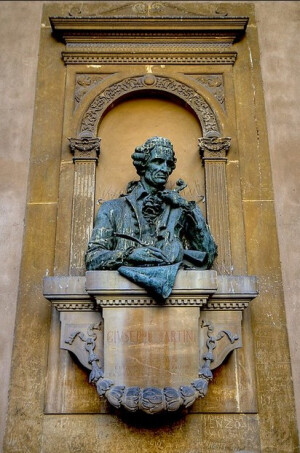
Bust of Giuseppe Tartini, Padua
Giuseppe Alessandro Tartini was an important figure not only for Bagatella but also for Danieli. In 1721, he was appointed first violinist at the Basilica di Sant’Antonio in Padua, where he later became the choirmaster. Three years later, he founded a violin school. During Danieli’s career, Tartini’s violin pedagogy grew into a school with students from all over Europe. His biography mentions 70 violinists who came to Padua to study with him, including Hellendaal from Amsterdam. When Danieli was just beginning his career in Padua around 1740, Tartini’s violin school had already become a phenomenon. Tartini was not only a violinist and teacher but had also studied law at the University of Padua.
In Venice, the violin makers’ guild exercised a strong control over the establishment of violin makers, whereas in the city of science, the guild had virtually no influence. What was impossible in Venice, Antonio Bagatella was able to do in Padua without hindrance. Around the age of twenty, he opened his own violin-making workshop in the city. A few years later, Giovanni Danieli joined him. Giovanni built a few violins, but at Bagatella’s workshop he mainly did repair work for Tartini’s students. That work often involved converting Baroque violins into instruments suitable for the Romantic repertoire. During the period of collaboration between Danieli and Bagatella, Bagatella studied the Füssener luthiers in Padua, but also became friends with Tartini. Tartini regularly visited Bagatella and Danieli’s workshop. Tartini had a scientific background, and whenever he had questions about the acoustics of the violin, he consulted scientists both at home and abroad. Antonio Bagatella recognized all kinds of mathematical formulas in the instruments he had thoroughly studied and corresponded about them with the mathematician Leonhard Euler, who worked at the University of Berlin.

Bagatella discussed his work with Tartini and had him evaluate his instruments. At that time, Bagatella was also working on his scholarly study Regole per la costruzione de' violini, viole, violoncelli e violoni. His research took eight years. He studied instruments made by Tartini’s students as well as those made by Tartini himself. In the preface to his Regole, Bagatella wrote: “He (Tartini) brought me many violins by the Amati brothers, which I was able to study carefully.” The violinist owned a Stradivari, a Ruggieri, and a Guarneri. The collaboration between the luthier and the violinist lasted until Tartini’s death in 1770. Using the Amati violin he owned as an example, along with the many others he was able to study, Antonio Bagatella described in detail how violins, violas, cellos, and double basses should be built, including the corresponding dimensions. He himself also built instruments more or less in the Amati style, as did Danieli.
In 1782, Bagatella entered the results of his research in a competition organized by the Accademia di scienze, lettere ed arti di Padova. He won first prize, after which the Accademia funded the publication of the book and, four years later, its translation into German and French.
Despite the fact that Bagatella built many instruments, he was primarily a theorist. His memoirs reveal that he did not think very highly of Danieli’s knowledge of theory. He must, however, have valued him as a craftsman. They worked together for many years and also built a number of instruments together. They labeled these instruments with the inscription: Danieli et Bagatella, fecerunt Patavii, Anno 17..
Instruments examined by Stenz show that Bagatella and Danieli were familiar not only with Amati’s work but also with the working methods of other Italian luthiers. They used a mold around which the instrument was shaped. The interior of both builders’ instruments shows virtually no traces of tools.
The f-holes are short and resemble those of Amati. The black strips of the edge inlay are made of ebony, and the center section is made of maple.
The finish consists of two layers: a pale yellow base coat and a warm reddish-brown top coat that gives the instrument a deep luster.
As far as is known, Giovanni Danieli built only a small number of violins. He appears to have been overshadowed by Bagatella, which is why Giovanni Danieli has remained relatively unknown. It is possible that his instruments were later sold under the name of another maker.
Its label reads: Joannes Danieli / fecit Patavii 17..
Stenz, J., Strad archive: a 1759 viola by Antonio Bagatella, in: The Strad, 2 / 2015 en 2020
Stefano P., 2004, Liuteri e Sonadori, Venice 1750–1870, Venice
Viol and Lute makers of Venice 1640- 1760, Venetie 2002
De Piccolellis, G., 1885, Ancient and Modern Lute Makers: Critical and Biographical Notes, Florence.
Peluzzi, E., The Rules of A. B.: Clarifications and Comments on the Treatise “Aures te fidibus oblectare canoris.”
Barzon, A. B., 1947, “Regole,” in Musica, II, Rome
Farseth, C., Carl Farseth’s Response to Euro Peluzzi’s Critique of A. B.’s Rules, Minneapolis.
Vannes, R., 1951, *Universal Dictionary of Instrument Makers*, Brussels.
Da Col, P, Airenti A., LOWENBERGER A.: The Tartini Violin Relics, in: Galpin Society Journal.
Tarisio, Cozio Archive, accessed 2023