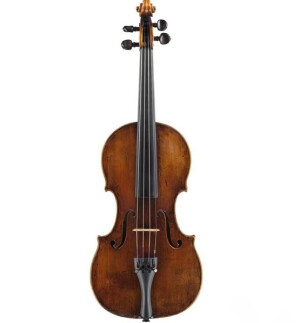
Instrument

violin
Giovanni Battista Grancino
Milan,
1714
played by
Marie Duquesnoy
Marie Duquesnoy

*1673 , Milaan †± 1724 , Milaan
Giovanni Battista’s grandfather, Andrea Grancino (c. 1617–c. 1680), was the first violin maker in the Grancino family. In 1646, he opened a workshop in his home on Contrada Larga in Milan, a short distance from the Duomo, in the city center. His son Giovanni had been born nine years earlier, in 1637. By the time he was eleven, Giovanni had already built his first violin.
At first, the instruments made by Grandfather Andrea and his son were still relatively simple, but that changed after Giovanni began building more instruments himself starting in 1660. It is believed that he had previously apprenticed with another skilled instrument maker. In 1664, he had the workshop registered in his name and gave it the address “al Segno della Corona.” Count Cozio di Salabue, a great connoisseur and collector of antique instruments, later wrote that the Grancinos “built some magnificent instruments.” It is striking that their work reveals no recognizable influence from the great makers of Cremona, Brescia, or Bologna, but instead represents a style all their own. Giovanni Grancino is now generally regarded as the founder of the Milanese school.
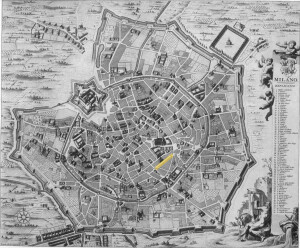
Milan (Contrada Larg(h)a in yellow), Daniel Stoopendaal 1704
Giovanni Battista, the eldest of his three sons, was born in 1673 in the family home on Contrada Larga. He was trained by his father from an early age and worked alongside a growing number of apprentices and employees. Giovanni Battista married in 1694 and had his first son, Michel Angelo, four years later, followed by his second son, Francesco, in 1699. By that time, the Grancinos were by far the best and most productive instrument makers in Milan. Around 1700, a large number of instruments were produced in the workshop. Given that his father was already advanced in age, Giovanni Battista undoubtedly played a leading role in the workshop.
In the early stages of his career, Giovanni Battista Grancino was not visibly influenced by the great, renowned architects from Cremona, Brescia, or Venice. This is not surprising, since Milan was a city that had long had to manage without a serious musical tradition and had suffered greatly under French and Spanish rule. It had become isolated and bled dry by heavy taxes. Violin makers from outside the city were not permitted to work there without the permission of the violin makers’ guild, which was under foreign authority. Moreover, the authoritarian regime had opposed every new development. The church had been just about the only place where music was still being made and where string instruments played an important role. A violin maker had the greatest difficulty earning a living there.
Although the Grancinos largely stuck to their own ideas, after Pasta’s arrival, elements of his mentor Amati’s style began to appear in the work of Grancino and Testore
Nevertheless, by the time of Giovanni Battista’s birth, several violin makers had already established themselves in Milan, most of them in the vicinity of the Contrada Larga. One of them was Bartolomeo Pasta (1640–1706). He arrived from Cremona in 1673 and had worked in Nicolò Amati’s workshop a few years earlier. In the Contrada Larga, he was viewed as an unwelcome competitor, but the knowledge he brought with him from the city considered the cradle of Italian violin making undoubtedly piqued the Grancinos’ curiosity. Carlo Giuseppe Testore also began his career as an apprentice with Grancino. Testore moved in with Pasta. It is believed that Bartolomeo Pasta worked for Grancino after his arrival in Milan. Although the Grancinos largely stuck to their own principles, after Pasta’s arrival, elements of his teacher Amati’s style began to appear in the work of Grancino and Testore.
Until 1705, it was difficult to attribute the instruments made by the father and son to one or the other
Giovanni Battista built many violins and violas, as well as a few cellos, all bearing his father’s label. The label states that the instrument was built in the workshop on “Contrada Largha in Milano,” just as was mentioned on Andrea’s label. Furthermore, no marks or initials of his assistants have been found on them. Later instruments become more personal, and Giovanni Battista’s hand is recognizable. During his time in hiding, he limited himself—likely out of necessity—primarily to violins. Instruments from that period are extremely rare.
The first instrument that can be definitively attributed to Giovanni Battista himself is a violin dating from 1705, built in the family workshop on Contrada Larga.
In 1708, Giovanni Battista became involved in a conflict that would have far-reaching consequences for all members of his family and would bring an end to the workshop’s existence. Lavazza, another violin maker who also lived on Contrada Larga, had entered Giovanni Battista’s home despite a court order prohibiting him from approaching Giovanni Battista, and had injured him. Giovanni Battista stabbed Lavazza and, after Lavazza died a few days later, was imprisoned and charged with manslaughter. Before the judge could render a verdict, his father died. Giovanni Battista was found guilty of manslaughter and sentenced to death. All of his possessions—including the house, the workshop, and his father’s instruments, which he was to inherit after his father’s death—were sold in 1709. The proceeds went to Lavazza’s surviving relatives.
Everyone—not just his wife and two children, but also his mother—was forced to leave the family home. Giovanni Battista did not wait for the sentence to be carried out and went into hiding. He continued to build instruments afterward, but he rarely labeled them. The authenticity of the instruments made between 1709 and 1712 that bear a label with his name is highly disputed. It was not until 1712 that instruments made by him reappeared. In 1716, he was pardoned and built a few more cellos. However, Grancino’s reputation had been so tarnished that his two sons saw no point in becoming violin makers.

Count Cozio di Salabue
At first, the Grancino family built inexpensive violins and violas for amateur musicians. After 1670, a growing number of skilled amateur musicians from Milan’s aristocratic circles began requesting better string instruments. Luthiers from Cremona and Brescia charged high prices for them, and Grancino built violins with a fine sound for two-thirds of that price. With the help of his contacts among the influential Milanese aristocracy, Giovanni Battista likely circumvented the obstacles to obtaining high-quality wood from outside the region.
It wasn't until around 1690, when the business was thriving and drawing on new outside influences, that they could afford better wood with a more attractive grain. Most other Milanese builders had to make do with simple, locally sourced woods for a long time to come.
Count Cozio di Salabue later wrote that the Grancinos “built some magnificent instruments”
Until 1680, their body of work consisted mainly of violas. Giovanni Battista gradually took over the workshop and, from that point on, began building more violins and cellos as well. Just before the turn of the century, the Amati-like style evolved into one that subtly reflected the influence of other Cremonese luthiers. This change brought them success, and their customer base grew. The violins and violas became more elegant, but their cellos retained their traditional form.
The cellos Grancino began making around 1690 form an important part of his body of work. They were usually large in size. They are beautifully crafted, and their sound quality ranks among the very best. Some experts describe his finest cellos as masterpieces.
The Grancinos initially used an orange-red varnish that turned deep yellow starting in 1690. That remained the distinctive color for the family’s instruments. The varnish that Giovanni Battista used during his time in hiding differs greatly in color and composition. Presumably, he lacked the proper ingredients to make the varnish he was accustomed to.
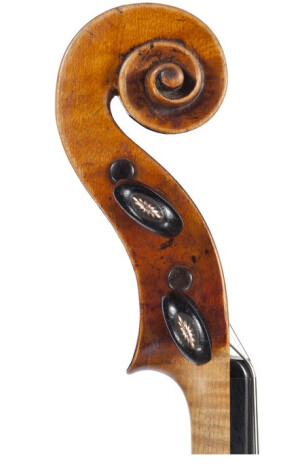
The scroll of the 1714 violin in the collection of the Musical Instrument Fund
It was not until 1712—three years after Giovanni Battista had gone into hiding—that he began building instruments again. He likely had to change hiding places several times and lacked a permanent workshop with his trusted violin-making tools, which caused the quality of his work to vary greatly. In Chiesa’s opinion, he rarely reached his former level of excellence again.
The Musical Instrument Fund has two violins by G.B. Grancino in its collection. One is a violin from 1714 (with a beautifully carved original scroll, see photo) that was added to the collection in 2013. Anne Sophie Mutter, among others, regularly praised that violin for its excellent tonal qualities when it was played by Noa Wildschut. In 2024, the Musical Instrument Fund was able to acquire a second violin. That violin was built in 1712 and is in very good condition. However, the scroll is not original; according to expert Charles Beare, it was made around 1770 by another great name in Milanese violin making: Pietro Giovanni Mantegazza.
Chiesa C., 1996, Violinmakers at the Contrada Larga in Milan.
Kass P. J., 1989, Stringed Instruments by the Milanese Violin Makers of the Contrada Larga.

