Instrument

violin
Gijsbert Verbeek
Amsterdam,
1682
Beschikbaar voor bruikleen
*1646 , Amsterdam †1717 , Amsterdam
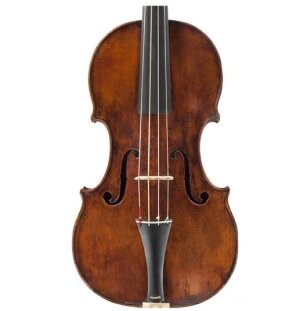
We know of many instruments made by his stepbrother, Pieter Rombouts. The few surviving works by Verbeek attest to his extraordinary craftsmanship. In terms of talent, he stands shoulder to shoulder with his stepfather.
Hendrik Jacobs married Verbeek’s mother, Femmetje Jans, in 1654. Note: the age difference between Jacobs and Verbeek was only about 13 years. Verbeek likely learned the basics of the trade from Jacobs not long after that. Nevertheless, Verbeek was first registered as a “whitewood craftsman,” which meant he made furniture from soft coniferous woods, such as spruce, pine, and fir. Whitewood craftsmen painted the furniture with detailed scenes or simpler motifs. Because of the inexpensive materials, their painted furniture was affordable and popular.
The last time we come across the name Gijsbert Verbeek is in an auction catalog from 1759 (…)
Although no record of training in Jacobs’ workshop has been found, the violins from the 1680s made by both men do show some similarities. One of the few official documents found regarding Verbeek is his own marriage certificate, which shows that he married Jaapie Willems on January 18, 1669. Recent archival research has revealed that Verbeek had at least seven sons with her, some of whom presumably did not survive to adulthood. His son Harmen is also said to have trained as a violin maker.
The last time we come across the name Gijsbert Verbeek is in an auction catalog from 1759, in which a violin he made is part of a large, high-quality collection of musical instruments belonging to bookseller Nicolas Selhof of The Hague.
In the small body of work we know of his, we see a masterclass in the Amsterdam style: high-quality instruments with unparalleled precision in the finishing, the edge work, the carving of the inlays and corners, the priming, and the rich varnish. His violins are therefore comparable to Jacobs’ work from the 1680s—a refined “Amatisé” model.
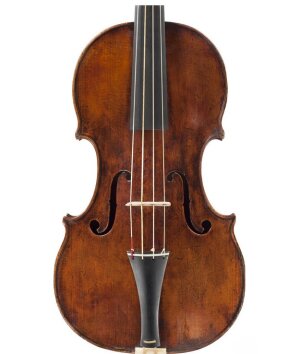
Violin by Gijsbert Verbeek (1682) from the collection of the Musical Instrument Fund.
The scrolls also bear a resemblance to those of Jacobs, but are slightly more distinctive and expressive, with thicker edges. The ribs are low—sometimes under 28 mm—which has led to some being raised or, in some cases, even completely replaced over the past few centuries. The tastefully carved f-holes again correspond in style to those of Amati, but the upper f-holes are often close together—a stark contrast to the work of his fellow townsman, Willen van der Sijde.
Verbeek’s varnishes, sometimes applied in generous layers, are of unparalleled beauty; the deeply transparent reddish-brown varnish lies over a highly reflective gold ground. Over the years, the varnish has developed a crackle pattern and acquired a distinct patina. All of this gives Verbeek’s varnish a very typical Venetian appearance—a school renowned for its thick reddish-brown varnish with a crackle finish. What is often overlooked, however, is that when Verbeek was active—and crafted, among other instruments, the violin from the collection of the Musical Instrument Fund—the grand master and founder of the Venetian school, Matteo Goffriller, had not yet arrived in Venice.
D.J. Balfoort, 1931 *Dutch Violin Makers*, H.J. Paris, Amsterdam.
Bolink, J., Giskes, J., Lindeman, F., and Stam, S., 1999, 400 Years of Violin Making in the Netherlands, Amsterdam.
Amsterdam City Archives, accessed in 2025