Instrument

violin
Georges (III) Chardon
Paris,
1908
played by
Sjaan Oomen
Sjaan Oomen

*1870 , Parijs †1949 , Parijs
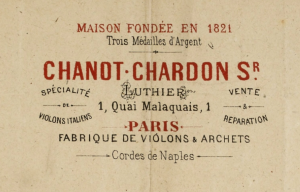
The history of the Chardon family of violin makers dates back to Joseph Chanot, who had a workshop in the small town of Mirecourt in northern France. His date of birth is unknown, but he built his first violin in 1790. In addition to being a violin maker, Joseph was also a farmer and merchant. He had to do this work to support his family, which consisted of twelve children. His eldest son, François (1788–1825), proved to be highly gifted and went on to study mathematics at the École Polytechnique in Paris. His interest in violin making did not develop until after he had been involved in the design of warships. Influenced by emerging scientific insights, he wrote two dissertations on stringed instruments. The first dealt with construction techniques, the second with the acoustic characteristics of stringed instruments. He was convinced that his scientific approach would result in an instrument that sounded better than existing violins. Both dissertations had a major influence on the French school of violin making.
His designs—violins with rounded corners—were built by the firm Lété & Payonne in Paris. Jean Baptiste Vuillaume (1798–1875) had come to Paris from Mirecourt specifically for this purpose. To assist Jean Baptiste in building these revolutionary instruments, François Chanot also sent his son Georges I to Paris in 1819.
François Chanot gave many lectures on his scientific approach to the acoustics of stringed instruments. His drive and persuasiveness were so great that he even gave a presentation in the presence of the King of France, who subsequently granted him a patent for it in 1818. The results fell short of expectations, but Chanot’s reputation was firmly established.
After that debacle, Georges I Chanot (1801–1883) continued to work for Jean Laurent Clement for some time, but opened his own business in Paris in 1821. Due to his inexperience, the venture was not a success, so he went to work for Charles François Gand (1787–1845) to gain more experience. Two years later, he opened a workshop again. This time, it was more successful. His decision to take on a female apprentice, Florentine Demolliens (1797–1840), caused quite a stir among violin makers in Paris. But that was not all. Florentine became Georges’ business partner, had five children out of wedlock, and thereby caused a scandal.
Florentine ran the business largely on her own during the years that Georges Chanot traveled throughout Europe and Russia to build his network. Connoisseur and collector Luigi Tarisio (1796–1854) would later describe him in his memoirs as a great connoisseur of old master instruments. He purchased several instruments from him, including a few Stradivari and Guarneri violins.
In 1840, Florentine left Paris to recover from an illness. But she died later that same year. Because Georges’ business was growing and he needed assistance, Antoinette Chardon, a friend of Florentine’s, went to Paris to help him. In 1843, a son, Marie-Joseph (1843–1930), was born. Since his parents were unmarried, he took his mother’s last name: Chardon. Marie-Joseph Chardon would also become a violin maker and, after George Chanot recognized him as his son, began an apprenticeship with him. The name Chardon was added to Chanot, and from that point on, the company was known as Chanot & Chardon.
Georges’ other son, Georges II Chanot (1831–1895), initially had no interest in the trade. For a long time, he led an exceptionally carefree life and did not join his father’s business until he was 20. First as a violin maker, later as a bow maker. Upon further reflection, his father saw more potential in him as a merchant and envisioned a future for him as an international expert. In 1858, he sent Georges II to London as a dealer, where he first worked briefly for Hart and Turner and later, with his father’s support, started his own business selling his father’s violins. He is regarded as one of the most important ambassadors of French violin making in England. Thanks to his knowledge and business acumen, he amassed the family’s initial fortune there, but lost a large portion of it by living up to his nickname, “Joly Georges.”
On two occasions, Georges II Chanot was implicated in a scandal as a dealer. The first time, the incident received extensive publicity. After being accused of forgery, he admitted to having counterfeited labels, but justified this by claiming that such a practice was quite common among violin makers. He considered it a tribute to Guarneri del Gesù, whose work he claimed to have replicated. The labels he had used bore no resemblance whatsoever to the originals. Nor did the “Guarneri.” As he later admitted, he had bought it in Paris; he had not built it himself, and it was not an authentic one either. The judge convicted him of this, and his colleagues saw the number of lawsuits against such practices increase. While his reputation suffered, his expertise ensured that he continued to be regarded internationally as a leading expert.
After his time in London, Georges II returned to Paris. There, the family business, Chanot & Chardon, was run very successfully by his illegitimate son, Marie-Joseph Chardon (1843–1930). His son, Georges III Chardon (1870–1949), also became a violin maker. Starting in 1905, instruments resulting from the collaboration between father Marie-Joseph Chardon and son Georges III Chardon were labeled “Chardon père et Fils.”
Georges III Chardon, following in the tradition of the Chanot-Chardon family, excelled at building instruments modeled after those of the old masters. He also made a name for himself as one of France’s leading experts. In 1897, his son André Chardon (1897–1963) was born. André carried on the family tradition, though he would be its last descendant. He was trained by his father and began working alongside him in their Paris studio in 1912. After two years, however, his career was interrupted by World War I. In 1915, he enlisted in the military and did not return to Paris until 1919, after recovering from his injuries. From that point on, the company was known as “Chardon et fils.” There, together with his father, he built many excellent instruments for years until he opened his own workshop in 1938.
Perhaps influenced by his grandfather Georges II, André came to specialize in making bows over the years. This would earn him great renown among musicians beginning in 1920. They are rare and exceptionally well-made. However, he continued to build stringed instruments as well.
In 1870, André’s grandfather, Georges II, had built up a large stock of exquisite wood for instruments and bows, which he and his father were able to draw on for many years to come. His grandfather had been a lover of bows. He had traveled throughout Europe in his carriage, carrying a large mahogany chest containing five layers of bows. Sometimes he sold the bows, but most often he traded them for violins.
In 1937, father and son participated in the major exhibition in Paris. Both their violins and their bows were highly acclaimed. After the death of his father, Georges III, in 1949, André took over the business. However, Georges III had stipulated that his daughter, Josephine, should become a partner. Together they ran the business until André died in 1963. Josephine continued to run the company until 1981, after which it closed.
Georges III and André built a large number of outstanding stringed instruments, most of which were modeled after those of the old French masters. Thanks to their extensive knowledge and skills, passed down from generation to generation, both are considered among the finest Parisian experts of their time.
The Chanot-Chardon family was highly successful in crafting instruments based on Guarneri del Gesù’s middle and late periods. However, no two violins are alike, even though they are always unmistakably “Chardon.”
The majority of Chardon’s back panels are made from a single piece of wood. Both Georges II and his successors selected wood that resembled the original—which had inspired them—as closely as possible. The large stock of wood that his father had purchased enabled them to do so.
The Chardons had several formulas for their varnish that produced different textures. They often used a reddish-brown varnish with a dark burgundy hue on a yellow base. It is usually a thick oil varnish that developed a natural crackle over time. The other color used on their instruments is orange-brown, again with varying textures. They refinished early instruments to give the impression of an old “Cremona,” complete with all its characteristic imperfections.
George II presumably built his instruments without using a mold, whereas George III and André did use them. All of their instruments are based on well-known examples of
Milliot, S., 1994, *The Chanot-Chardon Family: Parisian Stringed Instrument Makers in the 21st and 22nd Centuries*, Paris.
Carlson B., Schmitt J. F., Moroder I., Leonhard F., 2007, Italian & French Violin Makers, Keulen.
Cité de la Musique/Musée de la Musique, Violins, Vuillaume, a 19th-Century French Master Luthier, 1998, Paris.
Millant, R., 1979, J-B Vuillaume: His Life and Work. Hill & Sons, London.
Henley W., 1959 Universal Dictionary of Violin and Bow Makers. Amati Publications. London.
Vannes, R., 1999, *Universal Dictionary of Instrument Makers*, Spa.
Tarisio; the Cozio archives, accessed in 2020.
Archives Nationales de France, accessed in 2020