Instrument

cello
Gaetano Chiocchi
Two,
± 1870
played by
Beste Yıldız
Beste Yıldız

*1814 , Monselice (Padua) †± 1881 , Padua
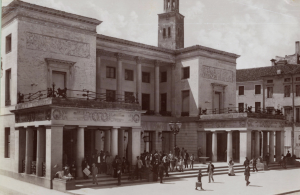
The fortified town of Monselice, where Gaetano Chiocchi was born in 1814, is located 25 km southwest of Padua. It was a popular pilgrimage site along the ancient Via Romae Germanica. There were only three cities in Italy where pilgrims could receive an indulgence. Monselice was one of them, provided the faithful had completed the journey and visited the seven shrines of Monselice. And hundreds did so each year.
The musical history of Monselice was closely intertwined with religion. The monastery of Santa Giustina was a center for medieval music, liturgical chants, and transcriptions of early music, which were performed during services. After spending his early years in Monselice, Gaetano attended high school in Padua. During and after his school years, he studied violin with Gaetano dalla Baretta, who was one of Tartini’s best students.
It seemed obvious that he would become a performing musician, but instead he enrolled at the University of Padua to study philosophy. He dropped out after a few years to pursue a degree in medicine, also at the University of Padua. After graduating as a physician, he left for Rome, taught briefly at the medical school there, and then returned to his native region.
Due to resistance against Austrian rule, records were scarcely kept there; consequently, there is no exact date of his return. Immediately upon his return to Padua, he joined the resistance movement that fought against the rule of the Austrian royal house and for a united Italy. This movement, led by intellectuals and revolutionaries, did not shy away from violence and would later launch the so-called Romagna Uprising of 1845. The uprising failed, after which repression was further intensified.
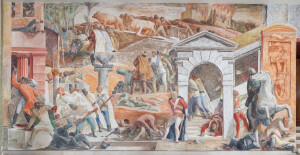
Fresco by Pino Casarini (1940), photo courtesy of the University of Padua
Until halfway through Chiocchi’s career, musical life under the occupying forces was a somewhat formal affair. The church strictly adhered to polyphony and the vocal tradition. In addition to Italian composers, Austrian and South German works were also performed, not only in concert programs but especially in churches. And military music could be heard in the streets.
‘Doctor, theater director, violinist,builder, and political activist’
The desire for a united, independent Italy (Risorgimento) was strong and led to resistance. In the early years of the uprising, opera emerged as the most important musical form. Opera evenings were social events for the bourgeoisie and the aristocracy. Works by Verdi, Donizetti, and Bellini dominated the repertoire. The opening aria from Verdi’s “Va, pensiero” from the opera Nabucco had become the ultimate symbol of oppression and the longing for national unity. In Padua and Mantua, it was sung as a battle hymn. Padua was not an opera center on the same level as Venice or Milan, but it closely followed the most important musical trends.
However, Gaetano was arrested even before the uprising, in 1841, declared a political agitator, and sentenced to six months in prison. He was released in mid-1842, worked for some time as a doctor in Padua, but also continued to play the violin. Out of fear, he supported the rebels less openly. At the same time, he began studying the bassoon. Ironically, he was drafted to play the bassoon in the brass band of the 13th Austrian Infantry Regiment. He could not refuse. Once back in Italy, he was appointed artistic director of the ballet and opera theater in Padua in 1844.
Resistance to Austrian rule in Padua was widespread. Politics was sometimes played out not only in the streets but also in the theater. Verdi’s opera *Il Lombardi*, which he had composed in 1843, was an open manifesto against Austrian oppression. Attending a performance of this opera was a political statement. Most performances sold out quickly. Due to a lack of facilities, *Il Lombardi* could not be performed at the theater in Padua, but it was staged in nearby Mantua. Gaetano Chiocchi’s influence as a fellow theater director, musician, and staunch revolutionary likely played a role in this. The University of Padua had been the center of the uprising. In retaliation, the Austrians closed the university in 1848, a measure that only further fueled the resistance.
Shortly after his return from Austria, Gaetano had resumed his violin studies. At first, he performed only in Padua, but after a few years he also began playing as a violinist in the orchestra of La Fenice in Venice and subsequently in that of Mantua. There he played alongside the aging Giuseppe Ceruti, who was not only a violinist but also a renowned violin maker from Cremona. Gaetano owned a Guarneri violin that needed repair. Given Ceruti’s knowledge and skills in the field of violin making, it was only natural that Gaetano asked him to carry out the repairs. That marked the beginning of a friendship between Chiocchi and Ceruti that would revolve around violin making and the resistance.
Ceruti, whose father and teacher had been Storioni’s successor, turned out to be one of the last representatives of the Cremonese school of violin making still active in Mantua. In Gaetano, a passionate advocate of all things Italian, he found a kindred spirit. Around 1856, Chiocchi began making violins himself.
Throughout the region around Padua and Mantua, the older generation of violin makers had either passed away or retired by the early nineteenth century. With a few exceptions in Venice and Trieste, there was a lack of continuity with the great makers of the past. It was thanks to a handful of individuals that a small renaissance emerged in Veneto, based on the old Cremonese masters but with modern touches. However, there was no unity; Blot (2002) even describes the situation as “fragmented.”
Due to years of oppression accompanied by heavy taxes, virtually no violin maker could make a living from his craft; with the exception of a few, they all held other jobs. It was only after a period of renewed musical activity that began in Venice that violin makers began to find work again, though most still held down other jobs. Beginning in 1857, Gaetano combined his efforts to become a violin maker with a new position as director of the Mantua Theater.

Cello (ca. 1870) from the collection of the Musical Instrument Fund
In 1859, the Austrians were defeated, after which Padua and Mantua became part of the Kingdom of Italy. Military music disappeared from the streets, and German composers were barred from the theaters. And musical life became less of an exclusive domain of the aristocracy. The middle class took on a greater role as organizers, sponsors, and audience members. Concerts and performances became more accessible to a broader audience. More people learned to play an instrument, and chamber music flourished. Opera remained the most important musical form. Venice, however, remained under Austrian control, making it more difficult for Chiocchi to reach the city than before. Performing in Venice was no longer possible.
He was not satisfied with his first instruments. He visited various violin makers and studied literature on violin making. Even that information did not yet provide him with the violin he had envisioned. For a year, he put aside everything he had been working on up to that point and devoted himself entirely to violin making. Not only did he study construction techniques, but he also began studying acoustics and attended lectures by Prof. Filipuzzi, a professor of chemistry at the University of Padua. And, with his scientific training, Gaetano systematically experimented with different types of wood and studied the effect that various varnish compositions had on the sound of a violin.
It wasn’t until 1858 that he was satisfied with the instrument, into which he had incorporated all the knowledge he had gained that year. For the first time, he labeled the instrument. Two years later, Giuseppe Ceruti died. Although he had instilled in Gaetano a fascination with violin making, Gaetano had not adopted his style. His sources of inspiration became Stradivari and Maggini.
In 1861, three years after he had built his first high-quality instrument, he submitted a violin to the national exhibition in Florence, the Esposizione Italiana. It was a grand event celebrating the unification of Italy, showcasing Italian art and industry. His efforts were rewarded; Gaetano received a gold medal for his entry. Later that year, he achieved the same success in Padua. Over the next ten years, he crafted his instruments with great skill and earned a reputation as an outstanding violin maker.
Gaetano died in 1881. Because of his modest but exquisite body of work, he was initially appreciated only by a few connoisseurs. Today, Chiocchi’s instruments are highly prized, especially among soloists.
‘politicshiddenin wood’

Violin dedicated to violin virtuoso Trombini, https://www.isabellesviolins.com/
As a “fervent patriot,” as Vasilievsky (1872) described him, Gaetano wanted to express his views—which by then had taken on a certain bitterness—in as many ways as possible. He wrote underground pamphlets and attended meetings of insurgents. Since open expressions of dissent were punished ever more severely after the 1845 uprising, he sometimes wrote his texts on the inside of his instruments as well. He continued to do so until the unification of Italy became a reality.
Gaetano Chiocchi’s body of work was relatively small. He built about 50 violins and a few cellos. This was partly because Gaetano Chiocchi could not make a living from violin making alone, and therefore had to continue working as a theater director and even as a performing musician. But his involvement in the uprising also hindered his output.
He knew Ceruti not only as a fellow violinist and violin maker, but also as a fellow conspirator against the Austrians. Chiocchi had once been captured but had managed to escape with his life. Ceruti did not let it come to that. When 110 supporters of Chiocchi and Ceruti were arrested in 1851, and 12 were immediately executed, Ceruti avoided imprisonment by going into hiding. He did not return until 1855. That year, he built two violins, which he submitted to the exhibition in Paris. Given the relationship between the two colleagues, Gaetano Chiocchi must have been forced to limit his further development in his new profession during that period.
Taking Ceruti’s work as a model, Gaetano began crafting a violin around 1856 in which he was able to successfully apply everything he had learned, though it was not yet labeled. That label did not appear until two years later. In the years that followed, he used various models from Brescia and Cremona as the basis for his own work. He presumably was very fond of the large Maggini model and therefore often used double-line inlays. He also built relatively freely in the style of Stradivari.
All of his known instruments have a slight curvature. He kept both the top and back of the instrument quite thick. Notable are the wide C-holes on the sides of his violins. He noted on his labels that he had won several medals and marked them with a serial number. His work is always distinctive, meticulously crafted, finished with a beautiful varnish, and, according to experts, produces an excellent sound. He branded them “CG” on the inside of the pegbox.
Chiocchi’s influence on the violin makers in Padua and Mantua was not significant; his body of work was too small for that, and he had to divide his time too much among his other activities. Gaetano worked almost entirely on his own during all those years. Although there is no strong evidence to support this, researchers, after studying instruments by Eugenio Degani, suspect that he was one of the few who was directly influenced by Gaetano Chiocchi.
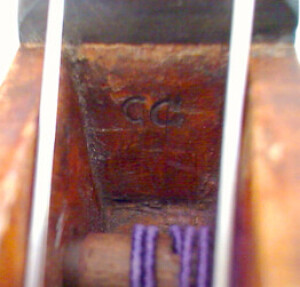
Gaetano Chiocchi brand, photo courtesy of Isabelle de Brossin de Méré
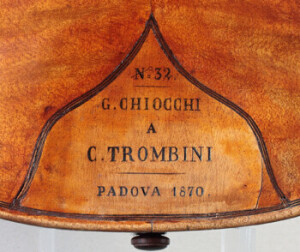
Photo courtesy of Isabelle de Brossin de Méré
The Cozio Archive, Tarisio, bezocht in 2024.
Dilworth, J., 2012, The Brompton's Book of Violin and Bow Makers, London.
Versari, A., 2012, Italian Violin Making: A Discovery, Cremona.
Nicolini G., 2008, Violinmakers in Italy - From the 19th Century to the Present, Bologna.
Henley W., 1997, Universal Dictionary of Violin and Bow Makers, Tunbridge Wells.
Blot, E., 1995, Italian Violin Making 1860–1960, Vol. II: Lombardy and Veneto, Cremona.
Vannes, R., 1981, Dictionnaire Universel des Luthiers, Brussels.
Hamma. W. 1964, Cremona, Italian Violin Makers.
By Wasielewski, W.J., 1872, Gaetano Chiocchi, Allgemeine Musikalische Zeitung, Leipzig.
Pietrucci, N., 1858, Biographies of Paduan Artists, Padua.